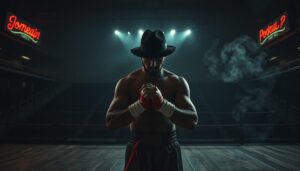
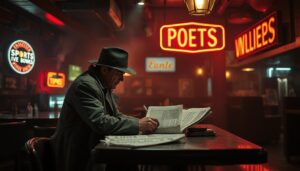
Pull up a stool. Let’s talk about the best genre mash-up: sports and noir.
We’re not filming a game. We’re creating a psychological thriller. The arena turns into the mean streets. Sweat looks like rain on pavement. Every shadow could hide a betrayal.
This idea isn’t new. Look at Adolf de Meyer, a photography genius. He didn’t just capture reality; he built it with light and shadow. He created moody fantasies from scratch.
That’s our plan. Forget inspirational montages. Think Raging Bull meets Chinatown. Why does a single bulb over a boxing ring feel like a confession booth? How can a hockey rink become a cold, dark maze of despair?
The answer is chiaroscuro lighting. It’s the harsh, beautiful mix of light and dark. It uses atmosphere as a weapon. It turns sports into intense drama, replacing cheerleaders with raw tension.
Hard vs Soft: Building Muscle and Motion with Light
Forget what you learned in film school about three-point lighting. In sports cinema, it’s all about hard versus soft light. This choice makes your film feel like a victory or a struggle.
The book Crafting Digital Cinema says this choice is key. It’s like deciding whether to carve or caress. Your choice shapes everything.
Hard light tells the truth. It’s harsh and shows everything. Imagine it as the light used to question a quarterback or a gymnast.
This light etches details. It makes a boxer’s cheekbone look like a map of battles. It turns sweat on a linebacker’s face into tiny lenses of fear. Every detail becomes part of the story.
Hard light’s shadow is sharp and clear. It’s like a cell door slamming shut. It creates deep shadows that show struggle.
Then there’s soft light. It’s like a veil. It shows memory, regret, and pain. It wraps around an athlete in a steamy shower, blending exhaustion with surrender.
Soft light suggests instead of shows. It hides bruises but shows the general pain. It makes a locker room feel like a quiet place for thought. Its shadows are smooth transitions.
So, when do you choose? It’s a deep question.
Use hard light for the raw, physical aspects. It shows the impact of a hit or the effort of a lift. It’s perfect for intense training sessions.
Use soft light for the mental side. It shows the pressure, past failures, and doubts. It’s great for quiet moments or after a tough win.
Great sports photographers use both hard and soft light. Hard light shows what the body does. Soft light hints at what the soul feels.
Your choice of light doesn’t just set a scene. It reveals the athlete’s inner world.
FAQ
Q: What is a practicals course?
A: A practicals course is a hands-on learning experience that focuses on developing skills through real-world applications. It allows students to gain practical knowledge and expertise in a specific field or industry.
Q: What are the benefits of practicals courses?
A: Practical courses offer several benefits, including the opportunity to develop practical skills, gain industry experience, and enhance employability. They provide a hands-on learning experience that prepares students for real-world challenges and applications.
Q: What are some examples of practicals courses?
A: Examples of practicals courses include internships, apprenticeships, vocational training, and on-the-job training. These courses provide students with the opportunity to apply theoretical knowledge in real-world settings and gain valuable industry experience.
Q: How can I find practicals courses near me?
A: To find practicals courses near you, you can search online for local institutions or organizations that offer practical courses. You can also check with your local community college or vocational school to see if they offer practical courses in your desired field.
Q: What are the advantages of practicals courses?
A: Practical courses offer several advantages, including the opportunity to develop practical skills, gain industry experience, and enhance employability. They provide a hands-on learning experience that prepares students for real-world challenges and applications.
Q: How can I enroll in practicals courses?
A: To enroll in practicals courses, you can search online for local institutions or organizations that offer practical courses. You can also check with your local community college or vocational school to see if they offer practical courses in your desired field. Once you find a course that aligns with your interests and goals, you can follow the enrollment process provided by the course provider.
Q: What are the benefits of practicals courses?
A: Practical courses offer several benefits, including the opportunity to develop practical skills, gain industry experience, and enhance employability. They provide a hands-on learning experience that prepares students for real-world challenges and applications.
Exploring the World of Venetian Blind Motifs
Venetian blinds are not just functional; they are also a canvas for artistic expression. The variety of venetian blind motifs available today offers endless possibilities for adding a personal touch to your home decor. From classic designs to modern patterns, there’s something to suit every taste and style.
One popular choice is the use of venetian blind designs that incorporate nature-inspired elements. These motifs often feature leaves, flowers, and even abstract representations of natural landscapes. These designs not only bring a sense of calm and serenity to a room but also add a touch of elegance and sophistication.
For those who prefer a more contemporary look, venetian blind motifs with geometric patterns are a great option. These designs often feature clean lines, bold shapes, and vibrant colors. They can add a modern and dynamic feel to any room, making it perfect for those who appreciate cutting-edge design.
Another popular trend is the use of venetian blind designs that incorporate personalized elements. These motifs can include names, initials, or even custom artwork. This allows homeowners to create a truly unique and personalized space that reflects their individual style and personality.
When choosing venetian blind motifs, it’s important to consider the overall aesthetic of your home. Whether you prefer classic elegance or modern simplicity, there is a wide range of designs available to suit your taste. Take the time to explore different options and find the perfect venetian blind designs that complement your home’s style and create a harmonious atmosphere.
By incorporating venetian blind motifs into your home decor, you can add a touch of personality and style to your space. Whether you choose nature-inspired designs, geometric patterns, or personalized elements, the possibilities are endless. So why not explore the world of venetian blind motifs and create a unique and visually appealing environment that reflects your individuality.
Key/Fills and Ratios that Sculpt Athletes
There’s a big difference between just showing an athlete and making them look legendary. It all comes down to the key-to-fill ratio. This isn’t about making someone look good. It’s about making them look interesting. It’s the math behind the mood.
The key light is like the main actor. It’s the main source, hitting the subject from a specific direction. It defines the primary shape—the curve of a bicep during a curl, the angle of a sprinter’s jaw at the block. The fill light is like the supporting cast. Or more often in noir, the conspicuous absence of one.
Fill light softens shadows created by the key. The ratio between their intensities is everything. A 1:1 ratio is flat, even, and frankly, boring—the lighting equivalent of a participation trophy. A 4:1 or 8:1 ratio? Now we’re talking. That’s where chiaroscuro lighting earns its name.
High ratios mean deep, inky shadows that swallow half a boxer’s face as he stares down his opponent. They turn a swimmer’s turn at the wall into a stark silhouette against a reflective pool surface. The light doesn’t just reveal; it interrogates.
This technique isn’t new. Look at Baron Adolph de Meyer’s 1920s portraits. In works like “The Shadows on the Wall,” he didn’t flatter his glamorous subjects. He dissected them with light. He used extreme ratios to create psychological tension, making a socialite’s gaze seem like a guarded secret. We can do the same for an athlete’s determination.
Why does this work so well for sports? Athleticism is about tension, effort, and vulnerability. Flat lighting hides that. It smooths over the strain. A high key-to-fill ratio accentuates it. Every tendon standing out on a weightlifter’s neck, every droplet of sweat on a cyclist’s temple—they become graphic elements in a shadow play.
You’re not lighting a person. You’re lighting a statue in the making. The key light is your chisel. The shadow is your negative space. The lack of fill is what gives the form its weight, its gravity, its …
Consider a quarterback in the pocket. A low-angle key light from below can make him look heroic, a pillar of light. Kill the fill, and that same light makes him look trapped, isolated, the shadows of the pass rush already climbing his legs. The same setup, different story, all dictated by ratio.
This is the core of cinematic chiaroscuro lighting. It’s subtractive. It’s about knowing what to not show. In a world obsessed with 4K clarity and seeing everything, noir sports cinematography dares to hide. It lets the audience’s imagination fill in the darkened half of a wrestler’s face. Is it pain? Is it strategy? The shadow keeps the secret.
Mastering this ratio is the first step from recorder to storyteller. It transforms a gym into a cathedral of effort, a ring into a gladiatorial arena, a simple athlete into a figure wrestling with their own limits in the dark.
FAQ
Q: What is the significance of the hard light in the spiritual realm?
A: The hard light in the spiritual realm is a powerful energy that holds immense significance. It is believed to be a divine light that guides individuals on their spiritual journey and helps them navigate through challenges and obstacles.
Q: How can I connect with the hard light?
A: Connecting with the hard light involves cultivating a deep sense of inner light and embracing the divine energy within. This can be achieved through practices such as meditation, prayer, and spending time in nature. By aligning ourselves with the hard light, we can tap into its transformative power and experience spiritual growth and enlightenment.
Q: What are the benefits of embracing the hard light?
A: Embracing the hard light offers numerous benefits. It can help individuals overcome challenges and obstacles, find inner strength and resilience, and experience spiritual growth and enlightenment. By embracing the hard light, we can align ourselves with our highest purpose and live a more fulfilling and meaningful life.
Q: How can I integrate the hard light into my daily life?
A: Integrating the hard light into daily life involves making conscious choices and aligning our actions with our spiritual values. This can be achieved by practicing mindfulness, staying grounded in the present moment, and cultivating a sense of inner light and connection to the divine. By embracing the hard light, we can create a more harmonious and fulfilling life.
Q: What is the role of the hard light in spiritual growth and enlightenment?
A: The hard light plays a significant role in spiritual growth and enlightenment. It serves as a guiding force that helps individuals navigate through challenges and obstacles, find inner strength and resilience, and experience spiritual awakening. By embracing the hard light, we can embark on a transformative journey of self-discovery and spiritual evolution.
Q: How can I connect with the hard light?
A: Connecting with the hard light involves cultivating a deep sense of inner light and embracing the divine energy within. This can be achieved through practices such as meditation, prayer, and spending time in nature. By aligning ourselves with the hard light, we can tap into its transformative power and experience spiritual growth and enlightenment.
Q: What are the benefits of embracing the hard light?
A: Embracing the hard light offers numerous benefits. It can help individuals overcome challenges and obstacles, find inner strength and resilience, and experience spiritual growth and enlightenment. By embracing the hard light, we can align ourselves with our highest purpose and live a more fulfilling and meaningful life.
Q: How can I integrate the hard light into my daily life?
A: Integrating the hard light into daily life involves making conscious choices and aligning our actions with our spiritual values. This can be achieved by practicing mindfulness, staying grounded in the present moment, and cultivating a sense of inner light and connection to the divine. By embracing the hard light, we can create a more harmonious and fulfilling life.
Q: What is the role of the hard light in spiritual growth and enlightenment?
A: The hard light plays a significant role in spiritual growth and enlightenment. It serves as a guiding force that helps individuals navigate through challenges and obstacles, find inner strength and resilience, and experience spiritual awakening. By embracing the hard light, we can embark on a transformative journey of self-discovery and spiritual evolution.
Composing with Darkness: Vignettes, tunnels, and catwalks
Vignetting is more than just an Instagram filter. It’s a way to draw the viewer’s eye with chiaroscuro lighting. Think of early photographers like Baron Adolf de Meyer. They used light and dark to create deep, emotional pictures.
These images weren’t just pretty. They were experiments in psychology. The dark edges weren’t empty. They were full of power.
Noir cinema and sports films share a secret. What you don’t show can be more powerful than what you do. A boxer in the ring, lit up but surrounded by dark? That’s not just good lighting. It’s chiaroscuro lighting at work.
This lighting makes the boxer seem like the only person in the world. It’s a powerful way to focus the viewer’s attention.
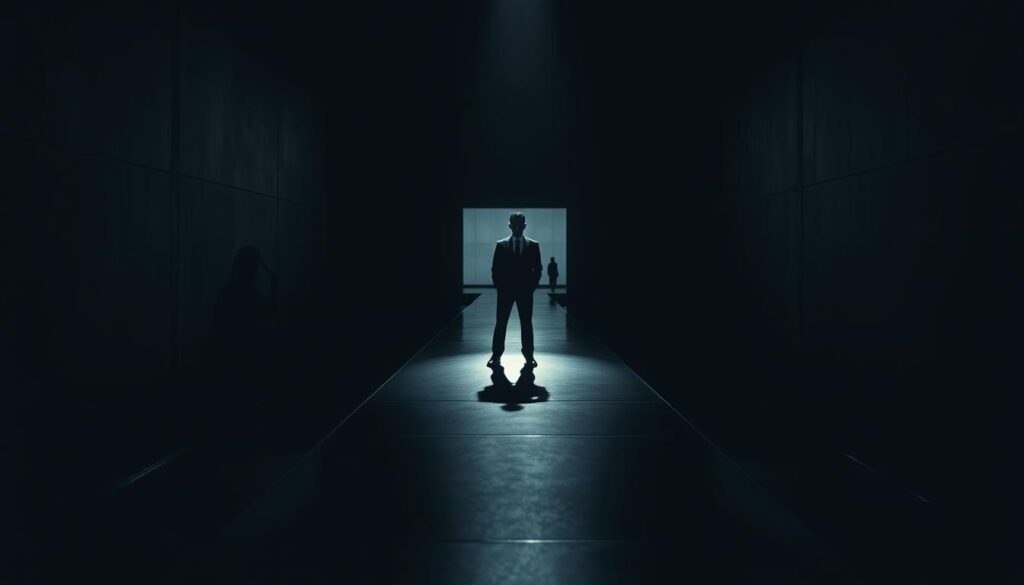
Architecture also uses this technique. The tunnel from the locker room to the field is like a birth canal. It’s a journey from the unknown to the spotlight.
The tunnel’s lighting is not even. It’s a path from safety to the open arena. This use of chiaroscuro lighting adds drama to the athlete’s journey.
Catwalks in sports arenas are more than just for maintenance. They’re perfect for the “man in the shadows” story. A scout or a gambler, seen only as a shadow, adds mystery to the scene.
This lighting creates shapes that seem to watch from the dark. It’s a classic use of chiaroscuro lighting.
Set design changes when you use this technique. A chain-link fence becomes a grid of shadows. Steam from a shower room adds mystery to the scene.
Darkness is not just the absence of light. It’s a presence. In sports films, shadows in the bleachers hold secrets. They add depth and emotion to the scene.
So, when blocking a scene, think about the dark areas. What do they contain? Mastering chiaroscuro lighting means knowing that sometimes, the most powerful thing is what you leave unseen. The audience will always be curious about what’s hidden.
Set Design: Tiles, metal, rubber, and reflective surfaces
Forget about decorating spaces—we’re here to weaponize architecture. The gym, the locker room, the boxing ring: these aren’t just places for action. They’re active partners in your visual story. Every surface you choose should do more than look good. It should mean something.
Think of it like De Meyer’s “View Through the Window of a Garden, Japan.” That photo doesn’t just show a scene. It uses the window frame as a grid, organizing chaos. Your set elements—tiles, chain-link, locker doors—should do the same. They’re the architectural frames that pattern your light and fracture your subjects.
Glossy, subway-style locker room tiles are more than walls. They’re chaotic, fragmented mirrors. When light hits them, they reflect distorted glimpses of an athlete’s face. This creates a splintered image, exposing the athlete’s psyche.
Metal is cold and hard, providing stark, unyielding lines. It’s like prison bars, boxing characters in. It creates sharp shadows. Metal doesn’t forgive or absorb. It just deflects.
Rubber flooring is the silent partner. It absorbs sound and light, creating dead zones. These are areas of quiet desperation. A boxer kneeling on the mat, head bowed. A wrestler alone in a corner. The rubber sucks up the light, leaving these moments in somber, focused isolation.
Reflective surfaces are the star players. A sweat-smeared weight machine mirror doubles a boxer. It creates a doppelgänger—a rival, a ghost, a darker version of himself staring back. A polished fighting ring canvas can reflect overhead lights as menacing pools. A chrome barbell becomes a distorted funhouse mirror of straining muscle.
The chain-link fence is a dynamic lighting tool. As characters move behind it, the shadow grid slides across their bodies. This creates a living venetian blind motif, constantly breaking the actor into pieces of light and dark. It’s confinement made visible.
We’re not choosing materials for durability or aesthetics alone. We’re selecting textures based on how they interact with photons. Will they shatter light? Will they swallow it? Will they bounce it back as a threat? The answer writes the scene.
| Material | Visual Effect | Narrative Function | Noir Example |
|---|---|---|---|
| Glossy Ceramic Tiles | Fragmented, distorted reflections | Show psychological splintering; amplify anxiety | Locker room pre-fight jitters |
| Bare Metal (Lockers, Racks) | Hard shadows, sharp lines, cold highlights | Create feeling of confinement, industrial pressure | Prison-like training facility |
| Rubber Flooring | Light absorption, muted tones, dead zones | Isolate subjects; emphasize loneliness or defeat | Boxer kneeling after a loss |
| Chain-Link Fence | Moving shadow grid, patterned light | Venetian blind effect; visual imprisonment | Fighter pacing in a caged yard |
| Mirrored/Sweaty Surfaces | Doubled imagery, distorted doppelgängers | Create internal conflict; externalize the “other self” | Boxer confronting his reflection |
This approach transforms location scouting. You’re not just looking for “a gym.” You’re hunting for specific textures. You need the right tile sheen. The correct metal patina. A floor that eats light in the perfect way. When you find it, you’ve found a character in your story as important as any actor.
The chain-link fence, in particular, is the ultimate venetian blind motif for sports noir. It’s never static. With the sun moving or a light panning, the grid walks across your subject. It literally cages them in light. It’s architecture participating in the drama, frame by frame.
So next time you walk into a set, ask the right questions. What do these walls do? How do they change the light? Your answers will determine whether you’re shooting in a building or building a world.
Case Studies: Raging Bull, Foxcatcher, Creed’s gym sequences
These films are the real tests of noir lighting sports. They put every principle to the test in real production. Theory is easy. But it’s the execution that shows who’s a contender.
Let’s look at three films that use light in unique ways. Each one creates a different feel of athletic tragedy.
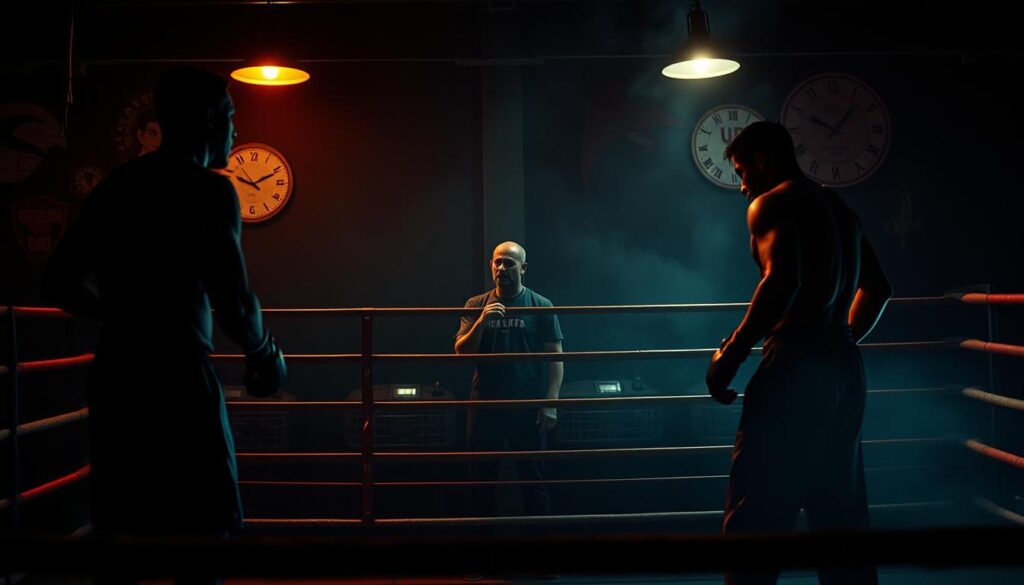
Martin Scorsese and Michael Chapman didn’t just film boxing. They turned it into a fight in hell. Forget normal lighting. They used flashbulbs that feel like punches.
The smoke swirls like damnation. Crowd noise is replaced with animal sounds and distorted strings. It’s not sports coverage. It’s a Greek tragedy with sweat and blood.
Their noir lighting sports is all about being extreme. Every punch has its own light. Every sweat drop catches a gleam before hitting the canvas. The ring is like a confessional, lit by interrogation lamps.
Foxcatcher (2014): The Chill of Institutional Noir
Bennett Miller’s film is a lesson in cold, psychological horror. The wrestling gym is lit like a morgue. It’s a place where ambition goes to die.
Compare this to the du Pont mansion. It’s lit like a museum of American decay. Windows frame pathetic masculinity. The colors are all regret.
This sports noir uses absence to show danger. Shadows reveal emptiness. The light makes sweat look like a chemical leak.
Here are some key techniques:
- Flat, overhead fixtures drain all drama from motion
- Cold color temperatures turn muscle into marble
- Window light frames, not illuminates
- Reflective surfaces show distorted versions of self
Creed (2015): Modern Grit and Steam
Ryan Coogler and Maryse Alberti modernize the formula. The Philadelphia gym in Creed is alive. It’s steamy, gritty, and full of life.
Light cuts through dirty windows and fog. It’s a fresh take on Rocky. It’s not just nostalgia. It’s a new start.
The noir lighting sports here is all about feeling. You feel the humidity. You smell the liniment. Every beam has a purpose, shaping bodies and legacy.
| Film | Noir Lighting Approach | Primary Emotional Effect | Key Lighting Tool |
|---|---|---|---|
| Raging Bull | Operatic, explosive | Animalistic tragedy | Flashbulbs, smoke, high contrast |
| Foxcatcher | Clinical, institutional | Cold emptiness | Flat fixtures, cold temperatures |
| Creed | Gritty, atmospheric | Raw legacy | Window light, haze, practicals |
What do these case studies teach us? First, noir lighting for sports is a language. Raging Bull screams. Foxcatcher whispers. Creed breathes.
Second, the setting guides the lighting. A historic mansion needs different shadows than a Philly gym. Third, the athlete’s mind shapes the light. Jake LaMotta’s rage needs different lighting than John du Pont’s ambition.
The common thread? Each film turns physical struggle into psychological drama. They show that the best sports cinematography reveals the soul of the game.
So, study these films as blueprints. Notice how they use the tools we’ve discussed. Then, create your own arena of shadows.
Safety and Sweat: Managing Shine and Drip Lighting
The toughest light to control on any athletic set isn’t from your lights—it’s sweat. Beautiful lighting plans meet their messy match when actors sweat. A glistening brow can turn a dramatic scene into a blinding hot spot.
Cinematography gets very practical here. Your key light isn’t just for the scene; it highlights every sweat drop. A boxer’s shadow is ruined by sweat on his neck. The fix isn’t less light, but smarter control.
Makeup artists and lighting teams work together. They use powder and sprays to reduce shine but keep sweat visible. This balance helps the audience see the effort without being distracted.
Then, there’s drip lighting. Those big drops in a boxing montage? Often, it’s not just luck. Real sweat is unpredictable, but movie sweat hangs around longer and catches light better. The gaffer and makeup artist work together to make it look real.
Why bother with all this? Sweat tells a story. In a dark sports film, sweat should look dangerous. A single bead down a fighter’s back shows the pressure.
Environments play a role too. Steam and condensation on windows change how light works. Planning for moisture means thinking about how it affects your lights.
This practical alchemy mixes real conditions with movie magic. It’s what makes good lighting great storytelling. The goal is to make sweat feel earned and meaningful.
So, when setting up a noir gym scene, remember to plan for sweat. The most authentic light might be the one reflecting off hard work.
DIY Lookbook: Mood Boards and Shot Lists for Indie Crews
Your budget may not be as big as Michael Chapman’s, but your vision can shine. Begin with a digital scrapbook. Pin images from The Wrestler and Nightcrawler. Look at the strong shadows in a boxing gym.
This visual guide is your first step. Tools like StudioBinder help turn your ideas into a detailed plan.
Your shot list is like a promise. Include the tunnel shot, lit from behind and low. Look for scenes with a single light source. Find venetian blind patterns in stadium architecture.
This way, you turn what you have into something special. A security lamp can be your main light. A janitor’s closet is perfect for a practical light. Chain-link fences add texture to your shadows.
Your lookbook is your guide. It shows noir is not about money, but how you see things. Now, grab your DSLR and find drama in the rain, tension in the tiles. Start painting with darkness.