Violence in sports cinema rarely arrives as chaos. It is framed, sculpted, and illuminated with intention. A punch thrown in a boxing ring, a helmet-to-helmet collision under stadium lights, or a wrestler collapsing against the ropes becomes something else once filtered through the lens. It becomes ritual. It becomes tragedy. It becomes myth.
In the tradition of sports noir, cinematography does more than document impact — it interprets it. Slow motion stretches time until each bead of sweat carries symbolic weight. Hard shadows carve boxing athletes into silhouettes of doubt and obsession. Silence, or the hum of a distant crowd, transforms violence into introspection.
To understand why certain sports films linger in memory long after the final whistle, we have to look not at the scoreboard — but at the light.
The Language Of Light And Shadow In Sports Noir
Film noir was never only about crime. It was about moral ambiguity expressed through low-key lighting, deep shadows, and claustrophobic framing. When those visual strategies migrate into top sports cinema, the arena becomes an interrogation room.
Consider how boxing films frequently use overhead lighting that isolates fighters in a ring surrounded by darkness. The audience fades away. The ropes feel like boundaries of fate. The athlete stands alone — not just against an opponent, but against personal history.
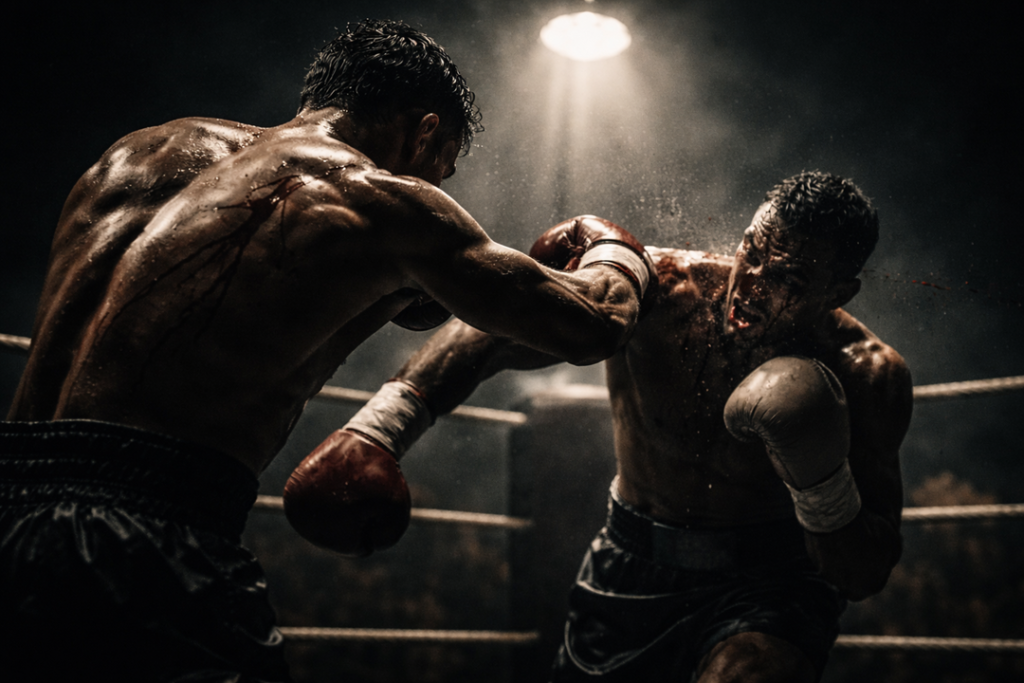
This aesthetic approach appears in films like Raging Bull and The Set-Up, where contrast ratios are pushed high enough to emphasize sweat against black backgrounds. In these moments, violence is not sensational. It is existential.
The effect is deliberate:
| Cinematic Element | Technical Function | Emotional Result |
|---|---|---|
| Low-key lighting | High contrast, minimal fill light | Moral ambiguity, isolation |
| Overhead ring lights | Top-down illumination, hard shadows | Exposure, vulnerability |
| Silhouetted backgrounds | Reduced environmental detail | Psychological focus |
| Smoke or haze | Diffusion of highlights | Dreamlike brutality |
The camera does not just show the fight — it frames it as confession.
Slow Motion As Psychological Amplifier
Slow motion in sports films is often misunderstood as stylistic indulgence. In reality, it is a structural device. By elongating a strike, a fall, or a moment of hesitation, filmmakers give viewers access to interior time — the split second where doubt enters.
Martin Scorsese’s approach to fight choreography in Raging Bull demonstrates this clearly. Blows are not merely slowed; they are isolated. Sound design drops away. The crowd dissolves into abstraction. The viewer is left inside the fighter’s perception.
This technique transforms physical violence into psychological rupture.
Across modern sports dramas — including wrestling and mixed martial arts narratives — slow motion often coincides with turning points:
| Scene Type | Use of Slow Motion | Narrative Purpose |
|---|---|---|
| First major hit | Brief temporal expansion | Establishing physical stakes |
| Climactic knockout | Extended, stylized slowdown | Moral or emotional culmination |
| Injury sequence | Fragmented slow motion with silence | Tragedy and vulnerability |
| Defeat walk-away | Subtle deceleration | Reflection and consequence |
When used effectively, slow motion reshapes violence into memory. It invites contemplation rather than spectacle.
Framing The Athlete As Anti-Hero
Sports noir often centers on the anti-hero athlete — proud, obsessive, flawed. Cinematography reinforces this characterization through framing choices that suggest entrapment or fragmentation.
Tight close-ups compress space, amplifying paranoia. Wide shots place athletes in cavernous arenas that dwarf their achievements. Mirrors double faces, hinting at fractured identity.
The ring ropes become visual bars. Stadium tunnels resemble corridors of judgment. Locker rooms glow with fluorescent harshness rather than warmth.
These choices align sports cinema with broader noir traditions explored in our analysis of moral descent arcs in sports film protagonists. The athlete is rarely triumphant without cost. The camera ensures we feel that cost.
Violence As Ritual, Not Spectacle
One of the defining differences between mainstream sports broadcasts and noir-inflected sports films lies in intention. Broadcasts prioritize clarity and replay precision. Sports noir prioritizes atmosphere.
Grainy textures, practical lighting, and restrained color palettes are often favored over hyper-saturated HDR aesthetics. Directors sometimes deliberately underexpose scenes to preserve shadow detail — a technique that echoes classic film stock limitations but serves a modern thematic goal.
The result is ritualized violence.
Rather than inviting adrenaline alone, these films ask viewers to consider consequence. A punch becomes a moral crossroads. A collision becomes a reckoning.
For readers interested in preserving these shadow details at home, our guide on calibrating home theaters for moody sports cinema explores how gamma settings and contrast adjustments can maintain low-key integrity without crushing blacks.
The Arena As Stage Of Judgment
In many sports noir narratives, the arena transforms into a symbolic courtroom. Overhead lights resemble interrogation lamps. Crowds function as juries. The athlete stands trial before public expectation.
Cinematographers enhance this sensation through spatial design:
- High-angle shots to imply vulnerability
- Static frames during decisive impacts
- Minimal camera movement in moments of moral clarity
The violence is choreographed not just physically, but ethically.
When the camera lingers after a blow lands — refusing to cut away — the audience is forced to confront aftermath. That pause is where noir resides.
Technology, Texture, And Modern Challenges
As digital cameras and high-dynamic-range displays the technology advances, dominate contemporary filmmaking, preserving shadow nuance has become both easier and more precarious. While HDR can expand contrast range, aggressive brightness mapping may flatten intended darkness.
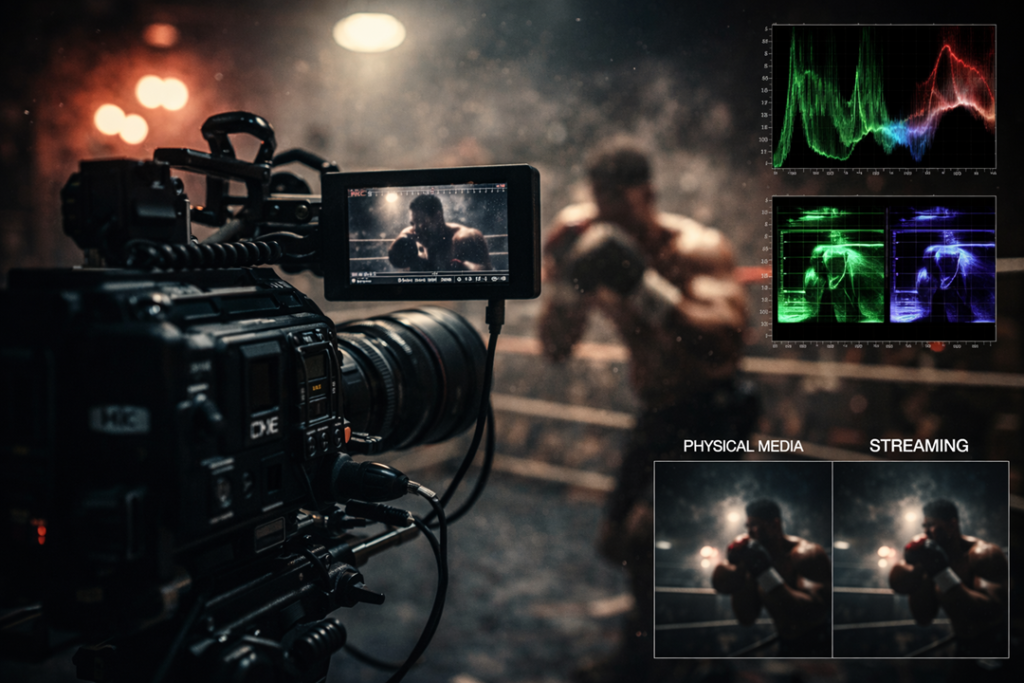
Streaming compression can also erode subtle gradients in smoke-filled arenas or dim locker rooms. What once felt textured and tactile risks becoming overly clean.
For serious viewers, comparing physical media releases against streaming transfers can reveal noticeable differences in grain retention and shadow fidelity — especially in black-and-white classics.
| Viewing Format | Strength | Potential Compromise |
|---|---|---|
| 4K Blu-ray | Higher bitrate, preserved grain | Requires calibrated display |
| Streaming (HDR) | Wider accessibility, expanded highlights | Possible shadow compression artifacts |
| SDR Broadcast | Stable contrast reproduction | Limited dynamic range |
Understanding these nuances ensures that the violence remains sculpted by shadow — not diluted by convenience.
Why The Shadows Matter
At its core, sports noir insists that competition is never only physical. It is ethical. Psychological. Existential.
Cinematography makes that visible.
Through slow motion, shadow play, and deliberate framing, filmmakers transform punches into parables. The violence becomes a mirror reflecting pride, desperation, and consequence.
When the lights dim and the crowd fades into darkness, the athlete stands illuminated — not as a champion alone, but as a flawed figure caught between ambition and self-destruction.
In those suspended seconds of shadowed slow motion, we do not merely witness sport. We witness judgment.