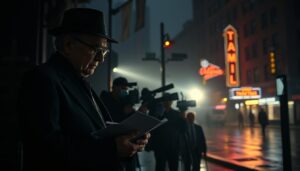
Let’s rewind the filmstrip. Today’s sports movies dazzle with slick CGI and desaturated grit. But their visual language has humble, grainy origins. Before Rocky shadowboxed in Philadelphia dawns, cinema spoke in a different dialect.
It began with snippets, not scripts. The jerky, high-contrast newsreel style turned real athletes into mythic figures flickering in dark theaters. This was raw documentation with unintended drama.
Those primordial images—grainy optical prints of Jesse Owens—didn’t just record history. They planted seeds for the stylized despair of film noir. German expressionist cinema gave noir its shadowy mood; postwar disillusionment provided the social context.
So how did the need to capture reality morph into a language to dramatize it? The newsreel’s “truth” was cinema’s first special effect. Every shadowy locker room and rain-slicked alley in sports film owes a debt to those early, urgent frames.
Origins: Newsreel Sports and Myth‑Making
Before Instagram, newsreels turned athletes into saints. Footage of Babe Ruth’s called shot or Joe Louis’s knockout was more than reporting. It was a visual hagiography, making athletes seem divine.
The process was magical. Low frame rates gave a dreamlike feel. High-contrast film made sweat shine and shadows tell moral stories. This was the original classic sports visuals language, shaping our views.
Newsreel cameramen shot from fixed spots, making athletes seem larger than life. Close-ups focused on faces, showing strain or triumph. But they didn’t show the full story.
This style created the archetype of inevitability. The grainy look made events seem destined. Watching Babe Ruth hit a home run today feels like seeing prophecy unfold.
In 2021, European soccer clubs tried to launch the Super League. Real Madrid’s president, Florentino Pérez, spoke with the gravity of a Scorsese gangster. He was playing a role, like those early newsreels made athletes into mythic figures.
Filmmakers like Louis de Rochemont used a newsreel look to make documentaries seem true. Sports coverage adopted this, creating a cycle of authenticity. Life imitated art that was imitating life.
What did this early visual syntax include? Let’s explore:
- The Heroic Low Angle: Camera looking up, making subjects monumentally imposing.
- The Isolating Close-Up: Tight frames on faces or hands, separating athletes from their environment.
- The High-Contrast Palette: Stark blacks and whites with minimal gray, creating moral and visual clarity.
- The “Stutter-Step” Motion: Lower frame rates lending movement a deliberate, fateful quality.
- The Lack of Context: Wide shots were rare; drama was personal, not spatial.
This was powerful propaganda. It made you believe in heroes before questioning their flaws. The classic sports visuals didn’t just show Joe Louis winning. They showed why he had to win.
Modern sports documentaries face a challenge. They have clear 4K footage but often add grain and black-and-white. Why? We don’t trust clean images with our myths. We need the grit to believe.
The newsreel aesthetic created a paradox we’re trying to understand. It used documentary style to make legends. The imperfections became signs of truth. It was the ultimate filter, creating a compelling version of reality.
Today’s sports scandal docs and superleague dramas wrestle with this legacy. Do they follow classic sports visuals for authority or deconstruct them to expose manipulation? Most aim to do both, blending styles in one frame.
The newsreels are gone, but their visual legacy remains. Every slow-motion replay, hero-cam, and desaturated flashback is a descendant of that early canonization. We didn’t just watch sports history being made. We watched it being sanctified.
Postwar Grit: Boxers, underdogs, and smoky arenas
The postwar boxing films were far from the clean, triumphant scenes of newsreels. Instead, they were set in smoky, dimly lit arenas. The stadiums of the 1940s and 50s were not shiny but damp. The air was thick with sweat, cigar smoke, and desperation.
The athletes of this era were not heroes. They were running from their past mistakes and personal demons. The ring was like a debt collector’s office, and the gym felt like a tomb for dreams.
In Robert Wise’s The Set-Up (1949), every punch thrown by Robert Ryan’s boxer is a gamble. It’s a bet on his body, ethics, and future. Unlike the uplifting montage in Rocky, this film shows a countdown to ruin, shrouded in deep shadows.
The visual style of these films was key. Cinematographers used film noir techniques, lighting the ring with harsh, single-source lights. Fighters emerged from darkness, only to be swallowed by it again. The training montage showed a man’s resolve crumbling in sweat.
Kirk Douglas’s Champion (1949) is a perfect example of this style. It tells the story of an athlete so consumed by success that he loses his humanity. The film shows victory as empty and toxic, with the crowd’s roar sounding like condemnation.
These films spoke to a generation scarred by war. They showed us that heroism was not always simple. Sports films reflected the disillusionment of the time, with “jabs of existential dread” instead of uplifting moments.
| Film (Year) | Director | Visual Signature | Central Conflict |
|---|---|---|---|
| The Set-Up (1949) | Robert Wise | Real-time noir; claustrophobic arena shadows | Age vs. ambition; body as currency |
| Champion (1949) | Mark Robson | Gritty realism; harsh training-yard light | Success vs. morality; winning as corruption |
| Body and Soul (1947) | Robert Rossen | Expressionistic fight sequences; moral fog | Integrity vs. exploitation; the fixed fight |
These films used editing to show decline. The montage was used to compress a fighter’s downfall. We saw missed punches, slumped shoulders, and bloodied towels. This taught us that training can also mean practicing how to lose.
The smoky arenas were not just settings. They were philosophical spaces. In that haze, clear victories were impossible. Every win had an asterisk, and every loss taught us about human frailty. Sports cinema spoke in shadows, and we’ve been listening ever after.
The Montage: Training grammar from Rocky to today
Behind the sweat and music, the modern training montage shows its deep roots. It’s a mix of old and new, blending the newsreel style with a modern twist. In the 1980s, it got a new heart, one that sold hope instead of despair.
Rocky’s famous run up the Philadelphia Museum of Art steps is a big reason why montages are so popular. It set a formula that works. We see characters doing everyday tasks, but with a twist. The montage shows their inner struggle.

This way of showing transformation became a standard. It says suffering plus time equals victory. But it’s not just about that. It’s how the story of transformation has changed over time.
| Era & Film | Visual Signature | Psychological Drive | Soundtrack Role |
|---|---|---|---|
| 1980s Blueprint (Rocky) | Gritty, low-tech, location-based. Pre-dawn runs, gritty gyms. | Proving self-worth. The external opponent is almost secondary. | Orchestral swell or iconic theme (Gonna Fly Now). Emotional catalyst. |
| 1990s Excess (Cool Runnings, Mighty Ducks) | Broader, comedic, team-focused. Highlights quirky failure as much as success. | Building community and identity. Outsiders finding their place. | Upbeat pop or rock. Emphasizes fun and camaraderie. |
| 2000s Hyper-Stylization (Creed, Warrior) | Speed ramps, dynamic camera spins, extreme close-ups on impact. Digital polish. | Legacy and fractured family. Training is inheritance and rebellion. | Hybrid: traditional score meets hip-hop or atmospheric electronics. Reflects duality. |
| 2010s+ Deconstruction (I, Tonya, Foxcatcher) | Unflattering, bleak, often ironic. Highlights obsessive repetition’s dark side. | Pathology and exploitation. The cost of the grind. | Ironic use of period pop or ominous, minimal scores. Undercuts triumph. |
Has the montage lost its impact? Sometimes. But films like Creed keep it fresh. They use the old formula but add a new twist. The camera is more involved, making the story more intense.
The montage stays popular because we love the idea of overcoming challenges. It’s a quick way to show hard work and dedication. The question is, how will future filmmakers update this classic technique?
Video Era to Digital: Maintaining texture in clean sensors
Hollywood’s switch to digital made sports films look too clean. It was like a stadium after the janitorial crew’s work. The film grain, which gave Raging Bull its gritty feel, was gone. In its place, early digital sensors brought a sterile clarity.
This change made sports cinema look boringly perfect. The problem was how to keep the raw, emotional feel of classic sports visuals. With digital, every detail was too sharp, every sweat drop looked fake. The late 90s and 2000s were a time of uncertainty for directors.
Oliver Stone’s Any Given Sunday (1999) was a game-changer. It used the camera like a linebacker, creating shaky, chaotic footage. The football field felt like a whirlwind, thanks to crash zooms and shaky shots.
Colorists became key players in this new era. Friday Night Lights (2004) used vibrant colors to create mood. The sky was a deep violet, the field a sickly green. It was emotional grading, simulating the depth of film grain.
Directors started adding artificial lens flares and texture overlays. It was like adding smoked salt to a steak, trying to recapture the real feel of film.
Consider this shift in technical approach:
| Analog Texture (Pre-1990s) | Digital Simulation (Post-2000s) | Emotional Effect |
|---|---|---|
| Natural film grain & halation | Digital noise overlays & bloom effects | Creates a sense of history, imperfection |
| Practical lighting limitations | Artificial lens flares & graded shadows | Adds dramatic, subjective intensity |
| Chemical color processing variances | Aggressive digital color grading | Establishes strong thematic mood |
| In-camera shake & focus quirks | Post-production motion effects & selective focus | Generates visceral, immediate POV |
This wasn’t cheating. It was finding a new way to tell old stories. The digital age needed a new language for classic sports visuals. The challenge was to make technology feel human again.
Today, sports are analyzed like never before. Yet, our films had to get messy again. They deliberately corrupted their images to recapture that old, truthful feeling. The soul is in the flaws we choose to keep.
Neo‑Noir: Desaturated palettes vs true B&W
The 21st century sports film faced a big choice: to show no color or just a little. After years of bright colors, movies started to focus on shadows. Directors of sports neo-noir films, like The Wrestler and others, had to decide. Should they go all black and white, or use colors that look sickly?
True black-and-white is more than just old-timey. It’s like a detailed look at the past. As seen in Raging Bull, the boxing ring is a place of guilt and judgment. Every shadow tells a story of right and wrong.
The desaturated look is different. It’s not black and white, but more like a world without much color. Think of the pale colors in The Wrestler or the weak lights in Million Dollar Baby. This look feels like life barely holding on.
Black-and-white is clear and planned. But desaturated colors tell a story of fading memories or lost hope. The world is not just black and white anymore. It’s a mix of gray, showing the struggle of everyday life.
Looking at the differences:
| True Black & White | Desaturated Palette | Psychological Effect |
|---|---|---|
| Absolute contrast | Muted gradients | Moral clarity vs moral ambiguity |
| Timeless quality | Contemporary malaise | Archetypal vs specific to era |
| Forensic examination | Emotional drainage | Clinical analysis vs subjective experience |
Which one is more powerful today? Black-and-white is like a classic statement. But desaturated colors show our world today, full of tired choices.
Which film language shows our world better? It depends on what we think about sports heroes. Are they heroes in a timeless story, or just surviving in a dull world? The choice of color is like the director’s main point.
The neo-noir sports film doesn’t just tell us about athletes. It shows us how to see their world. Through color or lack of it, it frames their story as either a classic tale or a sign of our tired times. The choice is not just about looks. It’s about what we believe.
The Camera Becomes a Coach: POV, GoPros, and shoulder cams
The biggest change in sports visuals isn’t what we see, but where we see it. We’ve moved the camera from the sidelines to right in the action. Now, the camera is a teammate, a coach, and sometimes, the opponent.
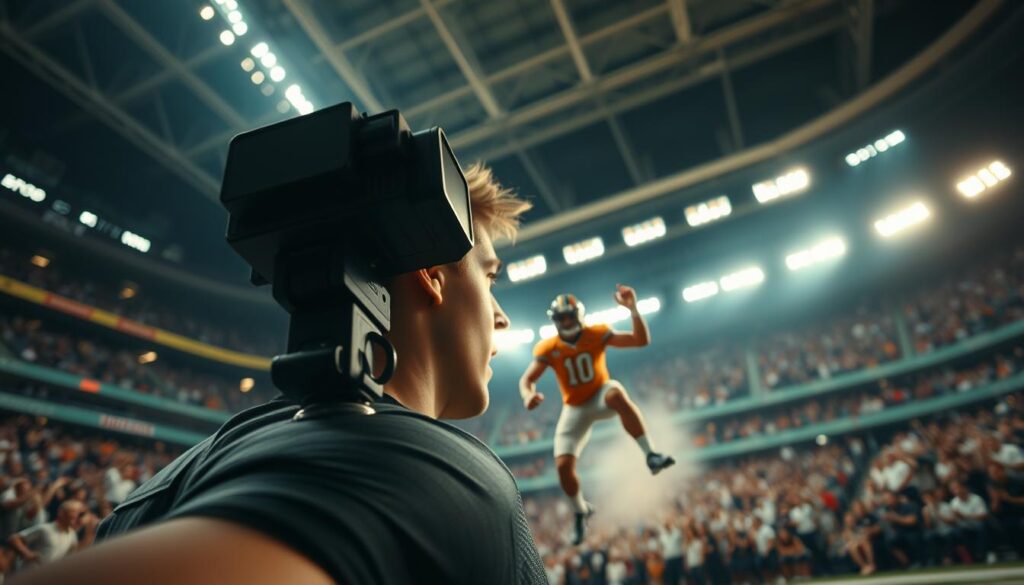
This is the new film language of immersion. It’s about feeling the action, like a boxer taking a jab. Or seeing a skier’s spin from their helmet. It’s about feeling like you’re right there.
It’s like a detective’s first-person story. We don’t just watch; we feel the struggle. We feel the burn, the noise, and the fear. It’s a way to connect deeply with the action.
But is it real, or just an illusion? A helmet cam shows what the athlete sees, but not what they think. A shaky cam makes us feel tired, but not scared. This view can make us miss the deeper story.
This style is inspired by video games and documentaries. It focuses on feeling the action, not thinking about it. The danger is that we might just enjoy the ride, without understanding the story.
But when done right, it’s amazing. It makes us feel like we’re part of the action. We’re not just watching; we’re experiencing it. The camera is not just showing us; it’s sharing the athlete’s effort.
This change in film language makes us question something. Are we getting too close and losing the bigger picture? The answer depends on how the story is told. The immersive camera is powerful, but it’s not everything.
Broadcast Aesthetics Inside Drama: Lower thirds and score bugs as narrative tools
Sports films have reached a new level by using broadcast tools in their stories. The scorebug, lower-third graphics, and telestrator lines are more than just details. They drive the story forward.
In Moneyball, Brad Pitt’s character, Billy Beane, watches a game on TV. The graphics on screen don’t just show the score. They reveal his strategy’s success or failure.
Creed II shows the fight isn’t just in the ring. It’s also in the HBO-style broadcast overlay. The scorebug counts down for Adonis Creed, and the lower third hints at his family’s past.
This approach adds a psychological layer to realism. We see the raw event and the official story side by side. This contrast creates the real drama.
The optical print has evolved from classic cinema to today’s digital graphics. It’s a layer of information added to the film. This layer is the broadcast graphics package.
This method is both cynical and brilliant. It shows that in our world, nothing exists without commentary. Every athlete is seen as both a person and a graphic.
This technique makes us active viewers. We watch a boxing match as presented by HBO. We’re aware of the filter and how stories are framed.
The scorebug is a key element in suspense. It shows the game’s outcome, adding tension. It tells us the game’s state without needing a character to say it.
This mix of drama and broadcast is a smart innovation in sports cinema. It shows us the game and how it’s presented. The optical prints of today are more than decoration. They’re part of the story.
So, when a lower third appears, don’t just read the name. Understand the character’s destiny. The gap between what’s shown and what’s meant is where the story unfolds.
The Ethics of Heroization vs Humanization
Is it more dishonest to show a montage of a hero or a close-up of the truth? Every shot in sports movies has an ethical side. The camera doesn’t just record; it judges and elevates or condemns.
Consider that low-angle shot of a boxer. It’s not just about the angle. It’s like a religious view. The athlete looks like a saint, with muscles lit up like a painting. Then, there’s the close-up of a battered face. It shows the same athlete but tells a different story. One makes them a hero, the other shows their humanity.
The classic training montage is a myth-making machine. Rocky running up steps is not just exercise. It’s a story of a hero, set to music. We all want to believe this story.
On the other hand, The Wrestler shows a different side. There’s no big montage of Randy “The Ram” training. Instead, we see him struggling with pills and hearing loss. The camera looks at him, not up at him. This shows that heroes are not forever, but pain is.
Noir sports films love to show fallen heroes. They show our own disappointment. A source said, “Noir loves fallen heroes because they’re the ultimate ‘cynical detective’ origin stories.” We see the hero’s fall through dark colors and shadows. The style itself tells us the truth behind the image.
| Visual Technique | Heroization (Myth-Making) | Humanization (Reality-Grounding) | Ethical Argument |
|---|---|---|---|
| Camera Angle | Low-angle (looking up) | Eye-level or high-angle | Deification vs. equalization |
| Editing Pace | Fast cuts, rhythmic montage | Long takes, lingering shots | Building momentum vs. showing fatigue |
| Lighting | Backlighting, halo effects | Naturalistic, harsh, or shadowy | Idealization vs. brutal honesty |
| Color Palette | Vibrant, saturated colors | Desaturated, muted, or noir B&W | Elevating emotion vs. draining glamour |
| Sound Design | Sweeping orchestral scores | Diegetic sound, silence, ambient noise | Emotional manipulation vs. raw presence |
Is one approach more honest? That’s not the right question. Putting an athlete in a big frame is already a myth. The real choice is what story we want to tell and what lies we accept.
Miracle shows us a story of unity and triumph. The Wrestler shows us decay and isolation. Both are made-up stories. The ethics are in how we make them.
Next time you watch a sports movie, look at the camera, not the game. Think about what the lens is asking you to believe. And why you’re so quick to agree?
What the Next Decade Might Revive
What’s next in sports visuals? I’m guessing a return to the real thing. In our world of perfect 8K, I think we’ll see a love for old imperfections.
Filmmakers might start to love the flicker and grain of old films. The newsreel style could come back, with a twist of irony or nostalgia. It’s like going back to comfort food in a digital world.
Film noir keeps getting new life. Sports movies might follow. As AI changes what’s real, the raw feel of newsreels could become the new truth.
Imagine sports stories told through TikTok clips or security footage. Shaky phone videos might become the new norm, replacing smooth camera work.
The future is a mix of old and new tech. Every new style is just a twist on something old. We’re coming full circle, with better tech and sadder eyes.
Our screens might soon show the flicker of old films. The newsreel style could return as digital art. It’s a full circle, showing that in sports and movies, old is always new again.