Sports movies often borrow from noir’s style. Imagine locker rooms lit like secret poker dens, athletes chasing dreams in dark alleys. While Rocky Balboa fights under bright lights, Jake LaMotta in Raging Bull faces a moral maze as thick as a cigar cloud.
Noir isn’t just about fedoras and femme fatales. It’s the gritty truth beneath the surface, the contrast of dreams and downfall.
Cinematographers use sports noir lighting to turn sports fields into places of confession. They create shadows that cut through scenes like knives, showing the dark side of ambition. These films dissect athletes, exposing their true selves under harsh lights.
Think about a basketball court lit in sickly green or a football field shrouded in rain. Classic noir sports movies swap victory for mystery and doubt. It’s not just about winning—it’s about the cost of the soul.
So, put on your trench coat and grab a drink. We’re exploring where sports drama meets noir’s fatalism. No happy endings here.
Introduction
What happens when competition meets human frailty? Noir sports movies show us jabs of existential dread instead of uplifting moments. They swap trophy ceremonies for moral confusion—where every win feels tainted and every locker room smells of desperation.
Imagine a boxing ring as an interrogation room. The ropes aren’t just boundaries—they’re like witness stands. Sports movies with noir aesthetics use sports to reveal our true selves, like in The Set-Up’s midnight scenes where streetlights flash like guilt. Even a simple punch combo can be a confession.
After the war, these stories reflected the disillusionment. Athletes became antiheroes, not chasing fame but escaping debt or their own moral decay. Remember Norma Desmond’s famous line in Sunset Boulevard? It’s like she says, “I *am* big—it’s the championships that got small.”
Why does this mix work? Sports need clear winners, but noir loves the gray areas. Together, they create a toxic alchemy. It’s a world where winning can be a curse, and the real battle is in dark places. It’s not about who wins. It’s about who makes it through.
Selection Criteria
What makes a sports moment gritty and noir? Imagine sweat-stained fedoras and shady managers in dark locker rooms. That’s the vibe we’re after. Our criteria for underrated noir sports films are strict. We call it the “Triple Threat of Bleakness.”
- Lighting: Does the scene feel like it’s under a dying bulb? If shadows make the hero question life, that’s a plus.
- Camera Work: Dutch angles that make you feel lost. Smooth tracking shots that hide the truth.
- Framing: Can you see the visual signs of a rigged game? Like doorways that trap characters.
In 1949’s Champion, Kirk Douglas’ character turns into a shadow of himself. The lighting is harsh, like it’s judging him. This is what we call “ethical chiaroscuro.” It’s when light and dark judge your choices.
| Noir Element | Sports Movie Twist | Example Scene |
|---|---|---|
| Low-Key Lighting | Locker room interrogations | Body and Soul’s midnight meeting |
| Moral Ambiguity | Fixed matches | The Set-Up’s desperate gamble |
| Existential Framing | Empty stadium shots | Raging Bull’s final bell |
We love classic scenes that twist sports clichés. Like that training montage where the punchbag seems to say “you’ll never make it.” Or the locker room that smells of regret. These are our top picks.
Scene 1: Raging Bull – The Final Fight
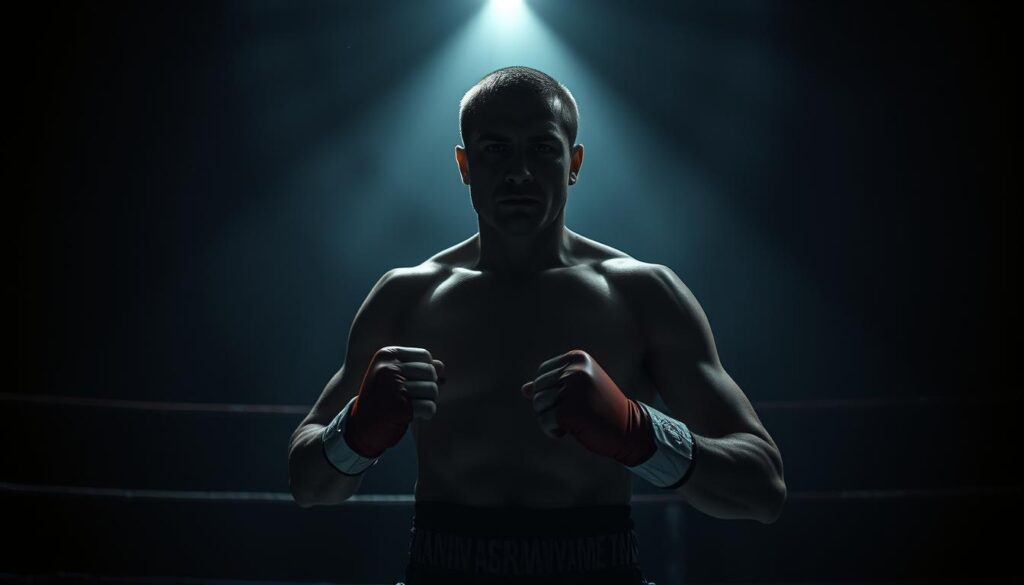
Martin Scorsese’s Raging Bull doesn’t just throw punches – it throws chiaroscuro lighting at your soul. The 1980 masterpiece turns Jake LaMotta’s final bout into a blood-smeared ballet of self-destruction. Every shadow whispers “you did this to yourself.”
Visual Motifs
Scorsese’s black-and-white palette isn’t nostalgic – it’s forensic. The ring becomes a cage outlined in guilt, with stark lighting carving LaMotta’s face into a living Francis Bacon painting. The ropes cast prison-bar shadows as Sugar Ray Robinson pummels our “hero.”
Moral Decay in Slow Motion
That floating blood droplet? A perfect metaphor for LaMotta’s life – suspended between violence and consequence. The slow-motion sequences aren’t just stylistic flair; they’re an autopsy of a man choosing ruin. When De Niro’s bloated frame stumbles through the haze, you’re not watching acting – you’re witnessing a Greek tragedy in sweatpants.
| Technique | Raging Bull Example | Noir Tradition |
|---|---|---|
| High-Contrast Lighting | Spotlights isolating LaMotta’s face | Venetian blind shadows in 1940s crime films |
| Claustrophobic Framing | Camera pressing against ring ropes | Low-ceiling shots in The Third Man |
| Symbolic Props | Blood-stained gloves as fallen crowns | Cigarette smoke as moral ambiguity |
Let’s address the elephant in the room: yes, De Niro’s 60-pound weight gain was impressive. But the real Oscar should’ve gone to Michael Chapman’s camera team. Their sports noir lighting turns sweat into liquid mercury and bruises into Rorschach tests of failure.
Scene 2: Body and Soul – The Bribe Offer
If film noir were a chess match, this alleyway confrontation would be checkmate by moral compromise. Body and Soul stages its corruption ballet not in a boardroom but a backstreet. Here, the smoke from a promoter’s cigar becomes the exhaust pipe of damnation. Boxing gloves meet Faustian bargains, and the ropes around the ring feel more like nooses.
The Price of Victory
Watch how the promoter’s diamond pinky ring catches the light while his words snuff it out. That cigar? It’s not just tobacco – it’s the incense of exploitation. Contrast this with our boxer’s sweat stains spreading like inkblot tests on his shirt. Which one’s the real Rorschach of desperation?
The dialogue crackles with subtext sharper than a switchblade. When the money changes hands, notice how the bills stick together – a tactile metaphor for ethical glue traps. As one critic quipped: “This is the kind of corruption that makes Wall Street look like a lemonade stand.”
Shadows as Silent Antagonists
The chiaroscuro here doesn’t just set the mood – it becomes the jury. Those slatted shadows across the boxer’s face? They’re prison bars for his conscience. The promoter’s silhouette on the brick wall? A funhouse mirror version of his actual stature.
| Element | Symbolism | Noir Function |
|---|---|---|
| Cigar Smoke | Moral Obfuscation | Visualizes Power Dynamics |
| Sweat Patterns | Physical/Mental Toll | Humanizes the Victim |
| Alley Walls | Social Entrapment | Frames Moral Claustrophobia |
Every shadow here works overtime. The diagonal slash of light cutting through the frame? That’s not just a lighting choice – it’s the blade of moral compromise hovering over our protagonist’s neck. Notice how the boxer’s shadow stretches toward the money while his face turns away. The body wants what the soul can’t stomach.
Scene 3: The Set-Up – Midnight Desperation
Robert Wise’s 1949 boxing noir The Set-Up would leave permanent stains on celluloid if urban landscapes could sweat. It’s not just about a fighter who’s lost his way. It’s a lesson in how city streets can feel like psychological torture. This 72-minute film is a must-see for sports movies with noir aesthetics.
Urban Claustrophobia
Wise shows his fighter pacing like a rat in a maze, where the cheese is rigged to explode. The tight shots are like cinematic straitjackets. The film’s first source called it “unforgettable uneasiness.” Every neon sign seems like a prison searchlight, every shadow a bookie waiting to break kneecaps.
These streets are like Travis Bickle’s taxi route in Taxi Driver. But Wise’s boxer lives in this hell. The city watches and bets on him.
The Clock Ticks, the Lights Dim
Wise uses time like a loan shark collects interest. The ticking clocks are doomsday devices. As the fight nears, the lighting turns from yellow to red. It’s not subtle. It’s not supposed to be.
This scene would get a ★★★★☆ on Yelp for “ambiance you can taste.” The smoke fills rooms and curdles in your throat. The sweat on walls is the building’s nervous system leaking.
| Noir Element | Sports Movie Twist | Psychological Impact |
|---|---|---|
| Low-Key Lighting | Ring spotlights as interrogation lamps | Creates visceral dread |
| Urban Settings | Alleyways as training grounds | Amplifies entrapment |
| Moral Ambiguity | Fixed matches as career suicide | Heightens desperation |
The Set-Up stands out in sports movies with noir aesthetics for more than its brutality. It makes us feel complicit. Every cheer and punch is a confession. By the end, it’s not just a boxing match. It’s a man’s desperate deal with the city.
Scene 4: Champion – The Betrayal
Champion (1949) is a prime example of how to show betrayal in noir. It’s like a neon “DANGER” sign flickering in the dark. This boxing drama doesn’t just show a double-cross; it dissects ambition’s corpse with precision.
Kirk Douglas’ Midge Kelly isn’t just flawed—he’s a Shakespearean tragedy in sweat-stained satin shorts.
The Double-Cross Close-Up
Director Mark Robson uses Dutch angles like a pickpocket uses distraction. When Midge betrays his manager (and brother) Connie, the camera tilts sharply. You’ll feel your moral compass spinning.
Douglas’ grin here isn’t just smug—it’s Macbeth at Dunsinane, if Macbeth threw uppercuts instead of soliloquies. Notice how the shadow of the boxing ring ropes transforms into prison bars as the deal closes? That’s not cinematography—that’s visual witchcraft.
The infamous handshake sealing the betrayal lasts seven seconds. Seven. Hitchcock would blush at the tension. Robson holds on Douglas’ eyes just long enough for viewers to see the exact moment “loyalty” becomes “liability.” It’s the kind of grip that makes you check your pockets afterward.
Noir’s Love Affair with Fallen Idols
Noir loves fallen heroes because they’re the ultimate “cynical detective” origin stories. Midge’s corruption mirrors Philip Marlowe’s clients—both are case studies in how power warps faster than a newsreel filmstrip. Champion argues that sports aren’t a refuge from noir’s moral quicksand—they’re its Olympic training facility.
This 1949 gem (often overlooked in classic noir sports movies discussions) proves ringside drama can rival any back-alley shootout. The Champion 1949 review that matters isn’t about fight choreography—it’s about how greed sucker-punches the soul. When Midge’s final opponent becomes his own reflection, you realize the real knockout happened three reels earlier.
Scene 5-10: (Other Notable Scenes)
Noir films have a secret weapon: underrated noir sports films. These films use shadows in a way that’s more powerful than any detective. They show how athletes can be trapped in desperation, like sweat-soaked jerseys.
Briefcase Full of Darkness: The Hustler’s Bar Scene
In The Hustler, Paul Newman’s Eddie Felson plays a game of Russian roulette with cue sticks. The bar scene’s sports noir lighting turns pool tables into altars. Shadows cut through smoke like guilt, and the lamps seem to interrogate.
Requiem for a Lightweight: Fat City’s Last Round
In Fat City, Stacy Keach’s dawn sparring is a funeral for dreams. The cinematography is hazy, filled with regret. A water-stained punching bag shows what losing your soul looks like at dawn.
These hidden gems show noir is more than just fedoras and femme fatales. Films that blend genres prove a boxing ring can be a stage for tragedy. Or, as Gordon Gekko might say, “Greed is good… for getting yourself shot in a parking garage.”
What Makes These Scenes Iconic?
Why do we keep watching scenes where dreams turn to defeat? It’s not the trophies or training montages. It’s the artistry of collapse. These moments grab us like a gambler’s last chip: beautiful, doomed, and full of bad choices.
The Alchemy of Desperation
Noir sports scenes are like jazz standards played in minor keys. Take Miles Davis’ Kind of Blue – the magic is in the silences where ambition rots. These films choose the dark path, not the redemptive one.
Consider the math of misery:
| Element | Traditional Sports Film | Noir Sports Scene |
|---|---|---|
| Resolution | Victory parade | Whiskey-stained regret |
| Moral Compass | Inspirational coach speech | Bookie’s whispered odds |
| Visual Signature | Sunsets over fields | Neon reflecting in gutter puddles |
Why We Root for Losers
America loves an underdog – until they start chain-smoking and betting on their own failures. These antiheroes fascinate us because they’re our shadow selves in shoulder pads. Their corruption shows us our own workplace compromises and doubts.
Three reasons these trainwrecks endure:
- Authenticity over inspiration: No montage can fix a broken moral compass
- Visual poetry: Sweat becomes holy water in the church of bad decisions
- Cultural catharsis: We exorcise our fears of failure through their disasters
Like a perfect boxing combo, these scenes hit us where we’re softest: the nagging suspicion that winning might cost more than losing. Now that’s drama no scoreboard can measure.
Analysis of Noir Techniques
Let’s dive into the heart of sports noir. It doesn’t just borrow from Double Indemnity. It uses those tricks to create a world of secrets. Every shadow in these films tells a story, thanks to clever lighting.
Lighting as a Narrative Weapon
Low-key lighting in sports noir reveals truths, not just sets moods. In Raging Bull, the final fight is lit like a Caravaggio painting. This makes the fight feel like a sacrilege caught on film.
Locker room showers in these films are filled with dread. It’s not just water vapor—it’s sports noir lighting revealing the true state of athletes. As Billy Wilder said in Sunset Blvd., “We didn’t need dialogue; we had shadows.”
Camera Angles: Guilty Until Proven Innocent
Dutch tilts are now used in sports films, thanks to The Third Man. Overhead shots in boxing scenes? That’s like God watching, but with a cigarette. These angles make you feel guilty.
In Body and Soul, a bribe scene is shot from above, like a vulture. It’s not just a negotiation—it’s a burial. The verdict is clear before the fight even starts.
Conclusion
Noir movies didn’t just borrow sports ideas; they took them and made them darker. Movies like Raging Bull and The Hustler show how sports films have a dark side. The ring is like a courtroom, and every win feels like a loss.
People might say noir-sports movies are weird, but they’re important. Watching Champion tonight, with the lights off and a drink in hand, shows something special. The camera focuses on Kirk Douglas’ smile, making us think about ambition and what we sacrifice for it.
The magic of these movies is in the details. In Body and Soul, bright lights are used to hide the truth. The Set-Up makes boxers look trapped. These choices are like punches to the heart of sports stories.
Next time someone says Rocky is noir, tell them it’s not true. Real noir has dim lights and worn-out hats. Film history is full of hidden gems waiting to be discovered.
Your job is to find these hidden sports noir movies. Start with The Set-Up and explore the Criterion Collection. Just remember to keep your drink cold, for your soul’s sake.