Let’s explore a fascinating paradox. The classic American film style, known for its dark themes and moral gray areas, was named by the French. It’s as if they uncovered a national secret we didn’t know existed.
The style is called film noir, which means “black film” in French. French critic Nino Frank coined the term in 1946. He was inspired by the gritty Série noire crime novels. This wasn’t just a label; it was a groundbreaking discovery.
So, what exactly are we discussing? Is it a distinct genre, a visual style, or just a mood? Scholars often debate the noir origins. I find it more interesting to follow the film noir evolution. Let’s trace it from German studios to Hollywood’s alleys.
The Birth of Noir in German Expressionism
Hollywood didn’t create noir’s darkness. It borrowed it from Germany, a country on the brink of chaos. The noir origins story is more about art than writing. Imagine Weimar Republic Berlin, a city filled with worry.
Its filmmakers had big ideas but small budgets. They wanted to show the turmoil inside people. German Expressionism was their way to express this turmoil.
This style was like a visual breakdown. Sets were twisted and light was used to create shadows. It wasn’t about showing reality but how it feels to be trapped.
Then, the Nazis came, bringing harsh light and fascism. The masters of shadow, like Fritz Lang and Billy Wilder, left for Hollywood. They took their skills and a way to show a dark world.
Lang’s M from 1931 is a key noir film. It tells the story of a child murderer hunted by all. The sound and lighting create a sense of dread. It’s a blueprint for noir.
These emigres brought more than just techniques. They brought a way to see the world as dark and fatalistic. Their work shaped American noir.
| Film / Artist | German Expressionist Element | Translated Noir Trope | Legacy Example |
|---|---|---|---|
| Fritz Lang’s M (1931) | Subjective sound, urban claustrophobia, the killer’s psychological portrait. | The obsessive, psychologically-driven criminal; the city as a character of menace. | James Stewart’s obsession in Vertigo. |
| The Cabinet of Dr. Caligari (1920) | Distorted, painted sets representing a fractured mind. | Unstable, dreamlike environments reflecting protagonist’s paranoia and confusion. | The skewed reality in The Lady from Shanghai‘s hall of mirrors. |
| F.W. Murnau / Robert Wiene (Lighting) | “Chiaroscuro” lighting—extreme contrasts of light and dark to create emotional tension. | The iconic Venetian-blind shadows, the face half-lit in mystery or guilt. | Every shadowy office and alley in The Maltese Falcon or Double Indemnity. |
| Billy Wilder (Worldview) | The cynical, ironic perspective of a culture in collapse. | The sardonic voice-over, the plot’s cruel twists of fate, the bitter punchline. | Sunset Boulevard and Double Indemnity (which Wilder, of course, co-wrote and directed). |
German Expressionism gave Hollywood more than style. It gave a worldview. A belief that visuals can show anxiety, fate, and moral gray areas. When these directors arrived in California, they planted the seed of noir. But they watered it with European despair. Noir’s garden was grown from haunted, imported soil.
Noir Arrives in Hollywood
The film noir evolution needed a spark, and RKO Pictures provided it. The European émigrés had the plan, but the American studio system had to build it. Their dark, psychological stories first found an American voice in a film everyone overlooked.
Stranger on the Third Floor (1940) was that spark. Directed by Boris Ingster and starring Peter Lorre, it was a low-budget film that lost money. Critics like Variety said it was “too arty for average audiences.” But, it had the seeds of American noir in its dark scenes and paranoid story.
John Huston’s The Maltese Falcon introduced us to the cynical private eye, Sam Spade. He was a businessman in a dirty world, not a hero. The film’s sharp dialogue and betrayals were new to audiences.
Orson Welles’s Citizen Kane wasn’t a noir but influenced the genre deeply. Its unique photography and storytelling set a new standard. Kane gave filmmakers the tools to create dark atmospheres.
The virus of noir spread through Hollywood. German Expressionism’s shadow crossed the ocean and stayed in the sunny land. The shift from European art to American pulp was complete.
| Film (Year) | Director | Key Noir Contribution | Lasting Legacy |
|---|---|---|---|
| Stranger on the Third Floor (1940) | Boris Ingster | First American film to fully integrate expressionist style with a crime narrative, featuring a definitive nightmare sequence. | Proved noir’s commercial viability as a B-movie template; the true “first” American noir. |
| The Maltese Falcon (1941) | John Huston | Codified the hardboiled private eye archetype and the world-weary, dialogue-driven crime thriller. | Blueprint for decades of detective noirs; established Humphrey Bogart as the quintessential noir anti-hero. |
| Citizen Kane (1941) | Orson Welles | Revolutionized cinematic grammar with deep focus, low-angle shots, and complex flashback structures. | Became the visual and narrative textbook for ambitious noir directors seeking artistic depth. |
This trio of films created a storm. A low-budget film showed noir’s possibility. A genre piece showed its popularity. A masterpiece showed its artistic value. The genre’s beachhead was secured. Hollywood’s view of black and white, and right and wrong, was forever changed.
Defining Tropes & Visual Style
The heart of 1940s cinema’s dark side isn’t in the story. It’s in the sound of a dripping faucet in a wet alley. Or the shadow of a fedora against a foggy window. Trying to define film noir is like trying to catch smoke. It’s a genre, a cycle, a mood, or a shared cultural breakdown, beautifully captured.
The characters in film noir are filled with American anxiety. There’s the private eye, a man in a rumpled coat with a tarnished code. The femme fatale, who uses love as a tactic and a kiss as a step before a bullet. And the grifter, who thinks he’s smart until he’s trapped in a tomb. These characters are more than just people; they represent a system in decay.
The look of film noir is unique. It uses chiaroscuro, where light and shadow are more than just contrasts. Light is an interrogator, and shadow is a hiding place. This style shows a world where the American dream has a dark side.
Experts like Alain Silver call it a “phenomenon,” not just a genre. The rules were flexible. You could have a noir without a detective, or a femme fatale who’s more a victim than a villain. What tied these films together was a deep cynicism, where every choice is bad and the frontier is a dead end.
So, when you see those shadows or hear that saxophone, remember it’s more than a movie. It’s a visual statement on disillusionment. Noir created a language that showed the world was not just dangerous, but also beautifully and tragically corrupt. This language, born in 1940s cinema, continues to speak to us in the dark.
1940s: The Classic Period
Welcome to the golden age of anxiety. The 1940s turned Hollywood into a world of moral gray areas and dark shadows. This was the peak of a poisonous bloom. While the world celebrated winning World War II, American movies explored darker themes.
This led to a wave of “morbid drama” that became known as film noir evolution.
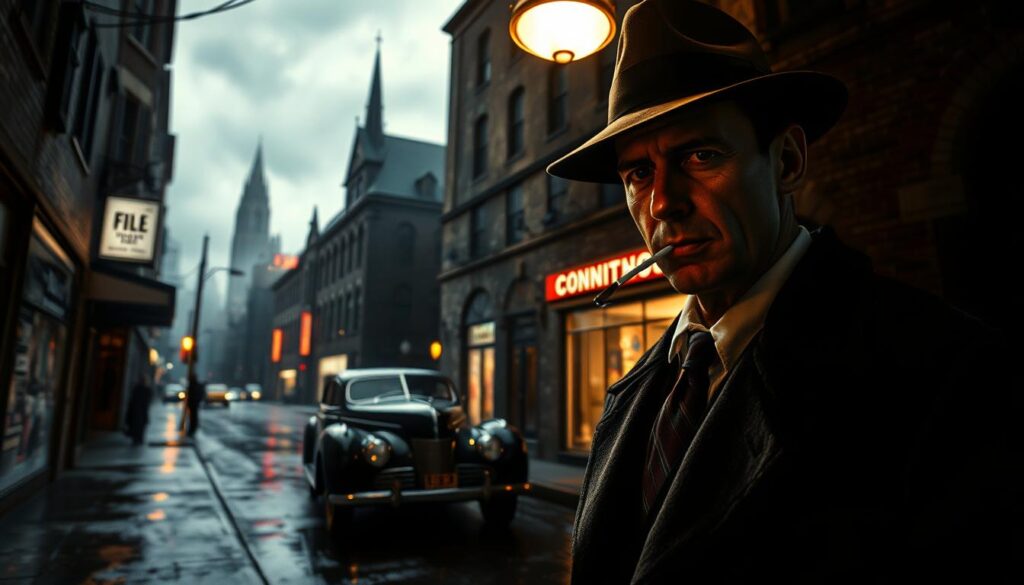
This era saw the rise of shadowy movie giants. Double Indemnity (1944) was a groundbreaking film. It showed audiences loved watching characters plot and then get caught in their own lies.
Then, in 1946, The Postman Always Rings Twice and Gilda hit the screens. They brought raw passion and glamorous deceit. By 1947, Out of the Past added a fatalistic twist, showing you can’t escape your past.
Many of these iconic films were made on low budgets. This gave them the freedom to sneak in daring themes. The real excitement wasn’t just in the steamy scenes but in the charged conversations and the architecture of despair.
Critics were shocked. They called it “celluloid dirt.” The Legion of Decency worried about its dark themes. They were right; this 1940s cinema was a dark reflection of the times.
Yet, we couldn’t look away. The shadows on screen mirrored our own darker selves. This era set the rules, then showed us how to break them. It was a time when style and substance merged into something both powerful and unsettling.
Thematic Shifts in the 1950s
The Cold War cast a chill over politics and changed noir. It became sleazier and more intense. The idea of a moral universe for detectives was lost.
Private eyes turned into psychopaths and obsessives. Films now explored extreme psychologies. This showed America’s growing anxiety through dark stories.
Kiss Me Deadly (1955) is a prime example. It’s the sleaziest and most erotic noir film. Mike Hammer’s search for the “great whatsit” ends in a nuclear explosion. It’s a dark reflection of the atomic age.
This change is key to understanding noir origins. Noir was not fixed but adaptable. It changed to reflect the world’s growing paranoia.
By the end of the decade, Orson Welles made Touch of Evil (1958). It’s a masterpiece of corruption. The film is a vivid, stylized corner of noir. It marked the end of a cycle but showed noir’s lasting impact.
The 1950s didn’t end noir; they reshaped it. From German expressionism to this point, noir reflects society’s darkest corners.
Noir After the Studio Era
Scholars love a good funeral, but film noir’s death was greatly exaggerated. The classic period ended, and the studio system collapsed. Yet, the genre’s evolution is far more interesting.
Did it die, or just change its look? Purists might say noir faded with black-and-white films. But most critics and audiences see noir’s spirit living on in new forms.
This new form is called neo-noir. It’s not a sequel, but a new way of speaking noir. Filmmakers use noir codes, sometimes with respect, sometimes with a wink.
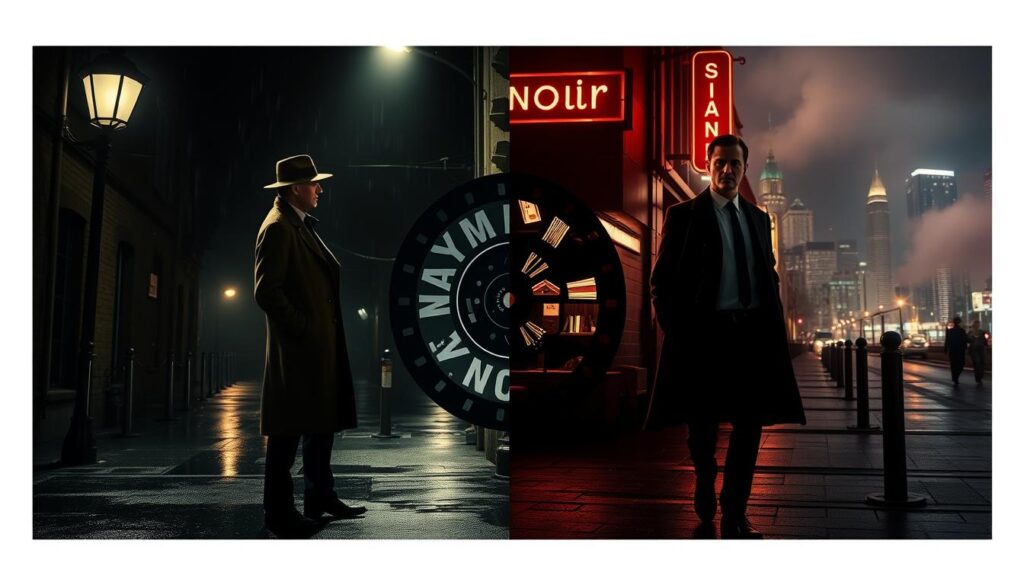
Look at the evidence. Roman Polanski’s Chinatown (1974) mixed noir’s corruption with California’s sun. Ridley Scott’s Blade Runner (1982) explored a noir detective in a futuristic world. Dan Gilroy’s Nightcrawler (2014) showed how the anti-hero thrives in today’s digital world.
This ongoing film noir evolution is a transformation, not a break. The table below shows the key changes in this journey.
| Element | Classic Noir (1940s-50s) | Neo-Noir (1960s-Present) |
|---|---|---|
| Visual Palette | High-contrast black and white; dramatic shadows (chiaroscuro); confined, studio-bound sets. | Color, often saturated or stylized (neon, sepia, stark primary colors); location shooting; influenced by graphic novels and digital effects. |
| Setting | Post-WWII American city (e.g., L.A., N.Y.); urban jungle with dark alleyways and smoky offices. | Expanded to sun-baked suburbs, dystopian futures, and the digital landscape; corruption is more systemic and global. |
| Protagonist | Hard-boiled private eye or doomed everyman; motivated by a personal code or fate. | Journalist, hacker, taxi driver, or media manipulator; often more explicitly psychopathic or nihilistic. |
| Technology’s Role | Telephones, cars, revolvers; tools of the trade. | Computers, cameras, surveillance gear; often central to the plot and theme of alienation. |
| Narrative Tone | Fatalistic, morally ambiguous; voice-over narration common. | Self-referential, parodic, or hyper-aware of genre tropes; mixes noir with other genres (sci-fi, thriller). |
The film noir evolution wasn’t an end, but a new direction. The genre kept its essence, even as it changed. Neo-noir shows noir’s style is about seeing the darkness in ourselves and society.
This style never goes out of fashion. It just gets new twists.
Conclusion: Enduring Appeal
Why does film noir, born in the 1940s, remain so relevant today? It’s because it tells it like it is. Unlike other films, noir doesn’t sell a dream. It shows us the harsh truth.
This genre’s gritty realism speaks to us now more than ever. It’s a world where nothing is as it seems. This feels real in our world of perfect social media images.
Its lasting appeal comes from a deep-seated resistance. Noir’s tough, no-nonsense style has stood the test of time. TCM’s Eddie Muller calls it the “gateway drug to classical Hollywood cinema.”
Exploring noir’s roots in German Expressionism is more than just film analysis. It’s a dive into our collective psyche. It shows how embracing our darker side can be enlightening.
The classic films of the 1940s have inspired many parodies. Yet, our fascination with noir never fades. It’s the dark heart of American storytelling, revealing the truth behind our dreams.