For years, a French saying ruled: “cherchez la femme.” Look for the woman. She was seen as the cause of all problems in dark tales.
But here’s the fun part. We didn’t just find her. We started to like her. The old studio bosses might be shocked, but fans were hooked. The story of women in noir is a lesson in turning things upside down.
They moved from simple villains to deep, complex characters. We weren’t just seeing a fall. We were seeing a fight back.
From a feminist view, the femme fatale is often seen as a myth. But what a fascinating myth she is. Now, we analyze her. And often, we secretly hope she succeeds.
This is your journey past the usual. The most dangerous thing in this world isn’t always a weapon. Sometimes, it’s just a smile.
Early Representation in Noir
In the 1940s, the term ‘femme fatale’ was just starting to take shape. This was a time filled with cynicism and moral gray areas. The women of this era were more than just love interests or victims. They were complex, dangerous, and groundbreaking.
Take Mary Astor’s Brigid O’Shaughnessy in The Maltese Falcon (1941). She’s not just a liar; she’s a survivor in a world stacked against her. Her power comes from a sonata of deception. She plays different roles to stay alive and in control.
Barbara Stanwyck’s Phyllis Dietrichson in Double Indemnity (1944) set the standard for the femme fatale. Wrapped in a towel and a plot to kill her husband, she’s a chilling figure. Phyllis uses society’s expectations against it, orchestrating its downfall.
These pioneers used society’s underestimation as their main weapon. In a world that expected little from them, their intelligence and wit were their greatest strengths —an idea often explored in discussions about film noir and its evolving character archetypes. The table below shows how these two figures laid the groundwork.
| Character | Film & Actor | Core Tactic | Legacy |
|---|---|---|---|
| Brigid O’Shaughnessy | The Maltese Falcon (Mary Astor) | Adaptive Role-Playing & Strategic Deception | The original survivor, proving a woman’s wit could outmaneuver brute force in noir. |
| Phyllis Dietrichson | Double Indemnity (Barbara Stanwyck) | Weaponized Femininity & Cold Calculation | Became the recognizable, iconic template for the classic femme fatale. |
Looking back, these early representations were like forces of nature. They showed a key truth of noir. The sharpest tool in a shadowy alley wasn’t always a detective’s gun. Sometimes, it was a well-timed lie from a woman everyone thought they knew.
Iconic Femme Fatales
Move over, detectives; the real power in classic noir wasn’t in the trench coat—it was in the silk stockings and sharp wit of the era’s unforgettable women. These noir heroines didn’t just enter a scene; they commandeered it. They turned vulnerability into a weapon and desire into a trap.
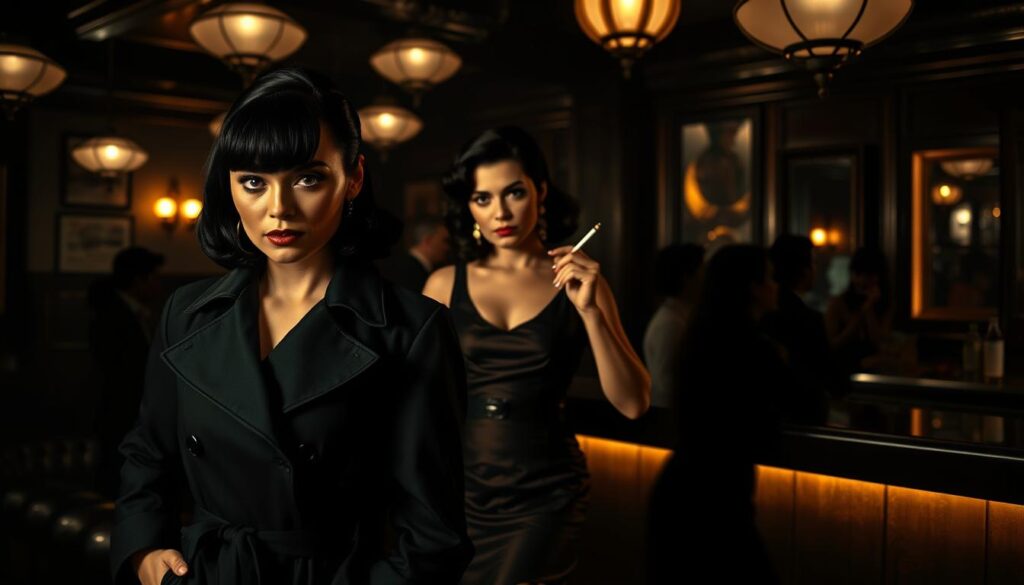
Consider Rita Hayworth’s Gilda. That famous hair flip wasn’t just a gesture; it was a declaration of independence. Gilda simmers with a dangerous, playful energy that makes her the quintessential noir heroine. She’s less a predator than a force of nature—men get burned just by standing too close.
Then there’s the tragic grandeur of Gloria Swanson’s Norma Desmond in Sunset Boulevard. She’s a gothic monument to faded fame, a femme fatale whose ultimate victim is herself. Her weapon isn’t sex appeal but delusion, and it’s far more terrifying. In stark contrast, Barbara Stanwyck’s Phyllis Dietrichson in Double Indemnity operates with chilling, suburban efficiency. These noir heroines show the archetype’s range: from glamorous icon to pathetic relic to cold-blooded strategist.
For pure, nihilistic cunning, look to Jane Greer’s Kathy Moffat in Out of the Past. She switches allegiances with the ease of changing a hat, her loyalty forever up for auction. Ann Savage’s Vera in Detour represents another breed of noir heroine. She’s not glamorous; she’s pure, snarling desperation in a sharp suit—a reminder that fatal attraction doesn’t require a gown.
Even Hayworth’s other major entry, Elsa Bannister in The Lady from Shanghai, plays a different game. Behind a facade of fragile beauty lies a chess master moving pieces toward a bloody checkmate. What unites them? Agency. They were the ones holding the cards, even if the hapless hero staring across the table hadn’t figured it out yet.
The table below breaks down the key attributes of these definitive noir heroines, showing how each wielded a unique form of power:
| Character | Film & Actress | Defining Weapon | Ultimate Target |
|---|---|---|---|
| Gilda | Gilda (Rita Hayworth) | Charismatic Glamour | The Male Gaze & Jealousy |
| Norma Desmond | Sunset Boulevard (Gloria Swanson) | Delusion & Former Fame | Herself & The New Hollywood |
| Phyllis Dietrichson | Double Indemnity (Barbara Stanwyck) | Manipulative Calculation | Her Husband & The Insurance Money |
| Kathy Moffat | Out of the Past (Jane Greer) | Adaptive Cunning | Whichever Man is Most Useful |
| Vera | Detour (Ann Savage) | Nihilistic Brutality | Survival at Any Cost |
| Elsa Bannister | The Lady from Shanghai (Rita Hayworth) | Deceptive Fragility | Wealth & Freedom Through Murder |
Debates rage about the most iconic femme fatales ranked, but their collective impact is undeniable. They taught audiences that the most interesting person in a shadowy room was often the woman smiling in the corner. These noir heroines defined a vocabulary of cinematic power that was glamorous, pathetic, cunning, and ruthless—but never, ever boring.
Shifting Roles and Agency
The 1990s brought a bold change to the noir genre. Women took the lead, challenging the traditional power structure. This wasn’t just a change in clothes; it was a fundamental shift in how stories were told.
In Bound (1996), the Wachowskis showed a new kind of partnership. Jennifer Tilly and Gina Gershon’s characters aren’t just lovers; they’re smart, equal partners in a crime. They outsmart the mob together, not because they’re destructive, but to free themselves.
Feminist scholars were also rethinking the “femme fatale” myth. They saw it as a way to control women’s stories, not a real character. They argued that these women were complex, fighting against unfair odds. The focus moved from their morality to their motivations.
This change made the characters more than just obstacles. They became the heart of the story. Instead of causing trouble, they succeed on their own terms. The story’s direction now rested with them, not just their actions.
Key Performances and Scenes
The femme fatale shines in her delivery, not just her dossier. Let’s explore the moments when a character turns from a plot device to a real strategist. These scenes are like psychological chess games. The actresses nailed it perfectly.
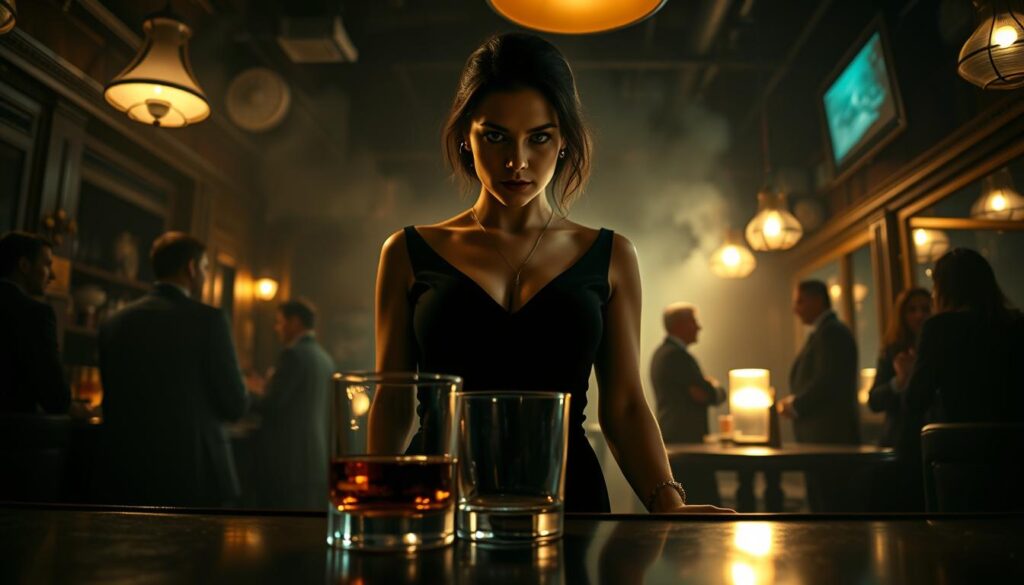
Carrie-Anne Moss as Natalie in Memento is a prime example. She uses Leonard’s memory loss as her tool. Moss’s performance is chilling and precise. It’s like gaslighting every day, making you question who’s the real victim.
Sharon Stone’s Catherine Tramell in Basic Instinct is another standout. Her famous leg-cross during an interrogation is more than a shot. It’s a declaration of war against the male gaze. Stone’s smirk is defiant, not seductive. She’s in control, not answering their questions.
Rosamund Pike’s Amy Dunne in Gone Girl is a modern classic. Her “Cool Girl” monologue is a harsh critique of performative femininity. Pike’s delivery is calm and detached. The power is in her pauses and glances. It’s a masterpiece of social engineering, not just a crime.
Barbara Stanwyck’s Phyllis Dietrichson in Double Indemnity is a classic femme fatale. Her final confrontation with her co-conspirator is intense. Stanwyck shows the mask slipping, revealing her true, ruthless self.
| Film & Character | Actress | The Strategic Move | The Lasting Impact |
|---|---|---|---|
| Memento (Natalie) | Carrie-Anne Moss | Exploiting amnesia for personal gain with casual, chilling precision. | Redefines manipulation as a quiet, administrative evil. |
| Basic Instinct (Catherine Tramell) | Sharon Stone | The leg-cross interrogation, weaponizing sexuality against authority. | A permanent icon of defiant control over the narrative gaze. |
| Gone Girl (Amy Dunne) | Rosamund Pike | The “Cool Girl” monologue, deconstructing feminine performance. | Elevates the femme fatale to a cultural critic and master manipulator. |
| Double Indemnity (Phyllis Dietrichson) | Barbara Stanwyck | The final, venomous confrontation in the rain. | Establishes the blueprint: glamour as a weapon, sentiment as a liability. |
What makes these performances unforgettable? The actresses didn’t play villains. They portrayed brilliant, strategic characters in a tough game. The calculation in their eyes makes the difference. These moments are etched in our minds as warnings, not just fiction.
Behind-the-Scenes Stories
If you think the most dangerous thing in noir is a .38 special, you haven’t met a film editor with scissors. The real story of noir heroines often happens off-screen. It’s in the writer’s room, the director’s chair, and the cutting room floor.
These decisions show if a character’s power was a deliberate choice or just a lucky accident of Hollywood.
Take the 1996 neo-noir Bound. The Wachowskis wanted more than a sexy thriller. They aimed for a true portrayal of a lesbian relationship with equal power. So, they hired Susie Bright, a feminist sexuality expert, to guide the intimate scenes.
This wasn’t about showing off. It was about getting the power dynamics right. Bright’s input made sure Corky and Violet’s relationship was built on mutual desire and partnership, not just fantasy. This made the women’s bond the heart of the story, creating a new kind of noir heroine.
Now, let’s go back to the classic Laura (1944). The story is more subtle but also more complex. Detective Mark McPherson falls in love with Laura Hunt while investigating her murder. But for most of the film, Laura is absent.
She’s a voice in a flashback and a story told by men, and literally a painting. Laura is the ultimate “woman as art object,” a creation of the male gaze and editing.
Was this a critique of male obsession, or just the default of the time? The line between creative intent and cultural impact is blurred in noir history.
We see this tension across the genre. The table below shows how off-camera choices shaped the noir heroines we remember.
| Film | Behind-the-Scenes Decision | Impact on the Noir Heroine |
|---|---|---|
| Bound (1996) | Hiring feminist consultant Susie Bright to choreograph sex scenes. | Crafted a relationship of equal power and desire, making the women’s partnership the central, active force of the narrative. |
| Laura (1944) | Constructing the character through flashbacks, a portrait, and the investigating detective’s gaze. | Presented the heroine as an idealized, passive object of fixation, reinforcing the “woman as mystery” trope. |
| Double Indemnity (1944) | The enforcement of the Production Code requiring punishment for the adulterous, murderous couple. | Forced the femme fatale, Phyllis Dietrichson, into a archetypal box of pure, punished evil, limiting narrative ambiguity about her agency. |
The Hays Code wasn’t a choice by filmmakers—it was a censor. Yet, it shaped the fate of many noir heroines, often ending their stories in death or prison. Their power was limited by the final reel.
Was the femme fatale a critique of patriarchy, or just a product of it? The answer is both. The magic and message come from the machinery. By looking behind the scenes, we don’t lessen these characters. We see the blueprint of their power and the choices made by filmmakers.
Modern Perspectives on Women in Noir
So, where are women in noir today? The talk has shifted from just listing types to really understanding them. We’re not just watching the femme fatale anymore. We’re breaking her down.
Take Amy Dunne from *Gone Girl*. She’s a modern femme fatale because she knows the genre inside out. She uses every trick in the book, analyzing her own story. She’s not just a mysterious figure. She’s a smart critic with a strategy.
Now, scholars ask a key question. Was the classic “femme fatale” ever a real person, or just a reflection of society’s fears? Today’s noir heroines often know they’re playing a role. They understand the expected part and twist it in their favor.
The new view is more complex and insightful. It goes beyond just seeing the femme fatale as a threat. It asks why we’re so drawn to labeling her as such. The story of women in noir is ongoing. We’re all contributing to the next chapter.