Cities in crime cinema are never neutral. They breathe. They corner. They listen.
From rain-slicked alleyways to echoing stairwells, urban architecture does more than frame the action — it shapes betrayal itself. Walls close in on conspirators. Windows expose secrets. Bridges become thresholds between loyalty and treachery.
In the language of film noir and modern crime movies alike, the city is not backdrop. It is accomplice.
To understand why betrayal feels inevitable in great crime films, we must examine the geometry of the spaces where it unfolds.
Verticality And Moral Descent
Staircases are among the most recurring architectural elements in crime cinema. Their symbolism is direct yet endlessly flexible: ascent suggests ambition; descent implies corruption or consequence.
Directors frequently frame betrayals on landings or midway points — spaces that are neither fully elevated nor fully grounded. Characters pause there. Conversations shift tone. Deals fracture.
Cinematographers emphasize verticality through:
- High-angle shots that reduce characters to vulnerable figures
- Deep focus compositions that elongate staircases into psychological tunnels
- Hard side-lighting that casts railing shadows across faces
The result is visual indictment. The architecture reinforces instability.
In classics of film noir, spiral staircases often suggest entrapment — movement without escape. In contemporary crime dramas, industrial fire escapes and subway entrances update that motif while preserving its moral charge.
| Architectural Element | Visual Technique | Narrative Function |
|---|---|---|
| Spiral staircase | Overhead shot, rotating movement | Entrapment, cyclical fate |
| Narrow stairwell | Deep shadows, compressed framing | Psychological pressure |
| Rooftop access | Wide-angle isolation | Exposure before betrayal |
| Subway descent | Diminishing light levels | Moral descent into secrecy |
The city’s vertical planes become moral gradients.
Corridors As Psychological Tunnels
Few spaces heighten tension like a corridor. Long, symmetrical, and unforgiving, hallways in crime films often precede confrontation or revelation.
Their design encourages anticipation. A character walks toward a door. The camera lingers behind. Fluorescent lights hum overhead. Shadows repeat rhythmically across the walls.
The corridor is not merely passage — it is procession.
Directors often employ slow tracking shots to stretch these sequences, allowing silence to gather weight. The audience senses betrayal before dialogue confirms it.
In many crime movies, hotel corridors or police station hallways double as liminal zones — spaces between loyalty and accusation. The physical narrowing of the frame mirrors the narrowing of options.
Architectural repetition becomes psychological repetition: suspicion, doubt, inevitability.
Windows, Glass, And The Illusion Of Transparency
Glass in crime cinema symbolizes exposure. Yet reflections complicate that clarity.
Interrogation rooms frequently use one-way mirrors. Office towers feature floor-to-ceiling windows that promise visibility but conceal private agendas. Rain-streaked panes distort faces, suggesting fractured truth.
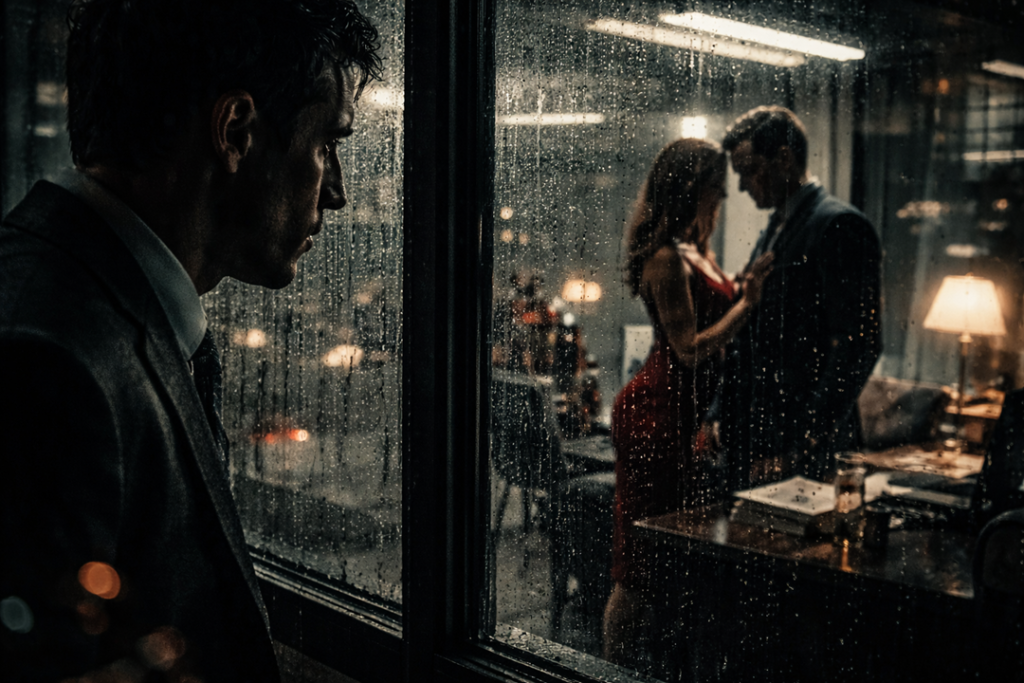
Cinematography amplifies these themes through layered compositions — shooting through glass, framing characters between reflections, or capturing neon signage bleeding into interior spaces.
Architectural modernism — particularly postwar glass-and-steel urbanism — reshaped the psychological geography of crime cinema.
Urban modernism — with its grids and glass facades — intensifies this dynamic in neo-noir. Steel and concrete structures impose order visually while chaos unfolds narratively.
The architecture promises structure. The plot dismantles it.
The Alleyway As Ritual Space
No space in crime cinema is more mythic than the alley.
Narrow, dimly lit, often slick with rain, the alley functions as a stage for confrontation. Its confinement strips away distraction. The world beyond fades into darkness.
Low-key lighting dominates here. Single-source illumination — a flickering streetlamp or neon spill — isolates figures within deep shadow. The visual vocabulary is unmistakably noir.
Alleyways transform betrayal into ritual. Deals are struck. Loyalties tested. Violence delivered without spectacle.
Unlike open boulevards or crowded intersections, the alley reduces betrayal to its elemental form: two figures, limited exits, compromised trust.
Public Spaces And Private Agendas
Urban design also shapes betrayal through contrast. Public arenas — train stations, courthouse steps, crowded restaurants — create tension by juxtaposing visibility with secrecy.
A whispered confession in a crowded café feels more dangerous than one in isolation. The architecture amplifies risk.
Cinematographers frequently use:
- Shallow depth of field to isolate conspirators within bustling spaces
- Long lenses to compress distance, making crowds feel intrusive
- Overhead lighting that flattens warmth, emphasizing surveillance
Public architecture becomes a reminder that betrayal carries consequence beyond the immediate participants.
In many crime narratives, betrayal unfolds at transitional hubs — airports, docks, train platforms. These spaces embody departure and severance.
Architecture dictates timing. Trains depart. Elevators descend. Bridges divide boroughs — and allegiances.
Mapping Urban Betrayal Across Eras
While architectural motifs persist, their visual treatment evolves alongside technology and urban design trends.
| Era | Dominant Urban Style | Cinematic Treatment | Betrayal Tone |
|---|---|---|---|
| 1940s–1950s Noir | Brick, shadowed interiors | High-contrast black-and-white lighting | Fatalistic, inevitable |
| 1970s Crime Drama | Concrete brutalism, subways | Gritty handheld cinematography | Institutional distrust |
| 1990s Neo-Noir | Glass towers, industrial lofts | Controlled color palettes, reflective glass | Moral ambiguity, corporate decay |
| Contemporary | Digital skylines, LED lighting | HDR contrast, expansive cityscapes | Fragmented loyalty in hyper-visibility |
Even as skylines modernize, the emotional architecture remains consistent. Betrayal thrives in transitional spaces — between floors, between boroughs, between public and private domains.
Sound, Space, And Structural Anxiety
Urban architecture shapes not only what we see but what we hear. Corridors amplify footsteps. Subway tunnels distort voices. Rooftops swallow dialogue into open air.
Sound design works alongside physical space to intensify betrayal. Echo suggests isolation. Muffled dialogue implies secrecy.
In crime cinema, silence is rarely empty. It resonates against brick and concrete.
For readers interested in how visual and sonic design intersect, our exploration of how lighting and slow motion heighten violence in sports noir offers a parallel study in atmospheric construction. Though the arena differs, the principles of space and tension remain aligned.
Why The City Always Knows
In crime movies, betrayal rarely occurs in pastoral landscapes. It belongs to cities — to density, shadow, and architecture that forces proximity.
Urban design creates pressure points. Narrow passageways compress decisions. Elevated platforms expose vulnerability. Glass towers reflect duplicity.
The city witnesses everything. It frames betrayal not as spontaneous act, but as architectural inevitability.
When characters turn against one another in crime cinema, the buildings seem to anticipate it. Staircases wait. Corridors stretch. Alleys darken.
In the geometry of urban design, betrayal is not an accident.
It is constructed.