Noir has always belonged to the city.
Rain-soaked streets, neon reflections, crowded anonymity—these were the natural habitats of crime and corruption. The city allowed people to disappear, to reinvent themselves, to commit acts that blended into the noise.
Land of Sin removes that noise entirely.
Premiering on Netflix on January 2, 2026, the Swedish series follows investigators Dani and Malik as they unravel the murder of a teenager in the Scanian countryside—a place where nothing is hidden, and yet everything remains concealed.
The shift is immediate and disorienting.
There are no crowds to hide in. Only people who already know each other.
Rural Isolation As The New Noir Pressure
In Land of Sin, the setting is not just rural—it is socially enclosed.
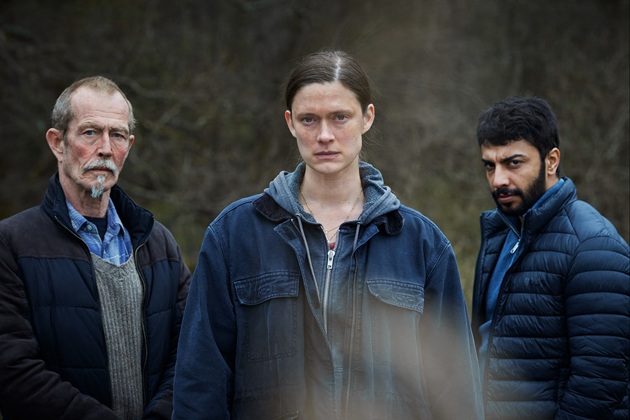
The Bjäre peninsula is defined by:
- Generational ties
- Family hierarchies
- Unspoken rules
This creates a different kind of tension than urban noir. In the city, anonymity protects the criminal. In the countryside, familiarity traps everyone.
| Element | Classic Urban Noir | Rural Noir |
|---|---|---|
| Environment | Dense, anonymous city | Isolated, tight-knit community |
| Threat | Hidden strangers | Known individuals |
| Power Structure | Institutions and crime networks | Families and local hierarchies |
| Escape | Possible through anonymity | Nearly impossible |
The crime does not disrupt the system. It exposes it.
The Family As The System Of Power
One of the most defining aspects of Land of Sin is how it replaces institutions with families.
The investigation quickly reveals a long-standing family feud rooted in land disputes, loyalty, and generational resentment.
There is no need for organized crime.
The violence is already embedded in the structure of the community.
The patriarchal presence of Elis—who pressures investigators to solve the case before taking matters into his own hands—illustrates how authority operates differently here. It is not enforced through law.
It is inherited.
When Everyone Is Connected To The Crime
In urban noir, characters often intersect briefly. In rural noir, they are permanently entangled.
Land of Sin intensifies this dynamic by linking nearly every character to the victim in some way—through family, history, or shared secrets. The investigation becomes less about discovering unknown connections and more about navigating existing ones.
This creates a suffocating narrative environment:
- Every suspect is familiar
- Every motive is personal
- Every revelation carries emotional weight
The detectives are not uncovering strangers.
They are disrupting a system that resists being exposed.
The Landscape As Emotional Mirror
Nordic noir has always used environment as a psychological extension, but Land of Sin pushes this further.
The Scanian countryside is vast, quiet, and visually open. Yet it feels restrictive.
The emptiness amplifies tension rather than relieving it.
- Long stretches of land create distance
- Silence replaces noise
- Isolation replaces distraction
This reflects a key evolution in noir aesthetics:
The darkness no longer needs shadows—it exists in space itself.
Personal Stakes Replace Professional Distance
Detective Dani is not an outsider to the case. She has a personal connection to the victim, having previously served as his foster mother.

This detail reshapes the narrative completely.
The investigation is no longer objective. It becomes entangled with guilt, memory, and responsibility. Dani is not just solving a crime—she is confronting her own past.
This aligns with the broader shift in modern noir explored in Why Netflix’s True Crime Wave Is Turning Friendship Into The Darkest Form Of Noir, where relationships and emotional proximity replace procedural distance as the primary source of tension.
Crime, Class, And Exclusion Beneath The Surface
Beyond the immediate narrative, Land of Sin engages with deeper social themes.
Critics have highlighted its exploration of:
- Class division
- Social exclusion
- Generational conflict
The rural setting becomes a lens through which these issues are magnified.
Unlike the city, where inequality can remain abstract, the countryside forces confrontation. Everyone knows where they stand. Everyone knows what they lack.
The result is a narrative where crime feels less like an anomaly and more like a symptom of structural imbalance.
The Return Of Moral Weight In A Closed World
Rural noir restores something that has become increasingly rare in modern thrillers: consequence.
In a closed community, actions cannot disappear. They reverberate.
- Secrets linger longer
- Betrayals carry generational impact
- Violence reshapes the entire social structure
This gives Land of Sin a distinct moral gravity. The crime is not just an event—it is a fracture that affects everyone connected to it.
Streaming And The Rise Of Rural Noir
The success of Land of Sin, which quickly entered Netflix’s Top 10 rankings in early 2026, reflects a growing audience appetite for slower, more atmospheric crime storytelling.
Streaming platforms have created space for narratives that:
- Prioritize environment over pace
- Focus on character over spectacle
- Build tension through silence and distance
This has allowed rural noir to emerge as a dominant form—one that feels both traditional and newly relevant.
A Genre Moving Away From The City
What Land of Sin ultimately represents is a geographic shift in noir itself.
The city is no longer the definitive space of darkness.
Instead:
- Isolation replaces anonymity
- Familiarity replaces suspicion
- Community replaces system
The danger is no longer external. It is embedded within relationships, within history, within the land itself.
The Darkness That Cannot Be Escaped
In the end, rural noir offers something uniquely unsettling.
In the city, there is always the illusion of escape—another street, another identity, another chance to disappear.
In Land of Sin, there is nowhere to go.
The past is fixed. The relationships are permanent. The secrets are shared.
And when the crime is revealed, it does not dissolve into the background.
It stays.
Because in rural noir, the darkness is not something you encounter.
It is something you inherit.