In classic noir, crime hides in shadows—back alleys, dim offices, smoke-filled rooms where corruption feels inevitable. Steal does something more unsettling.
It places the crime in full view.
Set inside a London financial firm, the series begins with a violent takeover of an investment company, forcing employees to execute a £4 billion heist in real time. The setting is sterile, corporate, controlled. There are no obvious villains lurking in darkness—only professionals, spreadsheets, and systems designed to appear impenetrable.
That’s where the illusion breaks.
The crime isn’t invading the system. It’s revealing what was already inside it.
Corporate Spaces As The New Noir Landscape
The evolution of noir has always followed power. In the 1940s, it was crime syndicates. In the 1970s, it was institutions. Today, it’s corporations.

Steal represents a return to what can be called corporate noir—a subgenre where the tension is embedded in financial systems rather than physical violence. The danger isn’t always visible, but its impact is far more expansive.
Inside Lochmill Capital, the crime is not about stealing objects. It’s about manipulating value, exploiting trust, and exposing how fragile economic systems really are.
| Element | Classic Noir | Corporate Noir |
|---|---|---|
| Setting | Urban underworld | Financial institutions |
| Crime | Murder, theft, corruption | Financial manipulation, systemic fraud |
| Power Structure | Criminal networks | Corporate and economic systems |
| Protagonist | Detective / outsider | Insider within the system |
This shift doesn’t remove tension—it reframes it. The stakes are no longer personal alone. They are systemic.
The Insider As The New Antihero
One of the most defining aspects of Steal is its protagonist, Zara Dunne—an ordinary employee caught in extraordinary circumstances.
But the series complicates her role quickly.
She is not simply a victim. As the narrative unfolds, it becomes clear that she may have played a part in enabling the heist. This ambiguity transforms her into a modern noir figure: someone navigating a system that both traps and implicates her.
Unlike traditional antiheroes, Zara doesn’t operate from experience or control. She is pulled into a situation shaped by forces larger than herself—economic pressure, institutional opacity, and moral compromise.
This reflects a key evolution in noir storytelling:
The protagonist is no longer chasing the system. They are inside it.
Greed, Desperation, And The Illusion Of Stability
At the heart of Steal lies a tension that feels distinctly modern—the gap between stability and survival.
The series explores how ordinary individuals can be pushed toward extreme decisions when faced with economic pressure and systemic inequality. What begins as a high-stakes heist quickly evolves into something more reflective: a commentary on how financial systems create conditions where morality becomes negotiable.
The crime is not driven by chaos. It is driven by logic.
- The logic of survival
- The logic of inequality
- The logic of opportunity
In this framework, the heist becomes less an anomaly and more a consequence.
The Aesthetic Of Controlled Tension
Visually, Steal departs from traditional noir while maintaining its essence.
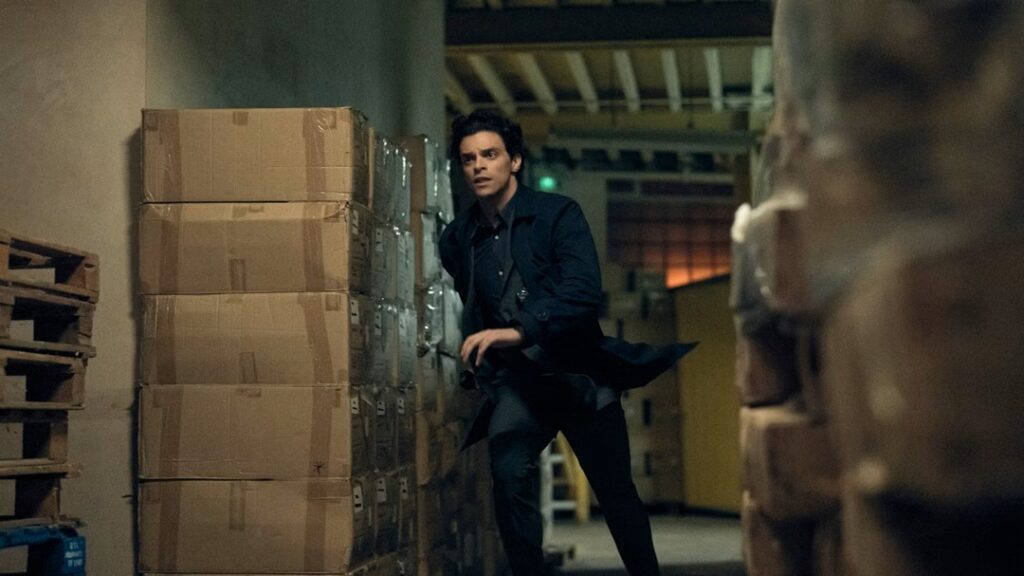
The environments are clean, structured, almost clinical. Offices filled with glass and light replace shadowy interiors. But beneath that clarity lies a persistent unease.
The tension is not visual—it is structural.
Every interaction carries weight. Every decision feels monitored. The openness of the space becomes deceptive, reinforcing the idea that transparency does not equal safety.
This aligns with the evolution explored in How Adolescence Turns Teenage Crime Into A New Form Of Psychological Noir, where modern narratives shift away from visual darkness toward psychological and systemic tension.
When The System Becomes The Villain
Traditional noir often presents corruption as something external—a force to be uncovered or resisted.
Steal removes that distance entirely.
The system itself becomes the antagonist.
The heist exposes layers of financial manipulation, offshore accounts, and hidden networks that implicate individuals far beyond the immediate crime. What initially appears as a singular event expands into a web of systemic corruption, suggesting that the real crime was never isolated.
This transforms the narrative:
- The investigation becomes secondary
- The system becomes the focus
- The characters become reflections of a larger structure
There is no single villain. Only participation.
Streaming Thrillers And The Return Of Systemic Storytelling
The rise of streaming platforms has created space for stories like Steal to exist with greater depth and complexity.
Unlike traditional formats, streaming allows for:
- Extended character development
- Layered narrative structures
- Slow-building tension
Steal uses this space to move beyond the mechanics of a heist and into the consequences of it. The pacing allows the audience to sit with ambiguity, to question motivations, and to recognize how each character is shaped by the system they inhabit.
According to series overview on Prime Video, the show combines high-stakes action with deeper exploration of why such a crime occurs in the first place, reinforcing its dual identity as both thriller and commentary.
Moral Ambiguity Without Resolution
Classic noir often ends with some form of closure, even if it is bleak. Steal resists that tradition.

The narrative leaves questions unresolved. Motivations remain partially obscured. Characters walk away not with answers, but with consequences.
| Narrative Element | Classic Noir | Steal |
|---|---|---|
| Resolution | Partial clarity | Lingering ambiguity |
| Justice | Delivered or subverted | Diffused across system |
| Protagonist Outcome | Defined | Open-ended |
| Moral Clarity | Blurred but present | Constantly shifting |
This refusal to resolve reflects the reality of the systems it portrays. Financial corruption is not easily contained. Its effects ripple outward, beyond the scope of any single story.
The New Face Of Noir Power
What Steal ultimately reveals is that noir has not lost its relevance—it has relocated its focus.
Power is no longer concentrated in individuals alone. It exists in structures, in systems, in networks that operate quietly and efficiently.
- The crime is larger
- The stakes are broader
- The consequences are harder to define
The darkness hasn’t disappeared. It has scaled.
The Quiet Violence Of Modern Systems
In the end, Steal reframes what violence looks like in noir.
There are still guns, threats, and moments of physical danger. But the most unsettling element is something less visible:
The quiet violence of systems that shape behavior, limit choice, and normalize compromise.
The characters are not just reacting to a crime. They are navigating a reality where the line between survival and complicity is almost impossible to define.
And in that space, noir finds its modern form—not in shadows, but in structures.