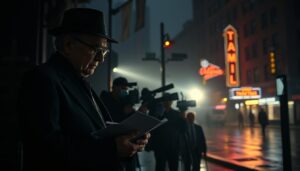
Forget the roar of the crowd. The real story in sports cinema often starts when the stadium lights go out. We’re talking about the genre of sports noir—where the game is just a prelude to the psychological unraveling.
Where does this drama fester? Not on the field, but in the aftermath. The locker room becomes the central set piece, a conflicted heart where victory feels hollow and defeat stains the tiles.
Think of Scorsese’s *Raging Bull*. That space isn’t for celebration; it’s a holding cell for Jake LaMotta’s crumbling psyche. The steam, the silence, the flickering fluorescent light—it’s all a visual language of dread.
This is the work of the production designer, the unsung psychiatrist of film. They build confessional booths out of benches and liminal spaces from shower stalls. Even an AI prompt for a “luxurious gym” locker room—with a discreetly lit mirror and a fallen robe—hints at narratives of vanity and exposure.
Let’s pull up a stool in the corner and analyze the blueprint. We’re here to dissect how these spaces are engineered to tell stories of grit, decay, and moral ambiguity.
The Locker Room as Confessional Booth
The production design of a sports noir locker room is like a space for deep talks. It’s not like a church or a therapist’s office. Here, you find truth in the sound of sneakers and the slam of locker doors.
This isn’t just about looks. It’s about how it makes you feel. The long lockers guide your eyes to yourself. The bench is for thinking, not just sitting.
Think of Robert Ryan in The Set-Up. He’s caught in a moment of truth, like a mirror reflecting his life. The locker room is where dreams meet reality.
Locker rooms in teen movies are bright and full of hope. But in sports noir, they’re dark and honest. Here, success is just a memory, covered in old tape.
What makes this production design a confessional? It’s the lack of escape. No windows, few doors. Secrets are hard to keep here. The shadows and dim light make you face your fears.
This place forces you to be honest. On the field, athletes show off. But in the locker room, they’re real. They shed their masks, revealing their true selves.
The table below shows how different spaces work as confessionals. The locker room’s tools are unique and worn.
| Confessional Space | Visual Language | Psychological Function | Iconic Example |
|---|---|---|---|
| Church Booth | Dark wood, lattice screen, candlelight | Anonymous moral reckoning | The Godfather (Baptism/confession parallel) |
| Sports Noir Locker Room | Metal lockers, steam, low-key lighting, tile | Physical & moral exhaustion; truth in isolation | Raging Bull (Jake LaMotta alone post-fight) |
| Police Interrogation Room | One-way mirror, stark table, bright overhead light | Coercion and power imbalance | Any Law & Order episode |
| Therapist’s Office | Books, comfortable chair, tasteful decor | Guided self-revelation | The Sopranos (Tony’s sessions) |
The beauty of this production design is its truth. It feels real because it smells like sweat and looks like scars. It’s not for easy answers but for hard questions.
So, when you see a character on a locker room bench, listen. They’re not just tired. They’re sharing their truth. The design makes sure of it.
Materials that Photograph Well in Low Key (tile, metal, wood)
The production designer’s palette for sports noir includes tile, metal, and wood. These materials add drama to the story. Each one interacts with light in a unique way, making shadows part of the narrative.
Tile is cold and glossy, perfect for showing off a clean gym. But under a single bulb, it becomes a place of judgment. Its shine creates harsh reflections, making every step feel tense.
Metal, like lockers, is a key part of the set. It’s hard and shows history through every dent and scratch. In low key lighting, metal breaks light into sharp highlights, adding tension to the scene.
When an AI image prompt asks for a “metallic locker,” it taps into our visual language. It’s cool, impersonal, and slightly dangerous. The algorithm has learned to create images that feel alienating.
Wood, found in older gyms, adds a sense of decay. It warps and stains over time, telling a story of its own. Under low-key lighting, wood’s grain maps out a history, showing a slow decline.
Together, tile, metal, and wood create a world where light behaves dramatically. Every surface has a role, making the environment a character in itself.
Choosing materials for sports noir is about psychology, not just design. The right textures tell us how to feel before the story begins. They set the tone: cold, hard, and haunted by the past.
Aging and Patina: Rust, water stains, decals, tape
Patina isn’t just a flaw; it’s the story’s text, written in rust and water damage. Unlike the shiny locker rooms of inspirational sports films, sports noir shows the dark side. It’s about looking lived-in by years of disappointment.
Think of it as urban archaeology. Every stain is a fossil. Every patch of rust is a slow-burning confession. The designer curates decay, adding history’s fingerprints.
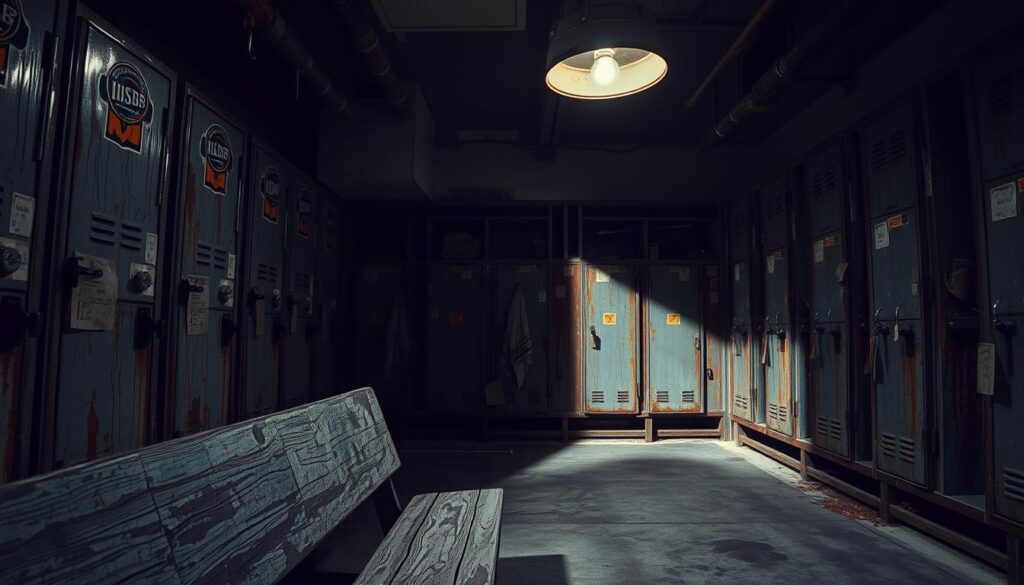
Rust isn’t just oxidation; it’s a visual sign of chronic injury. It spreads from a leaky shower, showing a system’s failure. On a locker hinge, it hints at a career left behind.
Water stains on ceilings are fascinating. They’re like Rorschach tests of neglect. Each stain tells a story of ignored problems and budget cuts.
Decals and stickers reveal the “ghosts in locker rooms.” A peeling logo or a faded sticker tells of lost dreams. They’re the opposite of the bright, youthful decorations of Y2K.
Tape is brutally honest. Athletic tape holds a door together after a punch. Duct tape fixes a bench, showing quick, lasting solutions. Each strip is a bandage on the environment.
The table below shows how each element of patina tells a story, not just decorates a set:
| Patina Element | Visual Character | Narrative Symbolism | Practical Application Tip |
|---|---|---|---|
| Rust | Orange-brown corrosion, textured, creeping | Systemic decay, neglected talent, chronic issues | Use iron oxide powders wet-applied to metal; focus on joints and seams. |
| Water Stains | Amorphous yellow-brown blooms, concentric rings | Hidden leaks (literal & metaphorical), unresolved past, looming consequences | Layer diluted sepia ink & coffee stains on tile or plaster; blend edges softly. |
| Peeling Decals | Cracked vinyl, faded colors, curled edges | Lost glory, abandoned loyalty, the “ghost” of past success | Partially scrape away real decals; use heat gun to curl edges authentically. |
| Tape Residue | Gummy, discolored outlines, frayed ends | Temporary fixes, lingering injuries, make-do mentality | Apply duct tape, remove after weeks, leaving adhesive ghost; add grime. |
| General Grime | Darkened grout, oily fingerprints, dust cakes | The accumulation of effort, the sweat of the grind, unseen labor | Mix matte finish dust (Fuller’s Earth) with a slight grease sheen for benches. |
This patina creates “textural authenticity.” The camera feels the grit. Light catches the sheen of old varnish and warped wood.
The goal is to avoid a “distressed but clean” look. Real aging is chaotic and layered. New tape over old rust. A fresh stain cutting through a vintage decal.
So, embrace the leak. Worship the rust. Let the tape peel. In sports noir, this patina is the most eloquent dialogue your set will ever speak.
Practical Lights that Motivate the Look
Forget the glamour of Hollywood – in sports noir, the real star is a flickering fluorescent tube. This is where we uncover the magic. It’s all about motivation. A practical light is a real object that does a job in the scene. The trick is making its harsh glow seem inevitable.
Think of the buzzing lights in a boxing gym. In Body and Soul, these lamps don’t just light up the fight. They question the fighter. Every punch is thrown under harsh, interrogation-room lighting. It’s clinical and exposing, with no place to hide. This is practical lighting with a purpose beyond just seeing.
The toolkit for this includes classics. A flickering fluorescent tube in a back hallway sets a rhythm of anxiety. A single, naked bulb over a steam-clouded mirror creates a lonely spot for reflection. A shaded wall sconce casts long, dramatic shadows that stretch like accusations across wet tile.
Even environmental elements become light sources. Steam from a shower doesn’t just obscure; it catches and diffuses light. This creates a hazy, ethereal glow that reveals as much as it conceals. It’s nature’s own diffusion filter, turning harshness into mystery.
This principle isn’t just for the 1940s. Consider the AI prompt for a “direct on-camera flash with a grainy Y2K magazine look.” That’s the same idea! A specific, motivated light source (the camera’s flash) creates a specific texture (the grain) and a precise emotional response. One feels like a surveillance photo. The other feels like a found, nostalgic snapshot. Both are meticulously designed artifacts of light.
And what about that “discreetly lit mirror” from the prompt for a luxurious gym? That’s Film Noir 101. A solitary pool of light in a sea of darkness. It doesn’t invite a casual glance. It demands a fraught moment of self-reflection, where a character must confront what they’ve become. The light isn’t friendly. It’s a witness.
| Practical Light Source | Emotional Effect | Cinematic Function | Real-World Example |
|---|---|---|---|
| Flickering Fluorescent Tube | Anxiety, instability, institutional neglect | Establishes rhythm and unease; mimics a failing system | Back hallway of a municipal ice rink |
| Bare Bulb Over Mirror | Isolation, brutal honesty, self-confrontation | Creates a “confessional booth”; highlights facial drama | Old boxing gym locker room |
| Shaded Wall Sconce | Mystery, partial revelation, dramatic shadow play | Directs viewer’s eye; sculpts actors with chiaroscuro | Private athletic club hallway |
| Steam-Diffused Overheads | Obscured truth, memory, ethereal ambiguity | Softens harsh reality; creates visual texture and depth | Community center shower room post-game |
| Direct On-Camera Flash | Surveillance, nostalgia (Y2K), stark exposure | Flattens the image; creates a “found footage” aesthetic | Late-90s documentary or paparazzi shot |
The table above isn’t just a checklist. It’s a menu of mood. Choosing the right practical lighting is like casting the right actor for a supporting role. That sconce needs to convey menace. That buzzing tube needs to scream bureaucratic decay. The motivation must be baked into the set itself.
So the next time you’re scouting a location, don’t just look at the space. Look at the lights already there. That broken exit sign glowing red in the corner? That’s not a safety violation. That’s a mood. The under-cabinet light in a trainer’s office? That’s a spotlight for a clandestine meeting. This approach to practical lighting transforms set decoration into active storytelling. The light isn’t added. It’s revealed. And it always has something to say.
Spatial Storytelling: Benches, hooks, steam, mirrors
The locker room is more than a set; it’s a psychological battlefield. Here, production design turns empty space into emotional landscapes. Every element shapes the story, influencing the characters and their actions.
Bench arrangements reveal much. Parallel benches show isolation, while circular ones suggest forced unity. The space between benches measures trust or distrust. In sports noir, no one feels at ease.
A single hook on a wall is a powerful symbol. It contrasts with rows of hooks, showing community versus loneliness. This single hook tells a story of abandonment, leaving the character isolated.
Steam in the locker room hides and reveals truths. It symbolizes change, from clean to dirty, hopeful to defeated. The steam acts like a curtain, controlling what we see and understand.
Mirrors in locker rooms are dangerous. They show the true self, often a darker version. In Raging Bull, the mirror reflects a monster, not a man. The production design makes this mirror a key element, revealing flaws and doubts.
Understanding spatial psychology is key in film and real locations. It informs how we design spaces, even public areas. The ADA guidelines also play a role in this, ensuring spaces are accessible and well-designed.
Every bench, hook, and mirror plays a role in the story. They don’t speak, but their presence is felt. The journey from shower to locker is a metaphor, guided by the production design team. The locker room’s layout is not just a backdrop; it is the story itself.
Prop Sound: Lockers, snaps, wraps, tape tears
The true feel of a space isn’t just felt with our hands. It’s heard in the echoes that stay long after the lights go out. Visual design gives us the set, but sound design provides the psychological weather. In sports noir, this weather is always tense—a low-pressure system of anxiety where every sound means something.
Think about the locker room’s sound. The clang of a locker door isn’t just for opening. It’s a sign of something ending, like a cell door slamming shut on hope. That sound is heavy. It’s final. In a place full of tile and metal, it echoes like a guilty conscience.
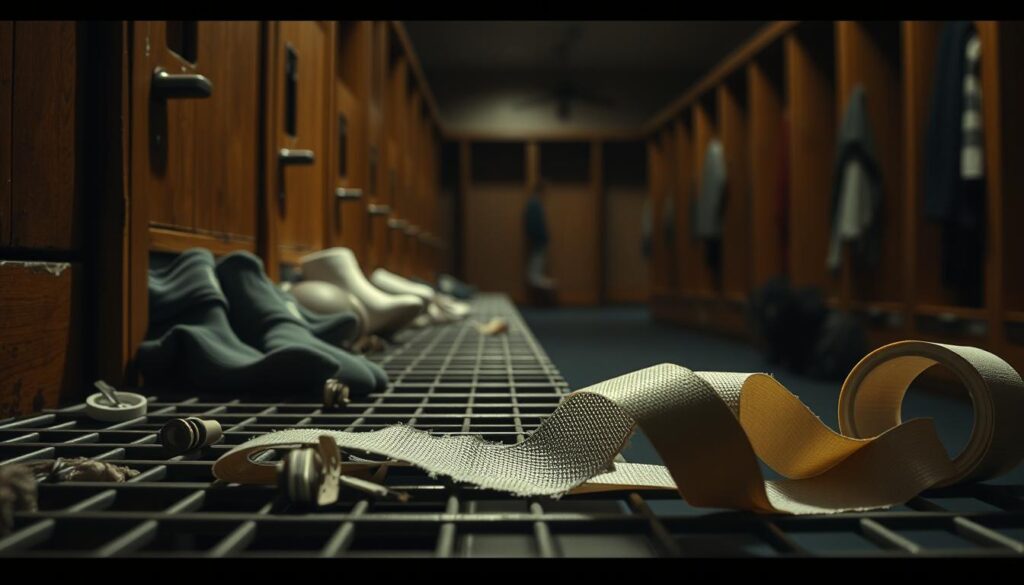
Then, there are the small, personal textures of sound. The sharp snap of an elastic waistband or athletic tape. It’s a shock. A signal for violence or getting ready. Listen to the wrapping scenes in Million Dollar Baby or The Wrestler. The tape doesn’t just hold things together—it ties fate. The sound is like a ritual, almost sacred.
The slow, deliberate tear of that tape being removed? That’s a release. A character shedding their protection, their identity, their last defense. These aren’t just sound effects. They’re emotional textures woven into the story.
Great production designers think like composers. They don’t just ask, “What does this prop look like?” They ask, “What does it sound like when our protagonist interacts with it?” This teamwork with the sound team is where the magic is. It’s where a simple step in a damp alley—amplified, layered, treated—turns into a heartbeat. Or a gunshot.
The locker room’s design is like an instrument itself. Hard surfaces like ceramic tile, metal lockers, and concrete floors create a cold, live echo. There’s no warmth here. No comfort in the sound. Every small sound gets louder. Every sigh is a statement. Every dropped towel sounds like a body hitting the floor.
This is the aural patina—the heard history of the space. The echoes of countless games, losses, victories, and secrets. That squeaky hinge on locker #24? It’s a character. The uneven drip from showerhead #3? It’s a countdown to something bad.
When looking for locations, I bring headphones. Not to listen to music, but to listen to the room when it’s empty. What’s its natural echo? Where do sounds gather? How does the space respond to noise? A gym might swallow sound, but a locker room throws it back at you—harder, colder, more accusing.
The best sports noir knows that suspense is in the silence between sounds. The tense quiet before the tape snap. The held breath after the locker slam. It’s like chiaroscuro—darkness and light, silence and noise, creating depth, tension, and those delicious psychological textures.
So next time you’re designing a scene, close your eyes. Listen to your props. What story does that metal bench tell when someone sits on it? What confession does that peeling tape make as it’s removed? The answers aren’t in the script. They’re in the sonic textures you choose to highlight—or to hauntingly withhold.
Wardrobe & Sweat: Fabric sheens for light play
Costume design in a locker room is all about physics. It’s how materials react with light, moisture, and urgency. What an actor wears is like a personal set design.
The walls set the mood, but clothes define the character. A cheap satin robe, like Jake LaMotta’s in Raging Bull, makes him look both flashy and vulnerable. It reflects light like a beacon.
On the other hand, a simple cotton towel absorbs light and sweat. It becomes heavy and dull. This choice is deliberate, showing the contrast between two textures.
Modern AI image generators get this. They don’t just ask for “a robe.” They specify “a shiny pink satin corset” or “sweat-slicked satin sheets.” They aim for a specific look that suggests luxury or vulnerability.
In sports noir, satin’s sheen tells a different tale. Under harsh light, it shows desperation, not luxury. The fabric is the same, but the context changes everything.
Sweat on skin is the ultimate texture. It shows a person’s stress and effort. It’s a truthful expression, more than words can say.
Your fabric choices should talk to your lighting. A matte cotton jersey hides a character’s shape. A shiny nylon athletic short shows every muscle. This is the language of textures, and everyone in a locker room speaks it.
The key lesson is simple yet deep. Don’t just dress your characters. Armour them in texture. Let fabrics tell the story that words can’t. In the end, textures often say the most.
Safe Moisture & Atmos: Condensation without chaos
Creating atmospheric moisture on a film set is tricky. You want the feel without the mess. Too little, and it’s too dry. Too much, and it’s a sauna scene gone wrong.
This isn’t about making things wet. It’s about making them feel wet. Think of the hazy mirror in Raging Bull or the steam in Any Given Sunday. That patina shows the room’s history.
To create this feel, we use simple tools. Fog machines are a start, but they’re too uniform. We need diffusion and containment.
Glycerin is key. A few wipes on a surface create perfect condensation. It looks like sweat without the effort. This is where the patina shines.
Light also plays a role. Moisture in the air changes how light behaves. It creates soft shadows and god rays. This makes the room feel heavy.
The goal is to tell a story with the environment. A fogged mirror says someone left. Beads on a pipe show a failing system. A haze tells of exhaustion. Each adds to the story patina without being loud.
Remember, moisture sets the mood in sports noir. It’s like a sigh. Get it right, and the audience feels it. Get it wrong, and it’s a big mistake.
Real‑World Scouting: Gyms, rinks, community centers
Forget green screens for a moment. A good pair of walking shoes and a willingness to explore are key. You’re not just finding a locker room. You’re uncovering a set with a rich history, told in water stains and faded decals.
The best digital set extension starts with a real, tactile foundation. Why paint patina when you can rent it for fifty bucks an hour? A savvy production design approach treats scouting like fieldwork. You become an anthropologist of atmosphere, cataloging the un-fakeable.
Is it the prison-block windows of a 1970s high school gym, casting perfect jailbar shadows across the tile? Or the cold of a municipal ice rink, where the chill seems baked into the concrete? These places are goldmines. They provide details no prop master can fully replicate.
Think of it as the physical counterpart to what an AI prompt engineer does. They scout cultural memory for “abandoned Y2K internet cafe” or “opulent 1980s health club.” We scout the physical world for its tangible fragments. Both are acts of intense curation, building a believable world from found artifacts.
Not all real-world locations are created equal, though. The value lies in their specific, often inconvenient, truths.
| Location Type | Key Atmospheric Detail | Scouting Challenge | Production Design Value |
|---|---|---|---|
| High School Gym (Pre-2000s) | Peeling championship decals, graffiti-carved benches, distinct acoustics from cinderblock. | Limited access during school hours; modern safety updates. | Authentic adolescent angst & institutional decay. The patina is earned, not applied. |
| Municipal Ice Rink | Constant low hum of compressors, condensation on concrete, a permanent, damp cold. | Extreme temperatures, scheduling around public skates. | Unbeatable sense of isolation and physical hardship. The environment is a character. |
| Community Center / Rec League | Mismatched lockers, outdated safety posters, the smell of industrial cleaner over sweat. | Clutter, bright & cheerful modern paint overs old layers. | The “everyman” aesthetic. It feels lived-in by countless anonymous bodies, perfect for noir. |
The magic is in the friction. A door that doesn’t quite latch becomes a source of suspense. A flickering bulb in a long hallway motivates a light cue. That outdated, mustard-yellow soap dispenser is a period-accurate prop you didn’t have to source.
So, the next time a script calls for a gritty, atmospheric locker room, skip the pure studio build first. Go scouting. The most compelling production design often begins not on a drafting table, but in a slightly depressing, wonderfully authentic municipal basement. The story is already there, waiting in the rust and the echo. Your job is just to frame it.
Case Studies: Iconic locker scenes and why they work
Let’s dive into three iconic scenes. Each shows how the locker room is more than a place. It’s a character, a confessional, and a crime scene.
Martin Scorsese’s Raging Bull has a post-fight scene lit like a Caravaggio painting. Jake LaMotta sits alone in a pool of light, his brother in shadow. The scene feels like a betrayal. This is thanks to a single overhead bulb, used for interrogation, not just lighting.
Robert Wise’s The Set-Up makes the locker room feel like a countdown. As the fight time gets closer, the space gets smaller and feels tighter. The lighting is harsh, like a police lineup. Every detail in the room tells a story of a life worn down.
John Huston’s Fat City shows Stockton’s locker rooms as symbols of lost dreams. The grime is not just decoration; it’s the mark of hard work. The practical lighting here seems to barely hold back the darkness.
These scenes succeed because they tell the emotional truth. Every detail, from the materials to the lighting, helps tell the story. They’re lessons in how to use the environment to tell a story. The toughest battles in sports noir often happen in the quiet, dark locker rooms.