Let’s be honest. You’re not here for a basic tutorial on staging a scuffle. You’re here because you’ve felt the difference.
You’ve seen a conflict that lands with the thud of a philosophical argument, not the slap of a wet noodle. Think of the balletic precision in John Wick, the raw, tribal desperation in The Warriors, or the psychologically charged shove in A Streetcar Named Desire.
This is about the visual grammar of impact. It’s the syntax of a punch, the punctuation of a fall, and the narrative weight of a blocked attack. We’re moving past simple violence into the realm of moody drama, where every movement tells a story.
True theatrical power—whether on stage or screen—isn’t about fake blood. It’s about channeling raw energy into disciplined, collaborative artistic expression. It’s about transformation.
So, how do you choreograph a moment that pops with meaning, not just motion? This is your playbook. We’re dissecting how to build conflict that resonates in the gut, using the fundamental tools of theater itself.
Introduction to Fight Choreography
Fight choreography is a vital part of filmmaking, blending physical action with storytelling. It’s a craft that requires a deep understanding of both the physical and emotional aspects of combat. This art form is essential for creating believable and engaging fight scenes.
What is Fight Choreography?
Fight choreography involves designing and executing the physical actions in a scene. It’s a blend of martial arts, dance, and acting, ensuring that every punch, kick, and movement is both realistic and visually appealing. This process is critical in creating a believable fight scene that enhances the overall narrative.
Importance in Filmmaking
In filmmaking, fight choreography plays a significant role in capturing the audience’s attention and emotional investment. A well-choreographed fight scene can elevate the entire film, making it more memorable and impactful. It’s not just about the physical actions but also about the emotional depth and storytelling that these scenes convey.
By integrating fight choreography effectively, filmmakers can create a more immersive experience for viewers, making the story more engaging and emotionally resonant.
Pre‑vis: Boards, stuntvis, lens plans
Pre-vis is like the first fight without blood. It’s where the director, DP, and stunt coordinator plan everything out. They use pencils and pixels to avoid chaos and ensure safety.
This planning is key to a successful scene. It’s not about just doing things and hoping for the best. That can lead to injuries or a scene that looks amateurish.
Pre-visualization is like a strategic plan. It has three main parts: the story, the practical aspects, and the emotional feel.
- Storyboards outline the story flow. They help decide what to show and what to leave out. It’s like a comic-book version of your scene, focusing on the story.
- Stuntvis deals with the practical side. It ensures that stunts are safe and workable. It’s about making sure actors are safe and stunts are feasible.
- The Lens Plan sets the mood. It decides how the camera will capture the scene. This is where camera blocking is planned, setting the emotional tone.
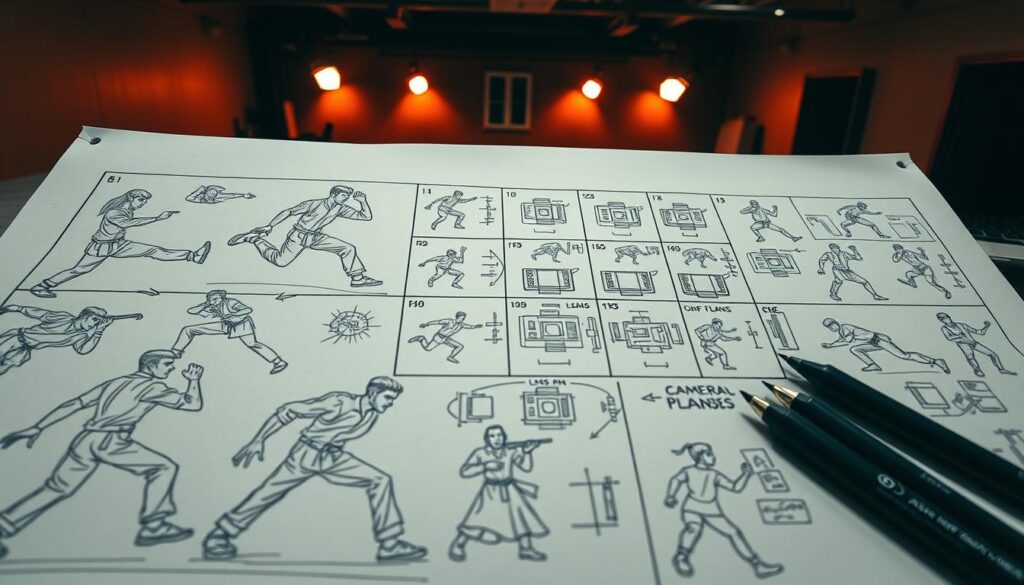
Choosing a 35mm lens makes scenes feel close and personal. A 135mm lens makes things feel aggressive and up close. The lens plan helps decide the right camera angle for the mood you want.
This planning gives you freedom on set. Director Emanuella Amichai says a good plan lets her be flexible. She can make changes or improvise if needed.
Without a solid plan, you’re just filming a fight. With one, you’re creating a memorable scene.
Camera Positions that Read Power (low, off‑axis, over‑shoulder)
In moody drama, the lens picks sides before the fight starts. The camera is not just recording; it’s presenting a case. Where you place the tripod is your first argument.
The low-angle shot is cinema’s strongest move. It makes your character seem like a giant, a force of nature. This angle shows power, not just dominance. It turns a boxer into a giant or a villain into a storm.
The off-axis, or Dutch tilt, shakes things up. It’s not just a weird frame; it’s a shake-up. The world seems off-kilter, like your character’s mind or the chaos of the fight. It’s great for a bar fight or when a hero’s beliefs are shaken.
The over-the-shoulder shot is powerful, not just for dialogue. In fights, it makes you feel like you’re part of it. Looking over the aggressor’s shoulder makes you feel like you’re with them. Looking over the victim’s shoulder makes you feel their fear.
These choices are the heart of your editorial rhythm. A mix of low and high angles shows power and defeat. It’s like a visual debate, the syntax of your scene.
Choosing the right camera angle is like picking the right verb. “Loom” and “tower” mean different things. “Cower” and “crumple” do too. Each angle is a word in your visual language. Arrange them well, and your edit will flow smoothly.
Cutting on Motion vs Holding for Dread
The real battle for your fight choreography isn’t in rehearsal. It’s on the NLE timeline, where two editing styles clash. The editor is like a conductor, guiding the final performance. If they mess up, the pacing can feel slow and the tone shifts awkwardly.
So, which rhythm do you choose? The editor has two main tools: cutting on motion or holding for dread. Your choice sets the scene’s mood.
The Philosophy of Cutting on Motion
This method uses the flow of violence. You cut the edit right when a fist hits, a body spins, or a weapon moves. This makes the scene feel fast and intense.
Think of the Bourne trilogy or Casino Royale‘s start. The action is thrilling, even if the setting gets fuzzy. The audience feels the impact without thinking. For this, your fight choreography must have clear, decisive moves.
On the other hand, you can use the power of pause. The camera doesn’t follow the punch; it stays on the person’s face. Or it lingers on the empty space after someone is thrown out of frame. This builds tension and dread.
David Fincher and the Coen Brothers are experts at this. Their scenes are heavy with tension. Your fight choreography needs to create strong, silent moments. A glance, a flinch, or a slow realization can hold the audience’s attention.
Bad adaptations mix these styles without reason. This creates a jarring feel. Your edit needs a consistent rhythm.
| Aspect | Cutting on Motion | Holding for Dread | Primary Emotional Effect |
|---|---|---|---|
| Pacing | Fast, propulsive, rhythmic | Slow, deliberate, suspenseful | Excitement vs. Anxiety |
| Editor’s Cue | The apex of physical action | The moment of reaction or anticipation | Kinetic energy vs. Emotional weight |
| Choreography Focus | Clean, dynamic movement arcs | Expressive faces & body language in silence | Fluidity vs. Intensity |
| Audience Experience | Visceral, “in the fight” sensation | Observational, consequential dread | Immersion vs. Contemplation |
| Risk if Misused | Becomes confusing, geography is lost | Becomes boring, pace drags | Chaos vs. Stagnation |
So, how do you decide? It depends on the story. Is it about skill and survival (motion), or power and consequence (dread)? A bar fight might be about motion, while a back-alley confrontation is about dread.
The best approach is to plan for both. Give your stunt team and actors material for both fluid motion and powerful pauses. This is why the best fight scenes are choreographed three times: by stunt coordinators, by the DP, and by the editor.
Your timeline is your last chance to direct the performance. Choose your tempo wisely. Will you make the audience flinch with a cut, or squirm with a hold? Great fight choreography isn’t just about what happens between “action” and “cut.” It’s about what happens between the frames.
Slow‑Mo and Ramp Timing: When to deploy
Slow-motion is like saffron—it’s expensive and powerful. But, it can ruin a scene if used too much. It’s like shouting in a library, effective but embarrassing if done for too long.
Slow-mo is a precise tool, not a simple trick. Use it to reveal what normal speed conceals. Show a character’s doubt, the exact moment something breaks, or the story of impact in blood droplets.
The when you use it is key. Use it for epic moments, like Neo dodging bullets. Or for the harsh reality of a broken jaw. Never just because the action isn’t exciting enough.
The magic happens in the ramp, the speed transition. A sudden drop feels gimmicky. But a smooth ramp, tied to a character’s feelings, is powerful.
Think of a slow-mo punch as showing the anticipation or the shock after. The ramp makes this shift in perspective feel real.
Good camera blocking is essential for slow-mo. It makes every shaky move or bad frame stand out. You’re creating a moving painting that viewers will study.
Consider these tactics:
| Scenario | Effective Slow-Mo Approach | Ineffective Approach | Why It Works/Fails |
|---|---|---|---|
| Revealing a Critical Detail | Brief, isolated slow-down on a specific object (a key dropping, a safety switch flipping). Smooth ramp in and out. | Slowing the entire scene for 10 seconds with no narrative payoff. | Focuses audience attention like a spotlight. The ineffective version dilutes importance and bores viewers. |
| Mythologizing a Character | Slow-mo on their movement during a skill display, often with a slight speed-up (ramp) into the action. | Slowing down every punch and kick in a fight sequence. | Creates a “power moment” that defines capability. Overuse makes the character seem slow, not skilled. |
| Showing Subjective Experience | Gradual slow-down as a character enters shock or adrenaline overload. Sound design muffles; focus softens. | Abrupt cut to slow-motion with no change in audio or visual perspective. | Ramp mimics the brain’s processing. The jarring cut feels like an editor’s choice, not a character’s reality. |
| Emphasizing Impact | Slow-mo on the moment of contact and immediate aftermath (flying debris, facial reaction). | Slow-mo on the wind-up or approach to the impact. | Highlights consequence and physics. Slowing the approach kills momentum and suspense. |
The table shows that good slow-mo is specific, motivated, and brief. It should serve the story, not the director’s ego. Your camera blocking for these moments must be perfect. Plan for extra lighting and rehearse the movement well.
Remember, the audience’s patience is limited. We’ve seen many video game “fatality” animations. Use slow-mo with precision, not like a kid with a new filter. Make them lean in, not check their phones.
When the ramp is right and the camera blocking is purposeful, slow-motion is more than an effect. It becomes insight. It turns action into poetry. And isn’t that what we’re all here for?
Sound Bridges that Glue Punches to Memory
The difference between a forgettable scuffle and a memorable brawl often comes down to sound bridges. They’re like auditory magic tricks. We’re not just watching a fight; we’re being orchestrated through it by a conductor we can’t see.
If the visuals are the fist, the sound is the knuckle-crack before and the grunt after. Great sound design doesn’t just accompany a fight; it constructs the reality of the impact. A sound bridge is that magical edit where a sound from the next shot sneaks in a hair early. The whoosh of a swing begins on the close-up of a clenched jaw, then we cut to the wide shot where the punch lands.
This isn’t a mistake. It’s deliberate editorial rhythm. It makes our brains do the work of connection, creating a seamless flow that feels more real than reality. We anticipate the hit because we hear it coming. The cut confirms what we already felt in our gut. It’s primal storytelling.
Now, let’s peel back the layers. A generic “thwack” from a sound library will kill even the most beautifully choreographed punch. It’s the cinematic equivalent of serving gourmet food on a paper plate. The magic is in the specificity:
- The Foley: Not just a body hitting the floor, but a body hitting this particular floor—wood, concrete, linoleum? Each has its own sonic fingerprint.
- The Cloth Rustle: The shift of a leather jacket, the tear of a cotton shirt. These are the sounds of effort and resistance.
- The Atmospheric Bleed: The distant traffic, the hum of a fridge, the drip of a leaky faucet. The world doesn’t go silent because two people are fighting.
- The Human Sounds: The sharp intake of breath, the guttural effort, the choked-off cry of pain. This is where consequence lives.
When these layers sync up with the cut, you achieve that hypnotic editorial rhythm. The sequence stops feeling like a series of shots and starts feeling like an inevitable, terrifying dance. It’s the reason the fights in Warrior or Eastern Promises feel like they leave bruises on your soul.
Consider the alternative: stage-to-screen adaptations often falter here. The sound design remains theatrical—supportive but not cinematic. It treats sound as decoration, not architecture. On screen, that approach leaves the action floating in a vacuum, emotionally weightless.
A glancing blow with a layered, visceral soundscape can feel more devastating than a clean hit with weak audio. Sound is the memory glue. We might forget who threw the punch, but we’ll remember the sickening crunch that sold it. That’s the power of a well-built editorial rhythm—it doesn’t just show you a fight; it makes you carry it home with you.
Using Obstacles: Ropes, posts, boards, benches, ref bodies
Your fight scene’s environment is like a supporting actor that steals the show. A blank white room is just a technical exercise. But add ropes, posts, and debris, and it becomes a story.
Fight choreography turns into storytelling here. Every obstacle makes a character choose. Will the hero defend with the alley post or get slammed against it? Or will the villain get tangled in the ropes or rebound with deadly force?
That wooden bench isn’t just furniture. It’s a weapon, a shield, and even fuel. The referee’s body isn’t just background—it’s a moving danger that changes the fight’s layout. These elements make your audience actively learn.
They’re not just watching punches. They’re reading the environment as part of the conflict. The sound of a body hitting a table tells a story of consequence. A character ducking behind a post shows their resourcefulness or desperation.
Good fight choreography uses the world meaningfully. It sees the space as another character with its own goals. The moody drama you’re chasing lives in these physical interactions. The environment whispers possibilities for every move.
Forget empty spaces. Embrace the clutter. Let the ropes bind and the posts bruise. Your fight will thank you for the company.
FAQ
Q: What is camera blocking?
A: Camera blocking is the art of arranging actors and props in a scene to create the desired visual effect. It involves careful planning and execution to ensure that the camera captures the intended shot.
Q: Why is camera blocking important in filmmaking?
A: Camera blocking is important in filmmaking because it helps create a visually appealing and cohesive scene. It allows the director to control the composition, lighting, and movement of the actors, ensuring that the final shot looks professional and engaging.
Q: How does camera blocking contribute to storytelling?
A: Camera blocking plays a significant role in storytelling by guiding the audience’s attention and creating a sense of tension or intimacy. It helps convey the emotions and intentions of the characters, adding depth and meaning to the narrative.
Q: What are some common camera blocking techniques?
A: Some common camera blocking techniques include the use of framing, composition, and movement. Framing involves positioning actors and props within the frame to create a specific visual effect. Composition refers to the arrangement of elements within the frame to create balance and harmony. Movement involves the use of camera angles and actor movements to create dynamic and engaging shots.
Q: How does camera blocking enhance visual storytelling?
A: Camera blocking enhances visual storytelling by creating a visually appealing and cohesive scene. It allows the director to control the composition, lighting, and movement of the actors, ensuring that the final shot looks professional and engaging. By carefully planning and executing camera blocking, filmmakers can create a visually stunning and immersive experience for the audience.
Q: What are some tips for effective camera blocking?
A: To achieve effective camera blocking, it is important to have a clear understanding of the scene and the desired visual effect. The director should work closely with the actors and crew to ensure that everyone is on the same page. It is also important to consider the lighting and composition of the scene to create a visually appealing and cohesive shot.
Q: How does camera blocking contribute to the overall success of a film?
A: Camera blocking plays a vital role in the overall success of a film. It helps create visually appealing and cohesive scenes, enhances visual storytelling, and contributes to the overall mood and atmosphere of the film. By carefully planning and executing camera blocking, filmmakers can create a visually stunning and engaging cinematic experience for the audience.
Checklists for Director/DP/Editor/Stunt Team
Theory is theater without an audience. Execution is the show. A fight scene needs all departments working together. Forget hoping for magic. Work the checklist.
Director, your job is to make things clear. What’s the story’s purpose? Is it about character, power, or tension? Have you told everyone what you want?
DP, you use light and shadow to tell the story. Does your camera setup show the power struggle? Are your lenses chosen for emotional impact?
Editor, you set the final rhythm. Have you worked with the director on the timing? Are your sound bridges ready to enhance the impact? Do you have the right shots to control the pace?
Stunt team, you make the physical part real. Is your choreography safe and ready for cameras? Does it show the story beyond just the action?
When these lists match, you’re not just staging a fight. You’re creating the visual language of conflict. The theory ends, and the show begins.