Imagine a fighter’s gloves shining under sickly arena lights. His sweat and blood mix, showing his ambition and downfall. Martin Scorsese’s 1980 film, Raging Bull, doesn’t just tell Jake LaMotta’s story. It mixes boxing with film noir, creating a powerful mix.
This film isn’t like Rocky’s story of overcoming odds. It’s more like Chinatown but with a mouthguard. It’s a film that shows the dark side of ambition.
Robert De Niro’s performance in Raging Bull is unforgettable. He turns LaMotta into a noir hero, like Sam Spade. Film scholar Marc Raymond says Scorsese’s skill is in mixing the violence of boxing with personal struggles.
Those close-ups in the locker room? They show LaMotta’s deep fears. It’s like his sweat is his worries turning into reality.
This film is a masterpiece of noir sports movies. Scorsese uses a fatalistic rhythm in every punch. The film’s dark scenes make the boxing ring a prison for LaMotta.
Forty years later, Raging Bull is a mix of genres. It’s not about winning or losing. It’s about the lasting impact of our mistakes.
Introduction and Film Legacy
Raging Bull is not your typical sports movie. When it first came out in 1980, critics were shocked. They said it was too harsh and lacked triumph.
But today, it’s celebrated in film schools and by critics. It’s a comeback story that even Rocky would admire.
From Critical Pan to Canonization
Film scholar Matthew King said it best: “Scorsese didn’t make a boxing movie – he built a confession booth with ropes.” The director showed the harsh side of LaMotta, making it a sports biopic like a noir detective story. The main character is his own mind.
Here’s what critics said back then and now:
| 1980 Reviews | 2020s Legacy | Cultural Impact |
|---|---|---|
| “A cinematic root canal” (Variety) | #4 AFI’s Greatest Films | Inspired Nolan’s Dark Knight fight choreography |
| “No hero, no hope” (NY Times) | 93% Rotten Tomatoes | Blueprint for Joker‘s psychological descent |
| “Beautiful but bleak” (Roger Ebert) | Martin Scorsese’s personal #1 | 4K restoration grossed 3x original box office |
What changed? We now accept the harsh truth in sports biopics. The moody cinematography that once felt oppressive is now seen as honest. Scorsese’s lighting shows LaMotta’s inner struggle.
Today, we love stories of sweat and regret. Streaming services call it “gritty sports drama.” But true fans see its roots in Body and Soul and Double Indemnity. It’s a film that proved its critics wrong.
The Noir Influence in Raging Bull
Imagine Double Indemnity with boxing instead of insurance fraud. Martin Scorsese’s Raging Bull mixes noir with sweat and Vaseline. It’s a film that blends boxing with Detour-style fatalism, showing that gym shorts can be as heavy as a fedora.
Smoke-Filled Rooms and Moral Ambiguity
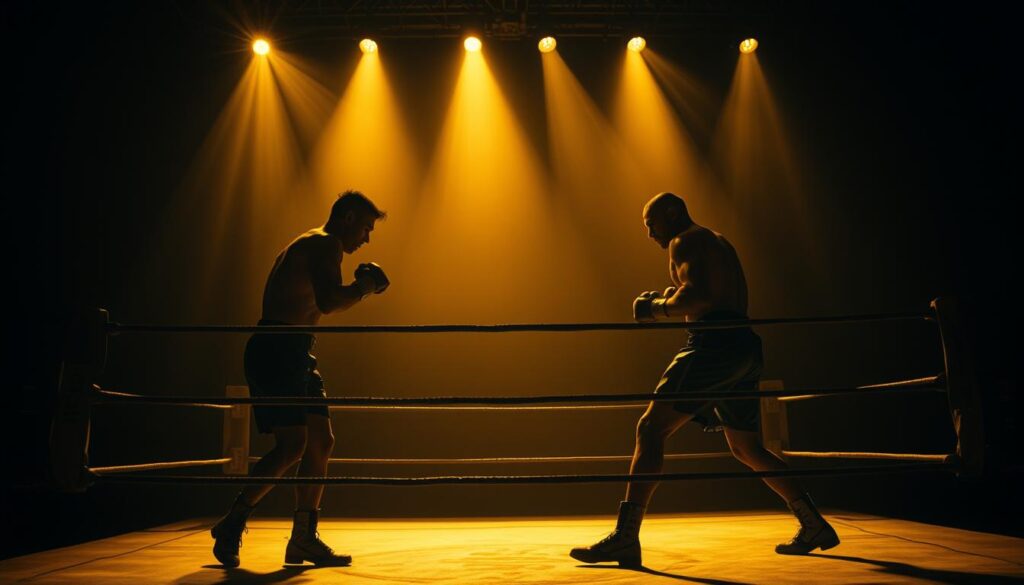
Michael Chapman’s camera makes the boxing ring a confessional booth in hell. Notice how:
- Locker room steam replaces the traditional noir fog machine
- Bloodstained towels serve as Rorschach tests for Jake’s crumbling psyche
- Dutch angles during fights mimic the disorientation of a sucker punch
Marc Raymond’s analysis of Mean Streets shows Scorsese’s early love for sports noir lighting. In Raging Bull, neon signs cut through darkness like accusations. The moral gray areas aren’t just in Jake’s actions but in the air he breathes.
Femme Fatales in Sweat-Soaked Robes
Cathy Moriarty’s Vickie redefines the noir temptress. Forget silk stockings – her weaponized innocence is in a terrycloth robe. She’s a Rorschach test in high heels, reflecting Jake’s paranoia through:
| Classic Noir Femme | Vickie LaMotta | Impact |
|---|---|---|
| Poison-tipped dialogue | Laconic stares | Amplifies Jake’s insecurity |
| Smoke-ring seduction | Ice cube chewing | Creates visceral tension |
| Clear motivations | Ambiguous loyalty | Mirrors noir moral fog |
The Unseen Opponent
Vickie’s greatest trick is becoming the living embodiment of every punch Jake never saw coming. Her slow-motion entrances, lit like Gilda auditioning for a Coppertone ad, turn domestic spaces into battlegrounds. When she adjusts her swimsuit strap at the pool, it has more impact than any right hook Sugar Ray ever threw.
Cinematography: Shadows and Violence
Scorsese doesn’t just film boxing matches; he dissects them under neon lights. Every punch is a stroke, every drop of blood a mark in this brutal dance. Raging Bull turns the ring into a crime scene and a church, where shadows cling to LaMotta’s wrongdoings.
The Brutal Poetry of Fight Choreography
The slow-motion scenes are like a sugar rush. They’re as deliberate as Hitchcock’s Vertigo. Cinematographer Michael Chapman’s camera is part of the fight, not just watching.
- Gloves explode faces in Kubrick-esque symmetrical frames
- Rope burns echo the jagged lines of Edward Hopper’s diners
- Blood mist diffuses light like a Giallo horror filter
This isn’t Rocky’s feel-good story. LaMotta’s 1950 fight against Laurent Dauthuille is different from Champion’s 1949 fights:
| Technique | Raging Bull | Champion (1949) | Modern MMA Docs |
|---|---|---|---|
| Camera Movement | Dervish-like rotation mimicking disorientation | Static wide shots | GoPro intimacy |
| Blood Depiction | Jackson Pollock expressionism | Theatrical ketchup splatters | Clinical HD close-ups |
| Shadow Play | Moral ambiguity through noir lighting | Hero/villain binary | Reality TV flatness |
The real innovation is those strobe-lit close-ups. They link The Killers (1946) to UFC’s Embedded series. Scorsese’s lens shows the true soul of LaMotta through sports movies with noir touches.
Character Study: Jake LaMotta as a Noir Protagonist
If film noir had a boxing gym, Jake LaMotta would be a regular. He sees self-sabotage as a sport. Scorsese’s hero fights his own demons, with every punch hitting him hard.
This isn’t about winning like in Rocky or Million Dollar Baby. LaMotta’s story is like a Stanley Kowalski monologue with punches. The real battle is outside the ring.
Self-Destruction as Sport
De Niro’s LaMotta moves through dark places like Robert Mitchum’s Out of the Past detective. He trades his whiskey for hand wraps. His accusations against his wife are like psychological body shots.
The film makes us want to see him fall. It turns fights into survival battles.
King’s work on white working-class anxiety hits hard. LaMotta’s jealousy is about more than sex. It’s about money, territory, and existence.
Scorsese shows LaMotta’s parties as crime scenes. The champagne flows like blood, with every laugh filled with desperation.
This is sports noir lighting at its worst. Harsh lights make LaMotta’s face look like a prison. The boxing ring is like a dark alleyway, lit by the glow of lost dreams.
In classic noir sports movies, Raging Bull is unique. It shows sports as a life sentence. LaMotta isn’t chasing a title; he’s running from the truth that winning doesn’t matter.
The biggest blow is seeing yourself in his reflection. It’s sweaty, blood-streaked, and real.
Iconic Scenes and Visual Motifs
If noir is a language of shadows, Scorsese’s Raging Bull writes its manifesto in blood and celluloid. This film is more than a boxing story—it’s a dream world of light and dark. Every punch is a splash of existential fear. Let’s explore the visual magic that makes this 1980 film a masterpiece.
Sugar Ray Robinson as Living Shadow
Remember when Robinson appeared in the ring like a ghost? It’s not just great camera work—it’s noir magic. Scorsese and DP Michael Chapman use special lighting to make Robinson seem like LaMotta’s shadow. This technique, used before CGI, shows how practical effects can be scarier than digital ones.
Water is a key element in the film, symbolizing sweat, ice, and tears. It flows like a dark baptism. LaMotta’s ice ritual after fights is like the rain-soaked scenes in Out of the Past. Both use water to reveal the truth, but Jake’s struggles are self-inflicted.
| Visual Motif | Raging Bull | Classic Noir |
|---|---|---|
| Lighting | Fight spotlights as interrogation lamps | Streetlamp silhouettes |
| Water | Sweat as moral barometer | Rain as fate’s accomplice |
| Monologues | LaMotta’s locker-room confessions | Detour’s roadside nihilism |
LaMotta’s post-fight monologues are intense. They’re not speeches—they’re existential ransom notes. Like Detour’s Al Roberts, they show self-loathing. But while Roberts blames the universe, Jake creates his own prison.
Critical Reception and Cultural Impact
If Raging Bull were a boxer, it would be like Jake LaMotta—first seen as just a fighter, then as a masterpiece. The film’s rise from being ignored to being celebrated is like Scorsese’s own comeback. It’s a story of endurance, told through the sounds of cameras and the creaks of the ring.
From Box Office Flop to Criterion Darling
In 1980, critics saw Raging Bull as a failure. The New York Times called it “a closed system of despair.” But now, it’s celebrated as a classic.
- Holds #24 on Sight & Sound’s Greatest Films list (sandwiched between Persona and Jeanne Dielman)
- Boasts a 4K restoration praised as “visual cocaine for cinephiles”
- Inspired David O. Russell’s The Fighter to borrow its sweat-soaked authenticity
This change isn’t just about tastes. As Marc Raymond’s analysis of GoodFellas shows, Scorsese’s later work owes a lot to Raging Bull. The film’s influence goes beyond LaMotta’s fights.
| 1980 Reviews | 2020s Legacy |
|---|---|
| “A cinematic root canal” | “The Rosetta Stone of sports noir” |
| Box office: $23M | Criterion sales: 300% above average |
| 0 Oscar wins for De Niro | 12 academic books analyzing De Niro’s performance |
Today, directors see Raging Bull as a challenge they can’t beat. Ryan Coogler’s Creed series uses its dark lighting. Whiplash also reflects its themes of self-destruction. Even video games like Fight Night Champion draw inspiration from it.
What changed? We now value truth over heroes. LaMotta’s raw honesty feels more groundbreaking than any victory. The Criterion Collection didn’t just restore the film; they showed us our own depths of brilliance and darkness.
Comparison to Other Noir Sports Films
When noir met boxing, it was more than just a mix of genres. It was a clash of ideas. Raging Bull shows us the dark side of life, while others hit different targets. Let’s explore this world where right and wrong are blurred.
Body and Soul’s Idealistic Shadow
In 1947, Body and Soul starred John Garfield, a hero against corruption. This contrasts with Raging Bull, where Robert De Niro’s character is the corruption. Both films use intense close-ups, but they show different things.
Champion (1949) is even more intense. Kirk Douglas’s character fights against class systems. This film is like a punch to the gut, while Raging Bull is like tasting blood.
The Set-Up’s Clockwork Tension
The Set-Up (1949) by Robert Wise is a blueprint for many films. Its real-time action makes a fight feel like a countdown. Wise’s film shows a boxer’s struggle for dignity, unlike LaMotta’s self-destruction.
| Film | Conflict | Visual Language |
|---|---|---|
| Body and Soul | Man vs. System | High-contrast idealism |
| The Set-Up | Man vs. Time | Claustrophobic realism |
| Raging Bull | Man vs. Self | Expressionist decay |
Breaking Point is often seen as a noir, but it can’t compare to LaMotta’s raw emotion. These films show boxing as a way to face life’s challenges. For Jake LaMotta, the ring is a mirror to his soul. This is a punch that earlier films didn’t deliver.
Conclusion: Raging Bull as a Timeless Noir Sport Classic
Forty years after its release, Raging Bull remains a haunting film. Martin Scorsese’s portrayal of Jake LaMotta is not just a sports movie. It’s a groundbreaking work that changed the genre.
The film’s dark and intense style is unmatched. It shows the brutal side of sports in a way that’s hard to ignore. This makes it stand out among other noir sports films.
The film uses boxing as a way to show LaMotta’s inner turmoil. Every punch he throws is a reflection of his own pain. This makes the film a raw and honest look at our darkest selves.
Raging Bull is not like other sports movies. It doesn’t offer easy solutions or happy endings. Instead, it shows the dark side of ambition and masculinity.
De Niro’s performance is not just acting. It’s a deep dive into LaMotta’s soul. We see a man trapped in his own destructive path, even with his success.
Seeing Raging Bull as just a boxing movie is wrong. It’s a film that explores the darker side of America. It’s a question of whether we’re ready to face its truth.