Cinema is a powerful tool for looking at society’s conflicts. A new film style, called sports noir, explores the intense world of professional sports. It shows this world as dark and full of moral complexity.
The themes include corruption, personal failure, and a search for meaning. On the other hand, the western genre is rooted in American history. It tells stories of the struggle between lawlessness and order.
The western values individual strength and honor. Both genres, though different, share a common thread. They both have heroes facing big moral choices.
The look of these films, from dark sports scenes to wide open landscapes, helps tell their stories. They deal with universal ideas like identity, justice, and finding redemption. This comparison is key for understanding films.
It opens up a deep dive into the common elements and stories found in both genres.
Shared grammar: the duel, code of honor, crowd as chorus, lawman/referee figures
Looking closer, we see the duel, a code of honor, a reactive crowd, and a mediating authority as key elements. These parts make up a shared story grammar between sports noir and the Western. This grammar turns conflict into a way to explore big themes.
The four main parts of this shared structure are:
- The one-on-one duel as central climax.
- An unwritten code governing conduct.
- The audience or townsfolk acting as a moral chorus.
- An official tasked with upholding rules.
The duel structure drives the drama in both genres. It’s the fight in the ring or on the street, leading to a violent showdown. This duel structure makes the stakes clear and the outcome definitive. It turns physical fights into a story’s climax.
Films like Raging Bull show boxing matches as intense duels. High Noon uses a similar approach for its showdown. Both use the one-on-one fight to release tension.
A code of honor guides character actions, beyond written laws. This code creates moral dilemmas that drive the story. Characters face choices between staying true to themselves and external pressures. Breaking this code can lead to shame, even in victory.
This code of honor makes characters question what’s more important: winning fairly or winning at all. It adds a layer of ethics to the physical battles.
The crowd acts as a reactive chorus. In the arena or western town, they judge the protagonist. Their reactions add to the emotional stakes, showing the character’s struggle for respect and legacy.
This chorus mirrors public opinion. It holds characters to community values. The crowd’s reaction often hints at the conflict’s moral outcome.
Authority figures, like referees and lawmen, enforce rules. They ensure a fair duel structure. But, their power is often weak. Corruption, fear, or incompetence can make them ineffective.
A referee might ignore fouls due to pressure. A sheriff might face the mob alone. Their weakness shows the fragility of official justice. It puts the burden of honor on the individual fighter.
This grammar creates a world where conflict is formalized. It tests personal morality under public scrutiny. The system of rules, both official and unofficial, is always tested. This setup lets both genres explore fairness, integrity, and consequences in a dramatic way.
Spaces: ring/arena as “corral,” gym as saloon, locker room as stable
The arenas of conflict, like the gym, ring, and locker room, act as modern corrals, saloons, and stables. These spaces are not just backdrops; they actively shape the story. They influence how characters interact and follow certain rules. The frontier myth is the key that makes this possible.
The boxing ring is like a Western corral. It’s a place built for violence, watched by many. Inside, there’s a clear order, and the crowd watches as justice is served. In “Million Dollar Baby,” the ring is where Maggie’s story ends. In “The Good, the Bad and the Ugly,” a circular showdown in a cemetery has the same role. These places are where the final decisions are made.
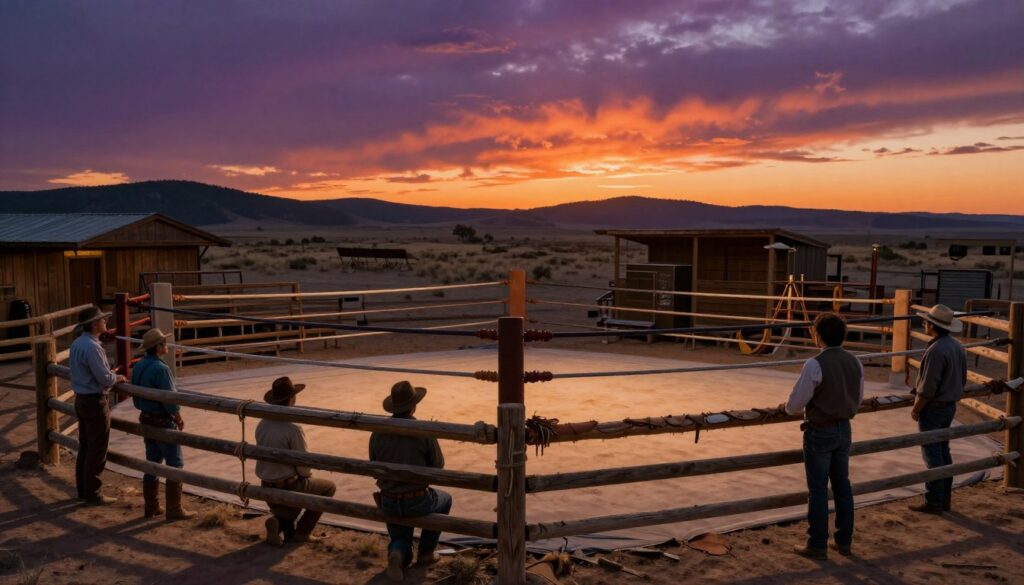
The gym is like a sports noir version of a saloon. It’s a place where fighters, trainers, and promoters meet. Here, alliances are formed and plans are made. It’s a place of both friendship and hidden dangers. Just like a saloon, it’s where important talks happen, away from prying eyes. The gym’s rough look adds to the story of hard work and struggle, a key part of the frontier myth.
The locker room is like a stable. It’s a private area where fighters get ready for battle. Here, they drop their public masks and show their true selves. It’s where they prepare, alone, for the fight ahead. This space adds a personal touch to the big show, making it feel real.
| Space in Sports Noir | Parallel Western Space | Primary Function | Thematic Role |
|---|---|---|---|
| Boxing Ring / Arena | Corral | Confined conflict resolution | Public spectacle, decisive justice under the frontier myth |
| Gym / Training Facility | Saloon | Social hub, intelligence gathering | Alliance formation, tension escalation |
| Locker Room | Stable | Preparation, solitude | Vulnerability, introspection before battle |
These spaces are not just settings; they shape the story. The ring demands confrontation, the gym negotiation, and the locker room preparation. Together, they show how private thoughts turn into public actions. This way of using space is a key part of the frontier myth. It brings the spirit of the Old West into the world of sports.
Aging Gunslinger Archetype: The Wrestler (2008) vs Unforgiven (1992) Parallels
Clint Eastwood’s William Munny and Mickey Rourke’s Randy “The Ram” Robinson share a common story. They are both aging figures, struggling to find their place in a world that has moved on. The aging gunslinger from Westerns has a mirror in the sports noir’s aging athlete.
Both Munny and The Ram face the harsh reality of aging. Munny can barely ride a horse or shoot straight. The Ram deals with hearing loss and heart issues. Their financial struggles are evident, with Munny needing bounty money and The Ram working a low-paying job.
Both characters seek redemption by facing their violent pasts. Munny tries to overcome his killer instincts. The Ram wants to relive his wrestling glory days. Their stories are about finding dignity in their twilight years. This theme is common in noir athlete archetypes.
Personal relationships add to their isolation. Munny is a widower trying to be a better father. The Ram’s attempts to connect with his daughter fail. Their final acts are desperate attempts to find meaning.
Munny turns to violence to survive and seek justice. The Ram risks his life to win back his identity in front of fans. These stories critique the myth of the heroic warrior. They show the human cost of lives spent in conflict.
| Aspect | William Munny (Unforgiven) | Randy “The Ram” Robinson (The Wrestler) |
|---|---|---|
| Primary Conflict | Confronting his violent legacy as a hired gun. | Battling obscurity and the physical toll of his sport. |
| Physical State | Rusty, out of practice, struggling with basic skills. | Debilitated by injuries, requiring medical attention. |
| Economic Situation | Impoverished pig farmer needing bounty money. | Working part-time at a supermarket; financially struggling. |
| Redemption Quest | To provide for his children and escape his past. | To regain the love of the crowd and his daughter. |
| Final Confrontation | A violent shootout in a saloon, settling old scores. | A high-risk wrestling move, choosing the ring over safety. |
The table shows how the aging gunslinger archetype faces similar struggles in different settings. Both stories reject simple heroism. They offer deep insights into decline, making us question the cost of a life lived by a brutal code.
Justice systems: official vs extralegal—commission, promoters, posse/mob; consequences of crossing them
Justice is not always clear-cut in these stories. It’s a mix of official rules and the wild west’s lawlessness. Both sports noir and Westerns show a world ruled by two main powers. Characters must deal with both the official rules and the hidden laws of the underworld.
The official side offers a look of order. In boxing, it’s the athletic commission. They license fighters, enforce rules, and choose champions. Promoters act like lawmen, setting up events and controlling who gets in. In the West, the town sheriff or federal marshal plays a similar role. They bring in the rule of law and civilization.
The other side works in secret. The promoter’s backroom deal, the mob’s fix, and the corrupt manager’s scheme are part of sports noir’s dark side. In Westerns, the lynch mob or a powerful cattle baron’s posse does the same. These groups follow profit or revenge, not laws.
Characters often follow a code of honor when caught between these forces. This personal morality can clash with survival needs. A fighter might know a fight is rigged but feel bound to fight. A sheriff might know the mob is guilty but lack proof.
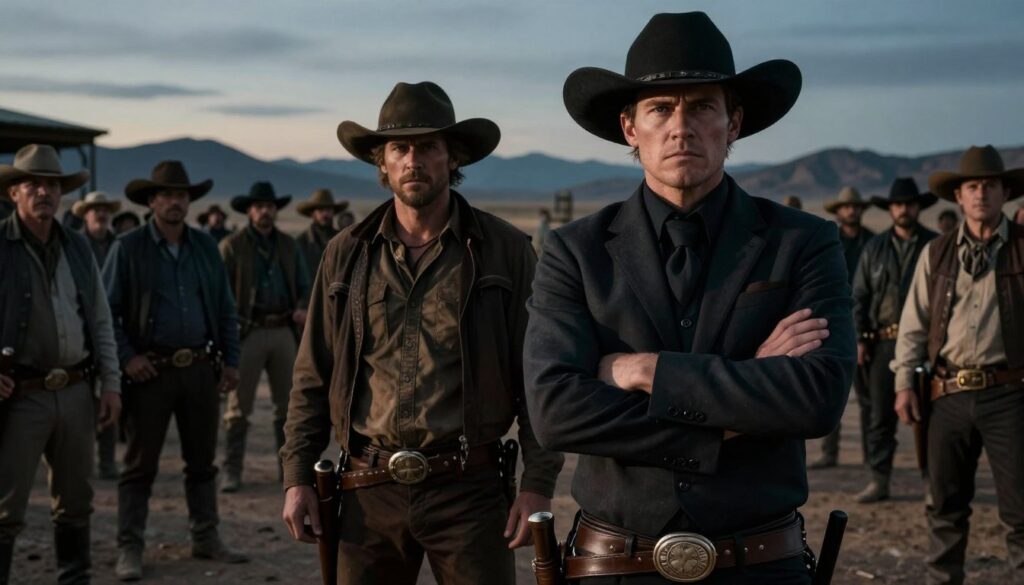
Going against either system has big consequences. Defying the official commission can mean bans, fines, or being kicked out of the sport. Angering a mob or corrupt promoter can lead to violence or harm to your career. In the West, going against the sheriff means jail or a bounty. But, crossing a posse or baron can lead to hanging or a shootout. This shows the frontier myth, where justice is about power.
The table below shows the differences between these two systems.
| Dimension | Official System (Civilization) | Extralegal System (Wilderness) |
|---|---|---|
| Primary Entity | Athletic Commission, Town Sheriff | Promoter’s Syndicate, Lynch Mob |
| Source of Power | Formal Appointment, Legal Statute | Wealth, Fear, Social Influence |
| Enforcement Tool | Suspension, Arrest, Banishment | Violence, Blacklisting, Coercion |
| Character’s Risk | Loss of Livelihood, Legal Penalty | Bodily Harm, Social Ostracism |
| Relation to Code of Honor | Often in Conflict (Bureaucracy vs. Ethics) | Often Demands its Abandonment (Survival) |
This conflict shows deep worries about true authority. In Chinatown, the police and water department are corrupt, making justice hard to find. In Deadwood, Sheriff Seth Bullock tries to enforce law while Al Swearengen rules through crime. The frontier myth sees this as a violent process of creating society. The personal code of honor is the human cost of this process.
Visual motifs: dust/smoke, hat/robe symbolism, walk‑up shots
Visual motifs are like silent storytellers. They weave the duel structure and frontier myth into a film’s look. These images create a common language between sports noir and Westerns.
Dust and smoke help set the mood. In Westerns, dust from a horse or street dirt signals someone’s arrival. It also hides a shooter’s aim. In sports noir, cigar smoke or chalk dust hangs in the air. These particles symbolize uncertainty and danger.
Cowboy hats and boxer robes mean more than just clothes. They show a person’s profession and status. Wearing them marks a shift from everyday life to conflict. Taking them off can mean defeat or returning to safety.
The way characters approach fights is also a visual motif. The walk-up shot is key. A cowboy walks down a street, while a boxer goes to the ring. These shots build suspense and show the character’s mental journey.
These visual elements serve several purposes. They make the film look cohesive and deepen its themes. They also bring out the harsh, changing landscapes of the frontier myth. The ring or gym becomes a place of dust and light.
Movies like There Will Be Blood and Cinderella Man use these visuals to tell their stories. They show how the duel structure is as much a visual idea as a story element.
Classroom prompt: Rewrite a climactic bout as a Western beat sheet
A practical exercise shows how sports noir and westerns are similar. It turns a famous fight scene into a western showdown. This task uses a direct comparison.
“Rocky” (1976) has a great final fight for this. We need to rewrite it like a classic western. This shows the duel structure is key in both genres.
The western beat sheet breaks down a story into stages. These stages are the call to adventure, preparation, showdown, and aftermath. Each stage has a match in sports noir.
Changing the beats makes us think about story pace and character growth. It shows how sports battles can be seen as western showdowns. This encourages creative mixing of genres.
| Beat Step | Sports Noir Application (Rocky’s Final Fight) | Western Translation |
|---|---|---|
| Call to Adventure | Rocky Balboa gets the unlikely title shot against Apollo Creed. | A retired gunslinger is called to defend a town from a ruthless outlaw. |
| Preparation | Montage of grueling training: running, punching meat, sparring. | The gunslinger practices his draw, cleans his weapon, and scouts the terrain. |
| The Showdown | The fifteen-round championship fight in the packed arena. | The high-noon street duel, with the town as silent witnesses. |
| Aftermath | Both fighters battered; Rocky loses the decision but wins respect. | The outlaw is defeated; the gunslinger’s victory is morally ambiguous or costly. |
| Resolution | Rocky calls for Adrian, proving his goal was validation, not the belt. | The gunslinger leaves town, forever changed, with the community’s fate altered. |
This table shows how stories follow the same pattern, no matter the genre. The duel structure stays the same. The crowd in the arena is like the townsfolk.
This exercise shows the core of storytelling is the same in all genres. It teaches us about genre flexibility. By comparing sports noir vs western, we learn more about storytelling.
It helps us see the importance of conflict in stories. The prompt makes us apply what we’ve learned. It shows the duel’s story structure is universal.
Pairings list + concluding insights
The sports noir vs western comparison is best shown through film pairings. These pairings show shared story structures and themes. For example, “The Hustler” (1961) and “The Shootist” (1976) both feature an aging gunslinger’s final battle.
“Foxcatcher” (2014) and “No Country for Old Men” (2007) explore corrupted codes. “Raging Bull” (1980) is similar to westerns in its harsh critique of myths.
This analysis shows both genres use similar story structures. The duel is key in both genres. A strict code of honor guides the heroes. The boxing ring and the street serve as similar stages.
The aging gunslinger is a common figure in both genres. Justice, whether through official courts or vigilante groups, brings fatal outcomes.
These pairings prove sports noir and westerns are mirror genres. They reflect our worries about morality, authority, and individualism. The global history of the western shows its themes are universal. This framework helps us appreciate these stories more deeply.