There was a time when thrillers lived and died by the crime itself. A missing person. A dead body. A ticking clock driving the narrative forward. The structure was mechanical, almost predictable—crime initiates, investigation unfolds, truth is revealed.
But Netflix’s current wave of thrillers is quietly dismantling that formula.
In series like 56 Days, Adolescence, and emerging psychological dramas across the platform, the crime no longer feels like the centerpiece. It exists—but only as a rupture, a consequence, a shadow cast by something deeper.
The real story begins where the crime ends.
From Investigation To Disintegration
Traditional thrillers relied on structure. Detectives followed clues. Audiences followed logic. Resolution, however imperfect, was still the destination.

Netflix’s new thriller model abandons that clarity.
Instead of building toward answers, these narratives spiral inward—toward memory, identity, and emotional instability. The investigation becomes secondary, almost symbolic, while the characters themselves become the terrain of conflict.
| Narrative Function | Traditional Thriller | Netflix Wave |
|---|---|---|
| Central Focus | Solving the crime | Understanding the psyche |
| Protagonist | Investigator | Emotionally unstable individual |
| Structure | Linear progression | Fragmented, nonlinear |
| Resolution | Answers revealed | Ambiguity sustained |
The shift is subtle, but it changes everything. The question is no longer “What happened?”
It’s “What’s happening inside them?”
Trauma As Narrative Infrastructure
At the core of this transformation is trauma—not as backstory, but as structure.
In these modern thrillers, trauma shapes:
- Perception
- Behavior
- Memory
Characters are not reacting to events—they are shaped by forces that predate the narrative itself. Every decision feels like an extension of something unresolved.
This is particularly evident in how these stories handle time. Flashbacks are no longer explanatory devices. They are disruptions—moments where past and present collapse into each other, creating instability rather than clarity.
The result is a form of storytelling where the past is never past. It is active, invasive, and impossible to fully interpret.
The Disappearance Of The Detective
One of the most striking evolutions in Netflix’s thriller landscape is the gradual disappearance of the detective figure.
Authority still exists—police officers, investigators, institutional voices—but they no longer control the narrative. They observe it, attempt to structure it, but ultimately fail to contain it.
This reflects a broader thematic shift:
- Systems cannot explain individual psychology
- Evidence cannot fully capture emotional truth
- Resolution cannot be imposed from the outside
As explored in Amazon’s Steal review, modern noir increasingly shifts away from external systems of control and toward internal, systemic collapse, where the real conflict is embedded within individuals rather than institutions.
Intimacy As The New Battleground
If crime is no longer the central driver, something has to replace it.

In Netflix’s psychological thrillers, that role is often filled by intimacy.
Relationships become sites of tension:
- Romantic connections that feel unstable
- Family dynamics shaped by silence and misunderstanding
- Friendships built on incomplete truths
These connections are not sources of comfort. They are environments where pressure builds, where identity is negotiated, and where trust is constantly at risk.
The closer the characters are, the more dangerous the situation becomes.
The Aesthetics Of Psychological Noir
Visually, this new wave of thrillers departs from classic noir while retaining its emotional core.
The shadows are still present—but they are softer, more ambient, less defined. Interiors dominate the frame. Spaces feel enclosed, even when they are well-lit.
Light itself becomes ambiguous.
Instead of revealing truth, it exposes fragments—partial expressions, fleeting reactions, moments that feel significant but remain unexplained. The audience is given access, but not understanding.
This is the defining trait of psychological noir:
- Visibility without clarity
- Exposure without resolution
Streaming As The Perfect Medium For Collapse
This transformation is not accidental. It is enabled by the structure of streaming itself.
Netflix allows for:
- Extended narrative arcs
- Slower pacing
- Deeper character exploration
These elements create space for stories that prioritize emotional accumulation over plot mechanics. Tension builds gradually, often without a clear endpoint.
According to a recent industry analysis on Netflix’s evolving thriller strategy, the platform has increasingly invested in character-driven narratives that emphasize psychological depth over traditional genre conventions.
This approach aligns perfectly with noir’s evolution. The genre has always been about tension—it has simply changed where that tension resides.
When The Crime Becomes Irrelevant
Perhaps the most radical aspect of this new wave is how little the crime ultimately matters.
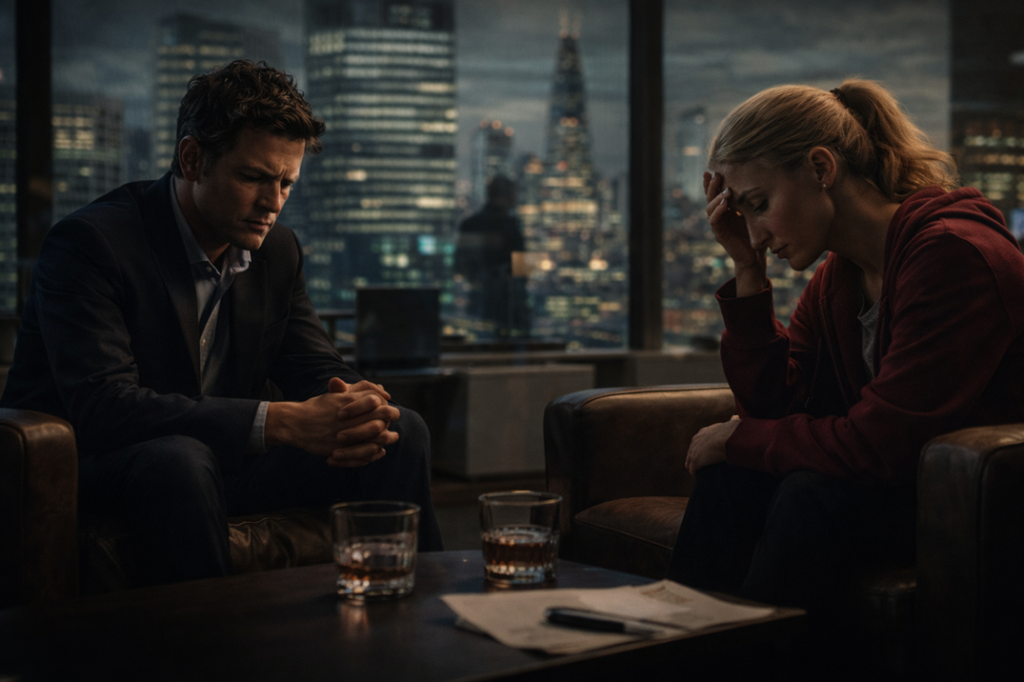
It initiates the story, but it does not sustain it.
What lingers is:
- The emotional aftermath
- The shifting perception of truth
- The instability of identity
In many cases, the resolution of the crime feels almost secondary—an administrative detail in a story that is fundamentally about something else.
A Genre Turning Inward
Noir has always adapted to its environment.
- In the post-war era, it reflected disillusionment
- In the late 20th century, it explored institutional decay
- Today, it turns inward—toward the mind
Netflix’s thriller wave represents the latest phase in that evolution.
The city is no longer the primary source of danger. The system is no longer the central antagonist. Instead, the focus shifts to something far more difficult to navigate:
The human psyche under pressure.
The Quiet Collapse At The Center
In the end, what defines this new era of thrillers is not what happens—but what breaks.
The characters do not simply encounter crime. They are reshaped by it, revealing fractures that were always present but never fully visible.
The investigation may end. The narrative may conclude.
But the psychological collapse remains unresolved.
And in that unresolved space, noir finds its most modern form—one where the darkness is no longer something to uncover.
It is something to endure.