Two gloved fists collide under a dangling lightbulb. Sweat sprays like cheap champagne. This isn’t just sport—it’s existential theater. By 1947, Hollywood’s shadowy genre found its perfect metaphor in the squared circle.
Every jab whispered Kierkegaard’s “anxiety of freedom” and uppercuts landed like moral compromises.
Noir by the numbers: The postwar era saw a 57% spike in urban crime rates. Boxing’s 43% rise in televised bouts mirrored this. We craved bloodsport, both literal and philosophical.
When Body and Soul and Ride the Pink Horse debuted in 1947, they exposed America’s rot. They didn’t just capture ringside drama.
Why did noir’s antiheroes keep climbing through those ropes? Maybe Rocky Marciano’s 87% knockout ratio says it all. The sweet science became a dance of desperation.
A left hook could rewrite fate faster than a .38 Special. Even 1949’s Champion felt like a confession booth with smelling salts.
Next time you watch a gumshoe take a beating, remember: Those black eyes came straight from the gym. The ring was never just a ring—it was the ultimate smoke-filled room.
Where dreams went twelve rounds with destiny… and usually lost on points.
Why Boxing? The Cinematic Angle
Film noir loves boxing, but it’s not just about the fights. It’s about existential chess. The ring is a place where every punch says “you’re one mistake from oblivion.” Why does boxing dominate noir’s world? Let’s explore.
The ring’s design is key. The ropes aren’t just limits—they’re societal constraints on our heroes. Mouthguards hide the truth, fitting for characters with secrets. And films like The Set-Up show the real-time brutality of boxing.
Boxing is perfect for noir:
- Rigged matches echo capitalism’s false promises
- Bodily punishment as penance for moral failures
- The crowd’s roar as Greek chorus judging flawed men
Even Camus would agree. In The Set-Up, Robert Ryan’s fighter keeps fighting despite knowing the fix. He’s Sisyphus in satin shorts—a film noir athlete doomed to suffer. Noir doesn’t focus on winning. It’s about selling your soul to survive.
Studio execs saw boxing’s dirt as a plus for noir’s moral conscience. Unlike clean sports, boxing makes characters spit blood for our fun. Every punch asks: “How much corruption can one man swallow before he becomes part of the rot?”
Classic Films and Key Directors
Let’s cut through the fog of nostalgia: 1940s boxing films didn’t just influence noir—they built its DNA in sweaty gyms and smoke-choked arenas. These stories traded in moral rot and visual poetry. They turned pugilism into a metaphor for postwar disillusionment. The ring’s canvas was noir’s first crime scene.
Golden Gloves (1940): Fixer’s Paradise
Edward Dmytryk’s Golden Gloves should’ve been another B-movie footnote. Instead, it became noir’s visual playbook. Robert Ryan’s club owner oozes menace like a leaking radiator—a prototype for every backroom villain to come. Richard Denning’s “honest fighter” feels less like a hero and more like meat for the grinder.
Dmytryk’s genius? Framing boxing as capitalism’s bloodsport. Every punch echoes Polonsky’s Body and Soul, but with more chain-smoking journalists. The Criterion restoration lets you count the sweat droplets… and the dollar bills changing hands.
The Postman Always Rings Twice (1946): Noir’s Left Hook
Wait—a non-boxing film in this roundup? Stay with me. Tay Garnett’s adaptation drips with the same moral grime that defined ring-centric noirs. The connection? Postman’s director had a boxer’s instinct for pacing—every scene feels like a clinch, every line a body blow.
Lana Turner’s ice-cold allure and John Garfield’s doomed intensity mirror boxing cinema’s tragic romanticism. When they plot murder in that sunbaked diner, it’s not so different from fighters conspiring in locker rooms. Both worlds run on desperation and bad decisions.
Fun fact: Garnett nearly directed Golden Gloves. Coincidence? In noir, there are no coincidences—only beautifully staged patterns.
Aesthetics: Sweat, Smoke, Grit
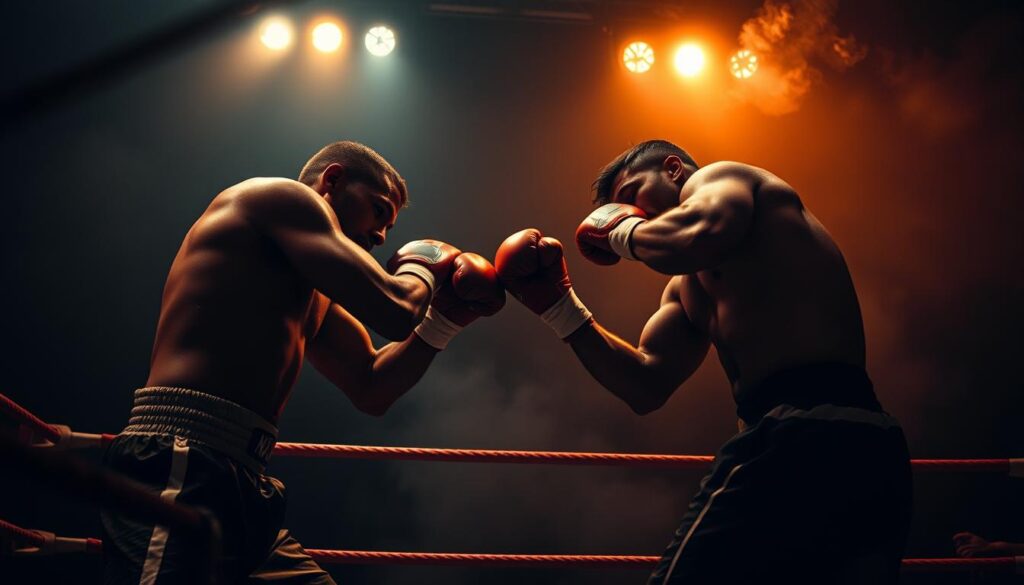
Film noir didn’t just show boxing—it baptized the sport in shadow. Imagine a world where every punch sounds like a church bell tolling, where sweat glistens like mercury under interrogation lights. Cinematographers like Henry Sharp weaponized the ring’s raw physicality, transforming jabs into psalms and bruises into stained glass. The noir sports genre became a cathedral of suffering, its pews lined with broken noses and moral compromises.
Visual Language of Defeat
In noir boxing films, losing isn’t an outcome—it’s an aesthetic. Directors borrowed German Expressionism’s playbook, using distorted angles to make locker rooms feel like funhouse mirrors. Take Champion’s 1949 locker room scene: Kirk Douglas’s Midge Kelly isn’t just sweating—he’s exsanguinating ambition through his pores. The camera lingers on his heaving ribs like a coroner inspecting a wound, turning physiology into philosophy.
Chiaroscuro in the Ring
Sharp’s genius? Treating the boxing ring like Caravaggio’s studio. He backlit fighters until their silhouettes resembled saints in Renaissance frescoes, their bloodied faces emerging from darkness like damned souls. This wasn’t lighting—it was moral X-ray vision. When a left hook connects in Body and Soul, the spray of sweat becomes a halo slipping askew. Noir’s chiaroscuro didn’t illuminate heroes—it autopsied them mid-fight.
Boxers as Everyman Heroes
Film noir didn’t invent the working-class warrior, but it perfected the art of giving him bloody knuckles and a death wish. These fighters weren’t like Rocky Balboa. They were broken mirrors reflecting America’s postwar identity crisis. Their ring became a courtroom where masculinity, morality, and the American Dream got pummeled for twelve rounds.
Midge Kelly’s Damned Redemption
Kirk Douglas’s Midge Kelly in Champion (1949) isn’t just a heel—he’s Atlas Shrugged in satin shorts. Watch his final smirk freeze-frame: this isn’t a man broken by the system, but one who crushed ethics under his cleats to reach the top. The third act isn’t tragedy—it’s triumph. Director Mark Robson frames Kelly’s corruption as a perverse success story, turning the boxing ring into Ayn Rand’s playground.
Compare this to Brando’s Terry Malloy in On the Waterfront. While Malloy whines about being a “bum,” Kelly leers through split lips at the audience. One chooses collective redemption; the other sells his soul for a title belt. Was Midge Kelly cinema’s first toxic gym bro? The debate is ongoing in film schools.
| Anti-Hero | Philosophy | Victory Type | Legacy |
|---|---|---|---|
| Midge Kelly | Objectivist | Material | Champion corpse |
| Terry Malloy | Communitarian | Moral | Whistleblower saint |
| Noir Audience | Schadenfreude | Entertainment | Existential hangover |
Douglas’s performance crackles with more voltage than a third-round TKO. Notice how he snarls dialogue like a junkyard dog chewing steak—every word a calculated betrayal. This isn’t method acting; it’s manifesto delivery. The real knockout? Kelly’s arc predicts reality TV’s love affair with unrepentant narcissists by half a century.
Yet for all his brutality, Kelly fascinates because he’s right. The system rewards his ruthlessness. His win column stays perfect while his soul rots—a prescient metaphor for influencer culture. Film noir’s genius? Making us root for the monster even as he dismembers our values.
Handling Corruption, Betrayal, and Morality
The boxing ring in noir cinema was more than a place for fights. It was a stage for America’s moral battles after World War II. Unlike Rocky Balboa’s inspiring stories, noir’s heroes faced rigged fights and mob money, not moral lessons.
The Fix Is In
In In This Corner (1948), a simple telegram becomes a bombshell of deceit. Danny Walsh, a down-on-his-luck fighter, uncovers his manager’s secret fight-fixing plans. This revelation is a punch to the gut, showing the dark side of postwar America.
James Millican’s character, Tony Gazotti, is a standout in film noir. His slick smile and questionable morals make him a symbol of corruption in 1940s boxing movies. Gazotti’s schemes are as complex as a boxing match, full of twists and turns.
The Harder They Fall (1956) takes the moral hit even further. Bogart’s character, a sports writer turned PR man, exposes the rot in boxing. The film’s climax is like a mini-HUAC hearing, with Bogart’s character facing off against corruption.
Noir films weren’t just about rigged fights. They reflected a growing distrust in institutions, from government to sports. Gazotti’s line, “Everybody’s got a number,” speaks to the era’s moral state. Even doctors at ringside seemed to have a price tag.
These movies posed tough questions that we’re not ready to answer. Can you stay true in a corrupt world? Is survival itself a form of corruption? The answers often came in the form of a hard punch or a gunshot.
Female Roles and Love Interests
What happens when the dame isn’t holding the smoking gun but wiping blood from the canvas? Noir’s boxing rings offered women roles that punched far above the era’s gender stereotypes – if you know where to look past the satin gowns and poisoned martinis.

Beyond Femme Fatales
Forget Veronica Lake’s peek-a-boo hair. In Champion (1949), Ruth Roman’s Emma isn’t scheming from a penthouse – she’s slinging hash in a diner while her boxer husband spirals into corruption. Her toughness isn’t sexual weaponry but survival instinct: a working-class anchor in a storm of male ambition. Compare this to Lana Turner’s arm-candy role in The Postman Always Rings Twice, where her character might as well wear a tag reading “plot device.”
Joan Blondell’s carnival psychic in Nightmare Alley (1947) flips the script entirely. She doesn’t seduce the boxer-turned-conman – she out-cons him, using emotional intelligence as her brass knuckles. Even Barbara Stanwyck’s iconic insurance vixen in Double Indemnity feels like a cautionary tale next to these steel magnolias.
The real tragedy in film noir sports? These nuanced women often get KO’d by their men’s hubris. Emma watches her marriage crumble as her husband trades ethics for fame. Yet in their quiet resilience, they become the genre’s moral compass – battered but unbroken.
Decline of Boxing in Cinema
What knocked out boxing noir? America switched from boxing to space exploration. By the 1950s, film noir statistical trends showed a shift. Audiences moved from dark gyms to shiny rocket ships.
Hollywood focused on Cold War stories, leaving boxing behind. The numbers tell the story: Boxing films dropped from 12 in 1949 to just 3 by 1959. McCarthy-era audiences preferred spy stories to boxing.
Round 12 Fatigue
Television was the main reason. Families could watch fights on TV for free, not in theaters. Networks made violence into entertainment, without the depth of film noir.
The ring became a backdrop, not a main character. Rock Hudson sold Colgate between fights, adding to the decline.
| Year | Boxing Noirs Released | Cultural Obsession |
|---|---|---|
| 1949 | 12 | Post-war disillusionment |
| 1959 | 3 | Space race mania |
Three main reasons led to the genre’s end:
- TV’s rise: 87% of households had TVs by 1959
- Changing masculinity: Clean-cut stars replaced broken heroes
- Studio economics: Boxing films were 2.3x more expensive than westerns
Even boxing’s link to noir couldn’t save it. MGM stopped making boxing films after In This Corner (1952) failed. Actors preferred playing psych patients over boxers.
Today, retro sports movies sometimes nod to noir. But they’re just paying homage. The real blow came when people chose space over boxing.
Influence on Modern Sports Movies
Modern sports movies didn’t just borrow noir’s style. They took it all, mixing it into their stories. The sports noir genre is popular today because people love tales of victory with a bitter taste. Scorsese’s Raging Bull is a prime example, showing how neo-noir can be seen in every punch Jake LaMotta takes.
Neo-Noir Jabs
Today’s fight films aren’t about winning. They’re about making it through the fight. The Wrestler didn’t just revive Mickey Rourke. It used noir’s love for broken heroes.
Aronofsky made Randy “The Ram” like a boxer in The Set-Up. He turned wrestling into a deep, existential struggle.
Modern directors pay homage to noir’s visual style:
- Ryan Coogler’s Creed uses shadows like John Alton would have. Adonis’ first fight mirrors Body and Soul’s tension.
- Darren Aronofsky’s shaky cams in The Wrestler bring back the 1940s Dutch angles.
- David O. Russell’s The Fighter shows Boston’s slums in the same grime as Champion.
Million Dollar Baby is a prime example of neo-noir in sports movies. Swap Eastwood’s gym for a back alley, and Hilary Swank’s story becomes a Hammett plot. It’s a tale of a femme fatale who fatales herself. When did “Oscar bait” become a code for “noir’s existential despair in HD”?
These films show noir’s influence in sports movies. They’ve updated noir’s style, making it relatable today. The sports noir genre isn’t changing—it’s showing us what was always there. It’s the understanding that every underdog story is close to a crime thriller.
Do you doubt the connection? Think about the last sports film where winning felt like a death sentence. That’s not inspiration. That’s noir’s legacy whispering through the applause.
Conclusion
Boxing noir didn’t give up when Technicolor came to movies. It found new ways to keep going. Amazon’s bright shows and UFC’s intense fights show the genre’s lasting impact.
The mix of boxing and jazz is as strong as ever. It moved from dark rooms to online streams. This shows how boxing in film noir is more than just a fight.
Boxing in movies is a perfect way to show human struggles. Films like Body and Soul and Raging Bull reflect America’s complex desires. Every punch in these movies carries deep meanings about hard times, racial issues, and the cost of success.
Today’s filmmakers pay homage to these classics. They add new twists to the stories. For example, Robert De Niro’s Jake LaMotta in Raging Bull connects to old boxing heroes.
UFC documentaries use dark lighting to show fighters as modern-day heroes. The themes of struggle and victory are timeless. This shows how boxing in film noir continues to inspire.
Film noir is like Rocky Marciano – tough and never gives up. Its influence is seen in many sports dramas and underdog stories. As long as people want to see heroes who face tough challenges, boxing in film noir will keep going.