For decades, the detective has wandered the shadows of cinema — trench coat collar turned up against the rain, city lights flickering through smoke and fog. In recent years, however, that familiar figure has begun appearing in a new environment: the digital streets of video games.
A growing wave of cyber-noir titles is bringing the hard-boiled detective into futuristic worlds defined by neon reflections, sprawling urban architecture, and morally ambiguous investigations. Among the newest examples is No Law, a recently announced cyber-noir open-world shooter that places players inside a crime-ridden port city where corruption shapes every corner of the environment.
The resurgence of cyber-noir storytelling suggests that digital media may now be one of the most powerful platforms for the genre’s evolution.
From Film Noir To Digital Noir
Traditional film noir established a visual and thematic blueprint that continues to influence storytelling across mediums. Dark urban landscapes, flawed protagonists, and moral uncertainty became hallmarks of the genre during the mid-twentieth century.
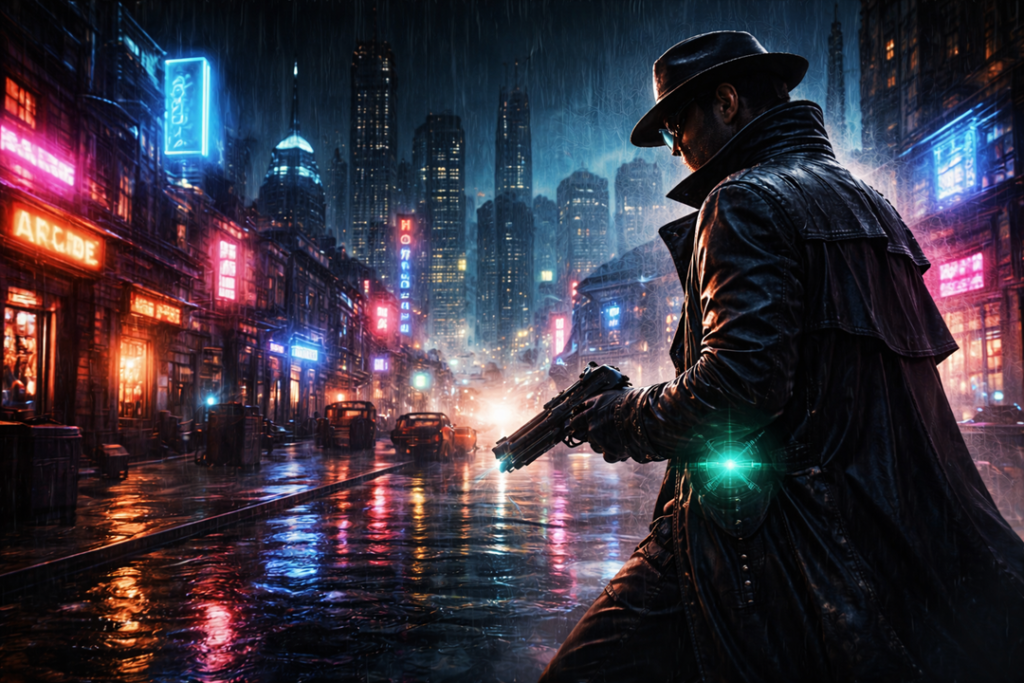
Video games have gradually adopted these same elements. Early attempts often focused primarily on detective characters or crime narratives. Today, however, modern game engines allow developers to recreate the entire atmosphere of noir cinema.
Rain-slick streets reflect neon advertisements. Towering skyscrapers loom through artificial fog. Narrow alleyways lead to unpredictable encounters.
What cinema once portrayed through carefully staged lighting and camera angles, video games now render dynamically through real-time environments.
| Noir Element | Classic Film | Video Game |
|---|---|---|
| Urban darkness | High-contrast lighting | Dynamic shadows and real-time lighting |
| Rainy streets | Atmospheric cinematography | Reflective surfaces and weather systems |
| Detective narration | Voice-over storytelling | Player-driven investigation mechanics |
| Moral ambiguity | Complex character arcs | Branching narrative choices |
The result is a genre transformation that retains noir’s emotional core while expanding its visual possibilities.
The Emergence Of Cyber-Noir Worlds
Cyber-noir builds upon traditional noir themes by introducing futuristic technology and dystopian urban settings. Instead of smoky nightclubs and mid-century city streets, these stories unfold in sprawling digital metropolises filled with holographic advertisements and advanced surveillance systems.
Despite these technological shifts, the genre’s emotional foundation remains strikingly familiar.
Corruption persists. Authority cannot always be trusted. Detectives — whether human or augmented — navigate systems designed to obscure the truth.
Games like No Law lean into these contradictions. By combining open-world exploration with investigative gameplay, they allow players to uncover layers of conspiracy hidden within the city’s infrastructure.
The cyber-noir city becomes both setting and puzzle.
Why Video Games Suit Detective Storytelling
Detective stories thrive on curiosity, uncertainty, and gradual discovery — qualities that translate naturally into interactive experiences.
Unlike film, where viewers observe an investigation unfold, video games invite players to participate in the search for answers. Clues are not merely revealed; they are discovered.
Exploration becomes part of the narrative structure.
Players may search abandoned apartments, interrogate suspicious characters, or analyze digital evidence scattered throughout the environment. Each decision shapes the progression of the investigation.
This interactive dynamic echoes the improvisational quality often found in noir storytelling, where protagonists adapt to new information as the mystery deepens.
Our earlier exploration of video game noir aesthetics and digital cityscapes highlights how environment design reinforces that investigative tension.
The city itself becomes a silent collaborator in the detective’s search.
The Role Of Technology In Modern Noir Atmosphere
Advances in game development have dramatically expanded the visual language available to cyber-noir creators. Lighting engines now simulate subtle reflections, atmospheric fog, and shifting shadows with remarkable realism.
These technical capabilities allow developers to replicate and expand the stylistic techniques that defined classic noir cinematography.
| Rendering Tech | Visual Impact | Narrative Contribution |
|---|---|---|
| Ray tracing | Realistic reflections and shadows | Enhances urban mood and tension |
| Volumetric lighting | Visible beams through fog or rain | Creates dramatic visual focus |
| Dynamic weather | Rain, storms, and fog | Reinforces noir atmosphere |
| Environmental storytelling | Detailed interiors and streets | Encourages exploration |
Such features do more than improve visual fidelity. They deepen the sense that players inhabit a living city where secrets hide in plain sight.
Open-World Design And The Modern Detective
One of the most significant developments in cyber-noir games is the shift toward open-world environments. Rather than following a strictly linear narrative, players are often free to explore entire city districts while investigating crimes.

This freedom aligns closely with noir’s thematic emphasis on uncertainty. The detective rarely possesses complete information. Instead, they assemble fragmented clues scattered throughout the environment.
In an open-world cyber-noir game, that investigative process becomes spatial. Players navigate neighborhoods shaped by economic inequality, corporate influence, and criminal networks.
Every street corner may reveal a new thread in the narrative.
The city does not simply host the mystery — it embodies it.
Cyber-Noir And The Future Of Interactive Storytelling
The revival of cyber-noir storytelling suggests a broader trend in video game design. As technology enables increasingly immersive environments, developers are gravitating toward genres that emphasize atmosphere and narrative depth rather than pure action.
Detective stories are particularly well suited to this evolution.
They reward careful observation. They encourage exploration. And they allow moral ambiguity to shape player decisions in ways traditional action genres often avoid.
Cultural institutions examining digital storytelling frequently highlight this shift. The Smithsonian American Art Museum’s overview of video games as a narrative medium notes how interactive environments allow players to experience stories through movement, discovery, and choice.
Cyber-noir games represent one of the most compelling expressions of that transformation.
When The Streets Turn Digital
Classic noir detectives walked through shadow-filled city streets searching for answers that often led to deeper uncertainty.
Today’s digital detectives do much the same — except the streets glow with neon, data streams replace paper files, and corruption spreads through networks as easily as through backroom deals.
Yet the spirit of noir remains intact.
A lone investigator stands against forces larger than themselves. The truth hides behind layers of deception. And somewhere in the distance, rain continues to fall on empty streets illuminated by flickering lights.
The setting may be futuristic, but the mystery still belongs to the shadows.