Crime stories have long occupied a central place in noir storytelling. From shadowy detectives wandering rain-soaked streets to morally conflicted investigators confronting corruption, the genre has always explored the darker edges of justice. Yet a new variation of noir has quietly gained momentum on television — forensic noir.
Rather than focusing on private detectives or police interrogations alone, forensic noir shifts attention toward the scientific investigation of crime. Laboratories replace smoky back rooms. Autopsy reports replace confessions. And the emotional weight of uncovering truth becomes the driving force behind the narrative.
Prime Video’s new series Scarpetta, starring Nicole Kidman as the brilliant forensic pathologist Dr. Kay Scarpetta, represents one of the clearest examples of this modern revival. Based on Patricia Cornwell’s bestselling novels, the series follows a medical examiner navigating complex murder investigations while confronting unresolved cases from her past.
The result is a crime drama that blends procedural science with the psychological tension traditionally associated with noir.
The Evolution From Detective Noir To Forensic Noir
Classic film noir typically followed investigators working outside formal institutions — private detectives, journalists, or cynical police officers navigating corrupt cities.
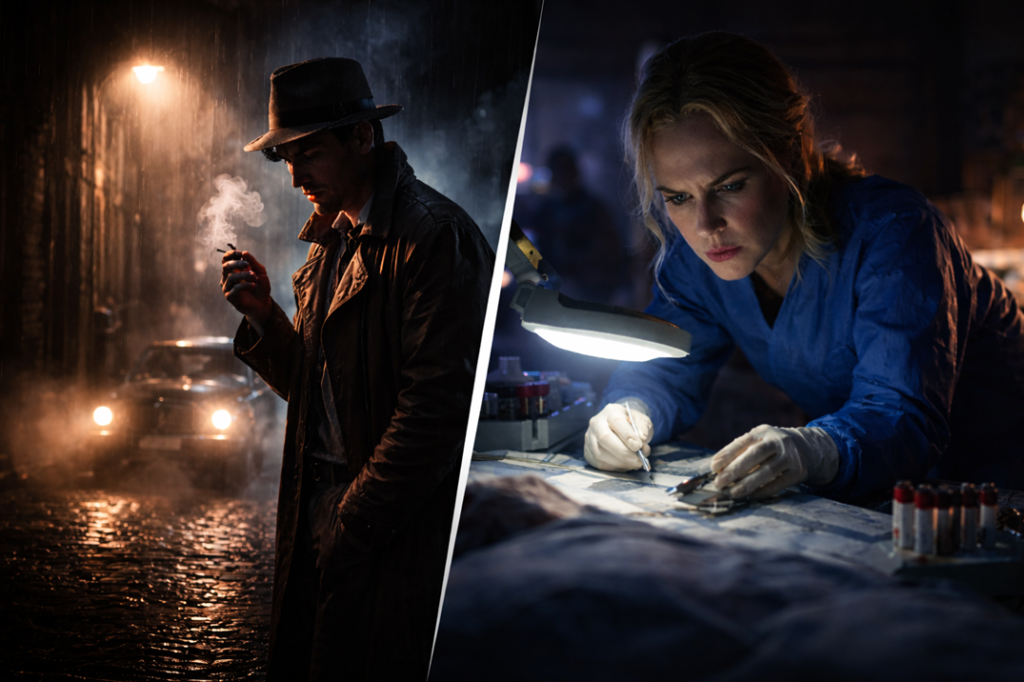
Forensic noir introduces a different perspective.
Instead of uncovering clues through interrogation or surveillance, forensic investigators reconstruct the truth through physical evidence. DNA traces, tissue samples, and microscopic analysis become the narrative tools used to reveal hidden crimes.
| Noir Investigator | Classic Noir Role | Modern Forensic Noir |
|---|---|---|
| Private detective | Interrogates suspects | Analyzes physical evidence |
| Police investigator | Follows leads through crime networks | Reconstructs timelines scientifically |
| Journalist | Exposes corruption | Reveals systemic failures |
| Forensic pathologist | Rarely present | Central protagonist |
This shift toward scientific investigation reflects how crime-solving itself has evolved. Modern forensic technology allows investigators to uncover details that would have remained invisible in earlier eras.
The noir atmosphere remains — but the methods have changed.
Kay Scarpetta: A Different Kind Of Noir Protagonist
Dr. Kay Scarpetta stands apart from the traditional noir detective archetype. Instead of a cynical investigator roaming city streets, she operates inside morgues, laboratories, and medical examiner offices.
Yet the emotional structure of her character still reflects classic noir themes.
Scarpetta often confronts:
- the psychological toll of studying violent death
- institutional pressure from political authorities
- unresolved personal conflicts tied to past investigations
- the moral weight of speaking for victims who can no longer speak for themselves
Nicole Kidman’s portrayal emphasizes this complexity. The character navigates both professional responsibilities and deeply personal consequences as she investigates crimes that often intersect with her own past.
This layered portrayal fits naturally within the broader noir tradition, where investigators are rarely untouched by the cases they pursue.
Why Forensic Science Adds New Narrative Tension
Traditional detective stories often rely on interrogation scenes or action-driven confrontations. Forensic storytelling introduces a slower, more analytical rhythm.
The tension comes from discovery rather than pursuit.
Small details uncovered during autopsies or laboratory analysis gradually reveal hidden truths about the crime itself. A single fiber, fingerprint, or microscopic fracture may change the entire direction of an investigation.
| Investigative Method | Narrative Effect |
|---|---|
| Autopsy analysis | Reveals hidden trauma |
| DNA evidence | Connects suspects across timelines |
| Crime scene reconstruction | Recreates events step by step |
| Digital forensics | Exposes concealed communications |
These techniques create suspense through methodical revelation rather than sudden confrontation.
The audience experiences the investigation alongside the forensic scientist, discovering clues piece by piece.
Streaming Television And The Rise Of Procedural Complexity
Modern streaming platforms have helped revive forensic noir because serialized storytelling allows complex investigations to unfold across multiple episodes.
Rather than resolving a crime within a single hour of television, shows like Scarpetta can follow layered investigations that evolve over entire seasons.
The series itself unfolds across dual timelines, exploring both present-day investigations and earlier cases that shaped Scarpetta’s career.
This narrative structure adds depth to the investigation by revealing how past decisions continue to influence present events.
Streaming audiences, accustomed to long-form storytelling, are particularly receptive to this kind of narrative complexity.
The Visual Language Of Forensic Noir
While traditional noir is famous for dark alleyways and neon-lit streets, forensic noir often unfolds in more controlled environments — laboratories, autopsy rooms, and investigative offices.
Yet the visual mood remains unmistakably noir.
Cold lighting, sterile environments, and reflective surfaces create an atmosphere of quiet tension. Shadows still play a role, but they appear within clinical spaces rather than urban back alleys.
| Classic Noir Visual | Forensic Noir Equivalent |
|---|---|
| Rainy night streets | Sterile morgue corridors |
| Cigarette smoke | Laboratory mist and cold light |
| Dark interrogation rooms | Clinical examination labs |
| Urban isolation | Emotional isolation of investigators |
The result is a different but equally powerful visual interpretation of noir’s central theme: truth hidden beneath layers of darkness.
Crime Investigation As Psychological Drama
One of the most compelling aspects of forensic noir lies in its emotional dimension. The investigators themselves must confront the psychological cost of studying violent crime.
Every autopsy represents a life lost. Every investigation exposes the darkest corners of human behavior.
This emotional tension mirrors the existential weight often carried by classic noir detectives.
Our earlier exploration of how cyber-noir games revive digital detective storytelling demonstrated how modern media continues to reinterpret investigative narratives across platforms. In forensic noir, the emphasis shifts toward scientific realism while preserving the genre’s moral complexity.
The detective still searches for truth.
Only the tools have changed.
Why Forensic Noir Is Thriving Again
The resurgence of forensic crime dramas reflects a broader cultural fascination with the intersection of science and justice.
Modern audiences understand that real-world investigations rely heavily on forensic technology. Television dramas increasingly mirror that reality.
Series like Scarpetta demonstrate how the genre can balance scientific accuracy with emotionally compelling storytelling.
Film historians and critics often note that noir has always evolved alongside societal anxieties. The British Film Institute’s examination of film noir’s defining themes highlights how the genre adapts to reflect changing cultural fears and investigative methods.
In the twenty-first century, those fears often revolve around hidden evidence, technological surveillance, and the fragile boundary between truth and interpretation.
Forensic noir brings those tensions to the surface.
The Future Of Crime Noir On Television
If the success of shows like Scarpetta continues, forensic noir may become one of the dominant crime storytelling forms on streaming platforms.
The combination of scientific investigation, character psychology, and serialized mystery offers a powerful narrative framework.
It allows creators to explore both the intellectual puzzle of crime-solving and the emotional consequences faced by those who seek justice.
In many ways, forensic noir simply represents the next chapter in a genre that has always evolved.
The trench coat may have been replaced by a lab coat.
But the shadows — and the search for truth within them — remain exactly the same.