
Noir has always relied on perspective.
A voice narrates. A mind interprets. A reality is filtered through thought, memory, and bias. But Alan Wake 2—and especially its expanding DLC content released through 2024 and continuing into 2025–2026 updates by Remedy Entertainment—pushes that idea further than most narratives dare.
It does not just present a story.
It presents a story that is aware of itself being written.
This is where meta-noir begins.
The Writer As Detective, The Narrative As Crime Scene
In Alan Wake 2, protagonist Alan Wake, portrayed again with performance capture by Ilkka Villi and Matthew Porretta, is not simply investigating events.

He is attempting to write them into existence.
This transforms the traditional noir structure:
- The detective searches for truth
- The writer constructs it
The DLC expansions deepen this mechanic, introducing layers where narrative fragments, alternate drafts, and shifting realities overlap. The “crime” is no longer a singular event—it is the instability of the story itself.
| Narrative Role | Classic Noir | Meta-Noir |
|---|---|---|
| Investigator | Detective uncovering truth | Writer shaping reality |
| Evidence | Clues and testimony | Text, drafts, narrative fragments |
| Structure | Linear progression | Recursive, self-aware loops |
| Truth | Hidden but fixed | Fluid and rewritten |
The investigation becomes creative.
And creativity becomes dangerous.
Meta-Noir And The Collapse Of Narrative Boundaries
The defining feature of Alan Wake 2’s DLC is its refusal to maintain a stable narrative boundary.

Characters are aware of stories. Stories influence environments. Environments reshape identity.
This creates a layered experience:
- A story within a story
- A character within a narrative
- A player navigating both
The DLC expands on this by introducing alternate scenarios and overlapping timelines, where cause and effect become interchangeable.
Events do not follow each other.
They rewrite each other.
This is not just nonlinear storytelling.
It is narrative instability as a core mechanic.
Horror As A Function Of Interpretation
While Alan Wake 2 is firmly positioned within psychological horror, its noir foundation remains essential.
The fear does not come solely from what is seen.
It comes from uncertainty:
- What is real
- What is written
- What is remembered
The DLC intensifies this by presenting scenarios where interpretation becomes the player’s primary tool. Clarity is never fully achieved.
Instead, the game encourages a state of constant doubt.
This aligns with the evolution explored in our Max Payne video game noir analysis, where games move beyond action into interpretive experiences shaped by perception rather than objective truth.
The Dark Place As A Living Narrative System
One of the most significant elements expanded through DLC is the concept of the Dark Place.
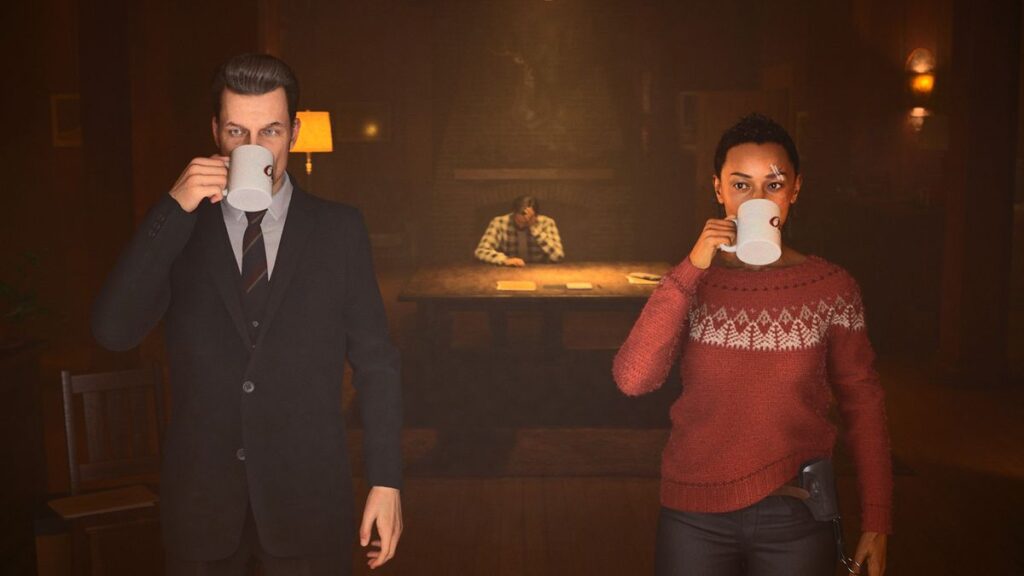
In the base game, it functions as a surreal environment shaped by narrative logic. In the DLC, it becomes more explicit:
- A space where stories manifest physically
- A system that responds to narrative intent
- A reflection of the writer’s subconscious
The Dark Place is not just a setting.
It is a narrative engine.
It blurs the line between environment and story, reinforcing the idea that in meta-noir, the world is not discovered.
It is constructed.
Dual Protagonists And Fragmented Identity
Alongside Alan Wake, Saga Anderson, played by Melanie Liburd, provides a grounded investigative perspective. Her presence creates a dual structure:
- Alan represents narrative instability
- Saga represents procedural logic
The DLC complicates this relationship by introducing moments where these roles begin to overlap. Saga’s investigation becomes influenced by narrative distortion, while Alan’s writing intersects with real-world consequences.
This creates a fragmented identity structure:
- Characters question their roles
- Roles influence behavior
- Behavior reshapes narrative
The result is a story where identity is not fixed, but constantly negotiated.
Visual Language And The Breakdown Of Reality
Visually, Alan Wake 2 and its DLC content expand noir aesthetics into something more fluid and immersive.
Traditional noir relies on contrast—light and shadow, clarity and obscurity.
Meta-noir introduces instability:
- environments shift without warning
- lighting responds to narrative tone
- visual elements repeat with variation
This creates a sense of disorientation that reinforces the game’s themes.
The player is not just observing a world.
They are navigating a system that refuses to remain consistent.
Streaming Influence And Episodic Structure
The structure of Alan Wake 2 DLC reflects broader trends in storytelling shaped by streaming platforms.
Content is delivered in segments:
- expansions function like episodes
- narratives evolve over time
- interpretation deepens with each release
This episodic approach allows for sustained tension and layered storytelling, similar to how modern noir television unfolds across seasons.
Industry analysis of Alan Wake 2 highlights its blending of cinematic storytelling with interactive systems, reinforcing its role as a benchmark for narrative-driven games. This positions the DLC not as additional content, but as an extension of its core storytelling philosophy.
For a deeper breakdown of how the game merges horror and narrative experimentation, see this critical analysis of Alan Wake 2’s storytelling design from a leading gaming publication.
When The Player Becomes The Interpreter
In traditional noir, the audience follows a guide.
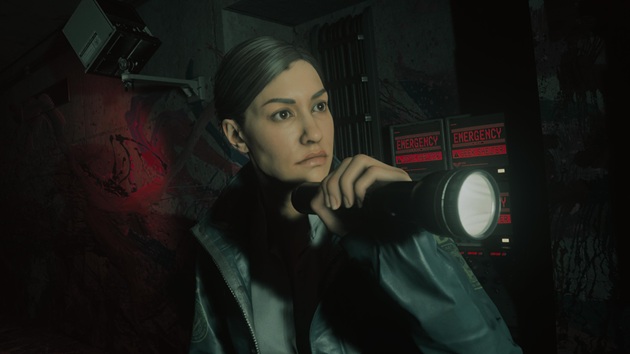
In Alan Wake 2, the player becomes that guide.
The DLC reinforces this by reducing certainty:
- clues contradict each other
- timelines overlap
- outcomes remain ambiguous
The player is forced to interpret rather than observe.
| Role | Traditional Noir Audience | Meta-Noir Player Experience |
|---|---|---|
| Function | Observer | Active interpreter |
| Perspective | Guided by protagonist | Self-directed understanding |
| Outcome | Narrative clarity | Persistent ambiguity |
This shift represents one of the most important evolutions in noir storytelling.
The experience is no longer delivered.
It is constructed by the player.
A Genre Expanding Beyond Its Own Limits
What Alan Wake 2 and its DLC ultimately demonstrate is that noir is no longer confined to a single format.
It can exist as:
- a film
- a television series
- a game
- a system of interaction
Meta-noir takes the core principles of the genre—ambiguity, perspective, psychological depth—and applies them to environments where narrative itself is unstable.
This evolution reflects a broader cultural shift:
- audiences seek complexity
- stories embrace uncertainty
- meaning becomes participatory
The Story That Cannot End
In Alan Wake 2, there is no definitive conclusion.
Every ending suggests continuation. Every resolution introduces new questions. The DLC ensures that the narrative remains open, evolving, and self-aware.
This is the defining trait of meta-noir:
The story does not end because it is always being rewritten.
And in that constant rewriting, the genre finds a new form—one where darkness is not just something to uncover, but something that reshapes itself with every attempt to understand it.