
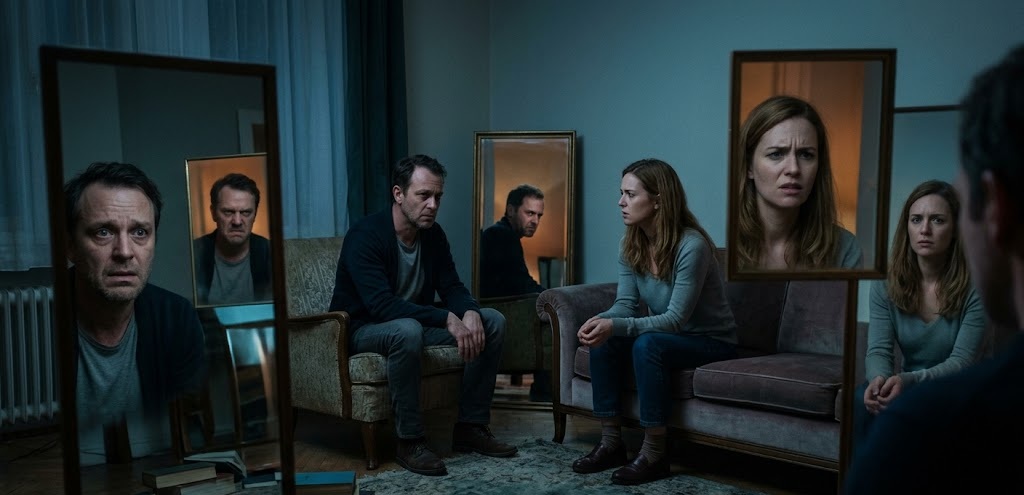
For decades, noir revolved around the crime.
A body, a disappearance, a conspiracy—these were the anchors that structured the narrative. Everything moved outward from the event itself, building toward revelation and resolution.
But Netflix’s 2026 thriller slate suggests something fundamentally different.
Series like Run Away (January 1, 2026), Adolescence (2026), and How to Get to Heaven from Belfast (February 12, 2026) all begin with familiar noir triggers—missing persons, deaths, fractured timelines. Yet in each case, the crime quickly fades into the background.
What replaces it is something less tangible, but far more unsettling:
The psychological state of the characters becomes the true narrative engine.
From External Mystery To Internal Collapse
The shift unfolding across Netflix’s thriller boom is not about abandoning crime—it’s about repositioning it.

Crime becomes the catalyst, not the core.
| Narrative Function | Traditional Noir | 2026 Netflix Thrillers |
|---|---|---|
| Central Focus | Solving the crime | Understanding the psyche |
| Protagonist Role | Investigator | Emotionally unstable individual |
| Structure | Linear, clue-based | Fragmented, perspective-driven |
| Resolution | Partial clarity | Lingering ambiguity |
This transformation marks a decisive move toward psychological noir, where tension is generated not by what happened, but by how characters interpret—and misinterpret—it.
The Rise Of Trauma As Narrative Structure
One of the defining features of this evolution is the role of trauma.
In earlier noir traditions, trauma functioned as backstory—something that explained a character’s behavior but remained secondary to the plot.
In 2026’s Netflix thrillers, trauma becomes structure.
Characters in Adolescence and Run Away do not simply react to events. They operate through unresolved experiences that shape perception, memory, and decision-making. Time itself becomes unstable, with past and present blending into a continuous psychological state.
The result is a narrative where:
- Memory is unreliable
- Motivation is fragmented
- Truth is interpretive
This reflects a broader shift in storytelling, where internal conflict replaces external progression.
The Disappearance Of The Traditional Detective
Perhaps the most striking casualty of this transformation is the detective figure.

In classic noir, the investigator serves as both guide and anchor—a character through whom the audience processes the narrative. Even in morally ambiguous stories, the detective provides structure.
In Netflix’s 2026 lineup, that role is increasingly diminished.
Authority figures still exist, but they no longer control the narrative. They are observers rather than drivers, attempting to impose logic on stories that resist it.
The investigation continues—but it feels secondary, almost symbolic.
This aligns with the evolution explored in The Undertow Analysis, where modern noir shifts away from structured investigation toward environmental and psychological immersion, allowing tension to emerge from within rather than from procedural mechanics.
Intimacy As The New Source Of Danger
If crime is no longer central, something else must take its place.
In 2026’s thrillers, that role is increasingly filled by intimacy.
Relationships—romantic, familial, or platonic—become the primary sites of tension. Trust is unstable. Communication is incomplete. Emotional proximity amplifies conflict rather than resolving it.
This creates a new form of noir dynamic:
- The closer the relationship, the greater the risk
- The more familiar the connection, the more fragile it becomes
In How to Get to Heaven from Belfast, friendship itself becomes the investigative space. In Run Away, the family unit collapses under scrutiny. In Adolescence, identity fractures under social pressure.
The danger is no longer external.
It is embedded within connection.
Visual Language And The Softening Of Darkness
Visually, this new wave of thrillers reflects its psychological focus.

The stark contrasts of classic noir—deep shadows, harsh lighting—are replaced by more naturalistic environments. Interiors dominate. Lighting is softer, often neutral.
But this does not reduce tension.
Instead, it relocates it.
- Darkness becomes emotional rather than visual
- Shadows are implied rather than explicit
- Atmosphere emerges from subtle dissonance
Scenes feel real, grounded, familiar—and yet slightly unstable.
This aesthetic reinforces the idea that nothing is hidden, yet nothing is fully understood.
Streaming As The Perfect Medium For Psychological Noir
The rise of psychological noir is closely tied to the structure of streaming itself.
Netflix’s format allows for:
- Extended character development
- Nonlinear storytelling
- Multiple perspectives
These elements create space for narratives that prioritize depth over pace. Tension builds gradually, often without a clear endpoint.
According to analysis on Netflix’s evolving thriller strategy, the platform has increasingly invested in character-driven series that explore emotional and psychological complexity rather than relying solely on plot mechanics.
This shift reflects a broader industry trend:
Audiences are no longer just watching crime—they are experiencing its impact.
When Resolution Becomes Irrelevant
One of the most radical aspects of this transformation is the diminishing importance of resolution.
In traditional noir, the ending—however ambiguous—still provides a form of closure. The crime is understood, even if it is not fully resolved.
In 2026’s thrillers, resolution feels secondary.
What remains is:
- Emotional ambiguity
- Psychological residue
- Unanswered questions that resist simplification
| Narrative Element | Traditional Noir | Psychological Noir (2026) |
|---|---|---|
| Resolution | Structured conclusion | Open-ended ambiguity |
| Truth | Discoverable | Subjective |
| Impact | External consequences | Internal transformation |
| Audience Role | Observer | Interpreter |
The story does not end when the crime is explained.
It lingers in how it changes the characters.
A Genre Turning Inward
Noir has always been adaptable.
From post-war disillusionment to corporate corruption, it has reflected the anxieties of its time. In 2026, those anxieties are increasingly internal.
- Identity is unstable
- Relationships are fragile
- Perception is unreliable
The genre responds by turning inward, focusing on the psychological landscapes of its characters rather than the physical environments they inhabit.
This does not abandon noir’s core principles.
It deepens them.
The New Definition Of Darkness
What Netflix’s 2026 thriller boom ultimately confirms is a redefinition of noir itself.
Darkness is no longer something external—something to be uncovered or confronted.
It is something internal.
It exists in:
- Memory
- Identity
- Relationships
The crime may initiate the story.
But the real narrative unfolds in how that crime is experienced, interpreted, and carried forward.
The Collapse That Cannot Be Solved
In the end, psychological noir does not offer solutions.
It offers insight.
The characters do not simply navigate crime. They are reshaped by it, revealing fractures that cannot be fully repaired. The investigation may conclude, but the psychological impact remains unresolved.
And in that unresolved space, noir finds its most modern form.
Not as a story about what happened—but as a story about what it does to us.